Up on deck, a string quartet is playing, guests are sipping drinks under the stars, and the ship glides through the water so smoothly that the champagne in the glasses barely trembles. Nobody thinks about what is happening five decks below, where the air is warm, the floor hums underfoot, and a machine the size of a house is turning, hour after hour, without stopping.
That machine is the engine room, and it is far more than an engine. It is the heart, the lungs and the power station of a floating city, making the thrust that moves the ship, the electricity that lights it, the fresh water the guests drink and the heat that warms their cabins. Here is how it all works together.
What surprises first-time visitors most is not the size of the machinery but the quiet. A modern luxury engine room is insulated, mounted on springs and hidden behind layers of soundproofing, so that the vibration never reaches the cabins above. Engineers wear ear protection inside, but a guest in the restaurant directly overhead hears nothing at all, which is exactly the point. The ship’s builders spend millions making sure the most powerful room on board is also the most unnoticed, because luxury is not only about what you can see, it is about what you never have to think about. The engine room is the proof of that idea, working day and night while the people it serves forget it exists.

How It Works
Step 1: The main engine turns fuel into turning force
At the centre of the engine room stands the main engine, a slow-speed diesel so large that a person can walk inside one of its cylinders during maintenance. Fuel is sprayed into the cylinders and ignited by compression, and the pistons drive a crankshaft that turns only a hundred times a minute, slow enough to connect almost directly to the propeller shaft. That slow, steady turning is what pushes a ship of tens of thousands of tonnes through the water at twenty knots and more.
Step 2: The propeller shaft carries power to the sea
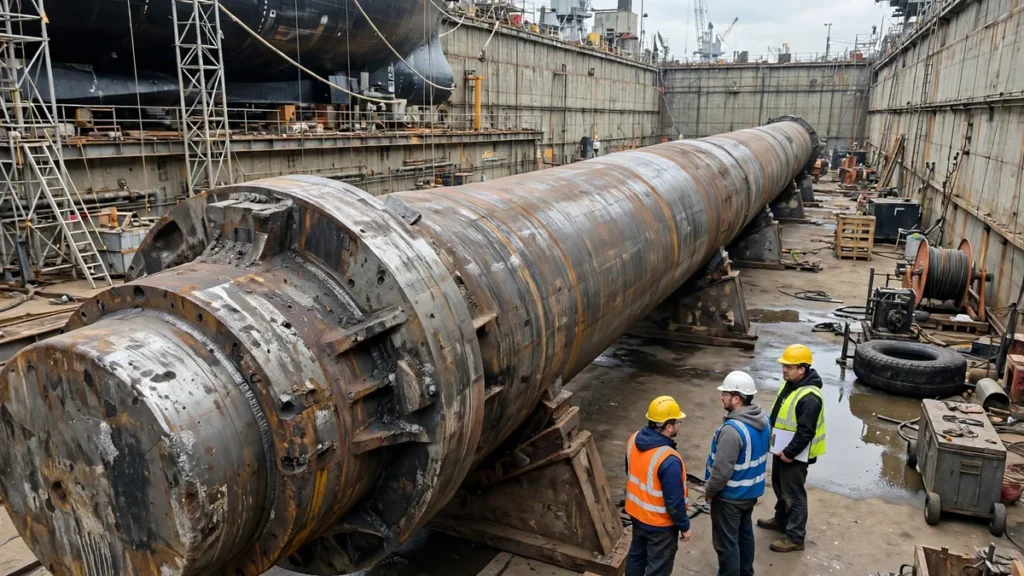
The crankshaft connects to a propeller shaft that runs the length of the engine room and out through the stern, sealed where it passes through the hull so no seawater can creep in. The shaft turns a propeller several metres across, whose blades are cast from bronze and polished to a mirror finish so they slice the water cleanly. A gearbox sits between engine and shaft on many ships, letting the engine run at its best speed while the propeller turns at its own.

Step 3: Generators make the ship’s electricity
A luxury ship needs far more electricity than a small town, for lighting, air conditioning, kitchens, lifts and stabilisers, so the engine room carries several generator sets of its own. These are smaller diesel engines driving alternators, and they run around the clock, sharing the load so that if one fails another takes over without the lights so much as flickering. The load is balanced automatically, with generators starting and stopping as demand rises and falls through the day, so the ship never burns more fuel than it needs and always has a spare ready to take over. On modern ships the main engines can generate electricity too, feeding electric motors that turn the propellers, a setup called diesel-electric propulsion.
Step 4: Cooling, fuel and fresh water are managed
All that power makes enormous heat, so a web of cooling systems runs through the engine room. Seawater is pumped through heat exchangers to cool the engines, then returned to the sea, while fresh water circulates in a closed loop inside the engines themselves. Fuel is stored in deep tanks, cleaned through centrifuges that spin out water and dirt, and heated so it flows smoothly to the injectors. The same waste heat that would otherwise be thrown away is used to boil seawater into fresh drinking water, hundreds of tonnes of it every day.
Step 5: The control room watches everything
The engine room is run from a control room that looks more like a space centre than a workshop. Engineers sit before screens showing temperatures, pressures, fuel flows and vibration levels from hundreds of sensors, and alarms sound long before a problem becomes a failure. On a modern luxury ship the engine room can run unattended for hours at night, with the computers watching the machinery and waking an engineer only if something needs a human hand.
Step 6: Safety systems stand ready
The final layer is safety. The engine room is divided from the rest of the ship by fireproof bulkheads, with automatic fire suppression that can flood the space with foam or gas in seconds. Bilge pumps stand ready to clear any water, and every engineer drills for fires, floods and blackouts, because a ship at sea cannot call for help from a workshop. The goal is simple: the guests above should never know that anything happened at all. Every drill is timed, and the crew practises until the response is automatic.

Luxury Ship Engine Room Specifications
The figures below describe a typical engine room on a large luxury cruise ship. Smaller ships carry smaller plants, but the way they work is the same.
| Specification | Typical figure | What it means |
|---|---|---|
| Main engine power | 30,000 to 80,000 horsepower | One or two slow-speed diesels, or a diesel-electric plant. |
| Propeller diameter | 5 to 8 metres | Cast bronze, polished to a mirror finish for clean thrust. |
| Electrical output | 20 to 60 megawatts | Enough for a small town, generated around the clock. |
| Fuel use | 100 to 300 tonnes per day | Cleaned through centrifuges before it reaches the engines. |
| Fresh water made | 500 to 1,000 tonnes per day | Boiled from seawater using the engines’ waste heat. |
| Engine room crew | 10 to 30 engineers | Working in watches, with the control room staffed day and night. |
What It Costs
A luxury ship engine room costs an estimated $50,000,000 to $200,000,000 to build and install, including the main engines, generators, shafting and control systems, depending on the size of the ship and whether it uses diesel-electric propulsion, with the largest cruise ships costing more. Those are estimates, not quotes, and they reflect machinery that must run without stopping for months at a time, thousands of kilometres from the nearest workshop. The eyes that guide this giant are covered in how a luxury ship radar works, and the cargo vessels that share its technology are explained in how a luxury cargo ship works.
A Rare Fact
Here is a detail most people never guess. A large ship engine is so big that its pistons are taller than a person, and its crankshaft alone can weigh more than a hundred tonnes, yet it turns so slowly that you can watch a single revolution happen, one stately turn every half second. Engineers sometimes say the engine breathes rather than runs, and they can hear a fault in that breathing the way a doctor hears a fault in a heartbeat, which is also why a ship’s hidden sense of balance matters, as how a luxury ship gyroscope works shows.