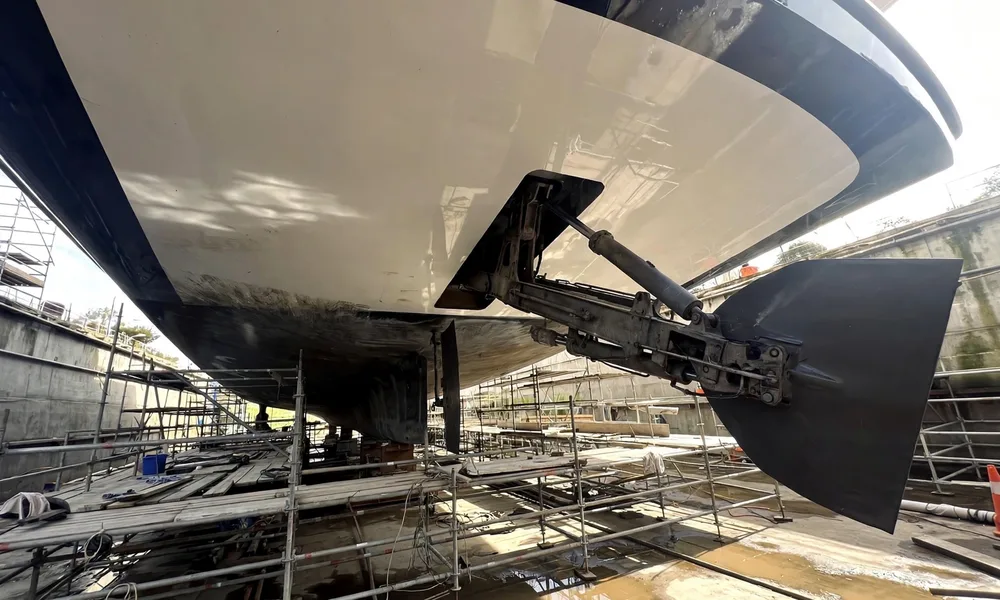
Below the waterline of a luxury ship, where no passenger ever looks, two steel wings reach out from the hull into the sea. When the ship rolls, they twist against the water and push back, holding the decks level enough that dinner stays on the table. They look like simple flat fins, but each one is a precision machine, built to swing tons of steel through seawater thousands of times a day without ever faltering.
A luxury ship stabilizer fin is made the way a bridge is made, not the way a car part is made: in pieces too big to lift by hand, welded in a hall the size of a warehouse, and machined to tolerances you could measure with a coin. Here is how it is built, from a stack of steel plate to the first sea trial.

How It Is Made
Step 1: Cutting and shaping the steel
A stabilizer fin starts as high-strength marine steel plate, thicker than the hull plating around it, because the fin takes the full force of the sea on every roll. The plate is cut to shape by a plasma or laser cutter guided by the fin’s digital pattern, and the edges are bevelled so the welds that join them can bite deep into the metal. The fin’s shape is not a flat board: it is a foil, curved like an aircraft wing, so it grips the water instead of simply pushing against it.
The plates are pressed and rolled into that curved shape on a great bending machine, a little at a time, with the curve checked against a template after every pass. A fin that is bent wrong will not grip the water evenly, and it will hum or shudder at speed, so the shaping is slow work, measured in millimetres over metres of steel.
Step 2: Welding the fin into one piece
With the plates shaped, welders join them into a hollow steel shell, working inside and out, in passes that build the weld up layer by layer. The welding is done by hand as much as by machine, because the curves of the fin do not suit a robot everywhere, and each welder’s work is inspected as it cools. A weld on a stabilizer fin is a structural weld in the truest sense: it holds the fin together against forces that would tear a bad joint open in a storm.
Step 3: Machining the shaft and the bearings
The fin turns on a shaft, a great steel pin that runs from the fin up through the hull into the ship, and the shaft is machined on a lathe big enough to turn a small car. It is turned, ground and polished until it is round to a fraction of a millimetre, because it must turn smoothly inside its bearings while the sea tries to bend it. The bearings themselves are built to carry the fin’s weight and the side load of the water at the same time, and they are fitted with seals that keep seawater out and oil in. The numbers that describe what the finished fin can do are laid out in the luxury ship stabilizer fin spec sheet, explained, but the making of it is all steel, welds and patience.
Step 4: Fitting the hydraulics
The muscle of the system is hydraulic: great cylinders that push the fin from side to side, fed by pumps and valves inside the ship. The cylinders are built and tested on their own first, stroked back and forth under pressure until they move smoothly with no leak at any seal, because a hydraulic leak inside a ship is a fire risk as well as a failure. The pipes that feed them are bent to shape, flushed clean and pressure-tested, since a single grain of grit in a hydraulic valve can jam it at the worst moment.
The fin, shaft and cylinders are assembled together in the yard as one unit, and the hydraulic rams are connected to the shaft through a linkage that turns a straight push into a twist. The assembly is moved on a cradle and lowered into its place in the hull. The hull is opened, the unit is set in, and the shaft passes through a sealing gland that must hold back the sea for the life of the ship.

Step 5: Sealing, aligning and bolting in
Once the fin unit is in the hull, the work turns to alignment. The fin must sit exactly square to the ship, or it will drag in the water and fight the other fin, so surveyors check its position with lasers and adjust it on shims thinner than a coin. The bolts that hold it are tightened in a set order, a little at a time, so the load spreads evenly, and each bolt is marked with paint so any movement later can be spotted at a glance.
The sealing gland around the shaft is packed and tested, and the compartment around the fin is flooded on the inside with water to prove the seals hold, before the sea ever touches them. The hydraulic lines are connected, bled of air and filled with oil, and the fin is swung through its full travel for the first time, slowly, while engineers watch the pressure gauges and listen for any knock or grind. The work is exacting because the fin will live where nobody can reach it easily, and a repair at sea means a dry dock. The smaller cousin of this system, built for a lighter hull, is shown in how a luxury yacht stabilizer is made, where the same ideas are fitted into a much tighter space.
Step 6: Testing in the dock and at sea
The final test begins in the dock, with the ship still tied up. The fins are swung from side to side, faster and faster, while the control system is checked against the ship’s roll sensors, making sure the fin answers the sensor’s call without delay. Then the ship goes to sea, and the testers wait for weather: a stabilizer fin can only be proven in a real roll, so the ship is taken out until the sea is rough enough to make her move.
At sea, the fins are worked through their full range, and the roll of the ship is measured with and without them, to prove they do the job they were built for. The hydraulics and bearings are watched for heat, and divers inspect the fin when the ship returns, to make sure the paint has held and nothing has moved. The question of why a fin that never moves can still be so dear is a different story, told in why a fixed fin costs more than the fuel it saves, but for the builders, the proof is simpler: the ship rolls, the fins answer, and the glasses stay on the table.
When the sea trial passes, the fin disappears below the waterline, and nobody on board will ever see it again unless the ship is docked. It will swing, silently, thousands of times a day, in seas its builders never saw, holding a floating hotel level with nothing but steel, oil and patience. That is the quiet work of a stabilizer fin: made in a noisy hall, tested in a rough sea, and then forgotten, which is exactly how a good machine should end up.