Beside a great ship, a tugboat looks like a toy. She is short, round and stubby, with a tall funnel and a tyre hanging on her bow, and she bobs on the water like a cork next to the steel wall of the ship she is about to move. Then her engine growls, her propeller bites, and the great ship begins to turn.
A tugboat is small on purpose. Everything about her is built for one job: to push and pull ships far bigger than herself. This is how a luxury ship tugboat works, and why the smallest boat in the harbour is also the strongest, tonne for tonne, afloat.

How It Works
Step 1: The big engine in a small hull
The secret of a tugboat is her engine. A tug carries an engine far bigger than a boat her size should need, sometimes as powerful as the engines of a ship ten times her length, and all that power goes to a single propeller, or a pair of them, under her stern.
The engine is a great diesel, low and slow, turning a propeller that is wide and heavy, built to push water rather than to go fast. A tugboat will never win a race, but she can pull a ship that weighs thousands of tonnes, and that is the trade she is built for. The way a luxury ship tugboat is made shows the same idea in steel, where a short, deep hull is built around the engine instead of the other way round.
Step 2: The propeller that can push in any direction
Many modern tugs do not have an ordinary propeller at all. They have azimuth thrusters, propellers mounted in pods that can turn through a full circle, so the tug can push forwards, backwards, sideways, or spin on the spot without moving at all.
The thrusters are controlled by joysticks on the bridge, and a skilled tug master can hold his boat against the side of a ship in a strong current, keeping her exactly where she is needed while the ship turns. It is like balancing a pencil on a fingertip, and it takes years to learn.
Step 3: The towline and the winch
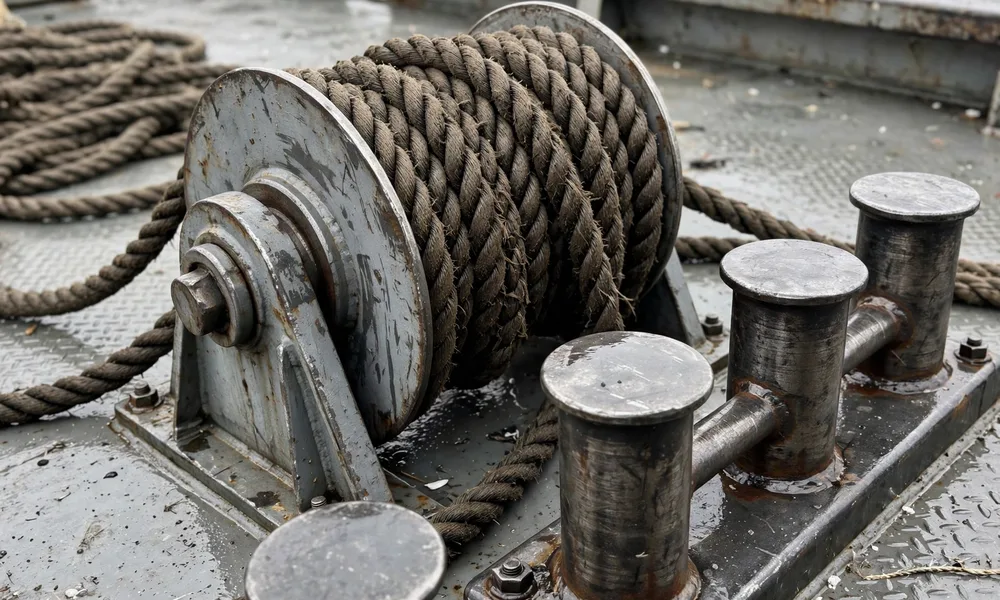
When a tug pulls instead of pushes, she uses a towline, a thick rope or steel wire that runs from a winch on her aft deck to the ship. The winch is a great drum that can pay the line out or haul it in, and it is fitted with a brake that slips before the line can snap, because a snapping towline is one of the most dangerous things in the harbour.
The towline is attached to the ship with a soft eye and a shackle, and the tug master keeps the line at just the right angle, never letting it run across his own deck where it could sweep a man overboard. The line, the winch and the brake are checked every day, because they are the tug’s whole reason for being.
Step 4: Pushing with fenders
When a tug pushes, she does it with her bow, pressing against the side of the ship through great rubber fenders. The fenders are thick pads of rubber, sometimes old tyres, that spread the push across the ship’s hull so the steel is not dented, and they let the tug roll and pitch without losing her grip.
The tug master watches the ship’s side as he pushes, feeling the movement through his feet and his hands on the controls. A gentle push at the bow will swing the ship one way, a push at the stern will swing her the other, and two tugs working together can turn a ship in her own length.
Step 5: The bridge with a view in every direction
The bridge of a tugboat is built for looking out. It sits high and forward, with windows all round, so the master can see the ship, the quay, the water and his own deck without turning his head. The controls are simple: two joysticks for the thrusters, a lever for the winch, and a radio to talk to the ship’s bridge.
The master and the ship’s captain work as a team, the captain telling the tug where the ship must go, and the tug master deciding how to get her there. It is a conversation of short, calm words on the radio, and it goes on until the ship is safely alongside or safely out to sea.
Step 6: The care a hard-working boat needs
A tugboat works every day, in all weathers, and she needs constant care. Her engine is serviced on a strict schedule, her thrusters are checked by divers, her towline is inspected for wear, and her hull is painted and repaired in dry dock.
The crew are small, often only three or four people, and each of them knows every machine aboard. A tugboat has no room for passengers and no time for fuss, and the way a luxury ship engine room is specified shows the same discipline on a grander scale, where great engines are tended with the same daily care.
| Spec | Detail |
|---|---|
| Engine | Great low-speed diesel, far bigger than a boat her size should need, turning a wide, heavy propeller |
| Thrusters | Azimuth pods that turn through a full circle, letting the tug push in any direction or spin on the spot |
| Towline | Thick rope or steel wire on a winch drum, with a brake that slips before the line can snap |
| Fenders | Thick rubber pads on the bow that spread the push across the ship’s hull without denting the steel |
| Bridge | High, forward wheelhouse with windows all round, joysticks for the thrusters and a winch lever |
| Crew | Small crew of three or four, each knowing every machine aboard, working in all weathers every day |
What One Costs
A luxury ship tugboat is an estimated 5,000,000 to 25,000,000 dollars, depending on the power of her engines, the size of her thrusters and how much of the boat is custom built. The engine is only part of the price; the thrusters, the winch and the towline all cost far more than they look, and the fitting and testing add up too. A small harbour tug sits near the bottom, while a great ocean-going tug, with engines that can pull a ship in a storm, costs far more.
A Rare Fact
The strongest tugs are measured not by speed but by bollard pull, the force they can exert while tied to a post on the quay. The biggest harbour tugs pull with a force of more than a hundred tonnes, enough to drag a loaded ship sideways against the wind, and the test is done with the tug straining at a rope while the whole harbour watches.

A luxury ship tugboat is muscle in miniature: a great engine, thrusters that turn in a full circle, a towline and a winch, rubber fenders and a bridge with a view in every direction. She is the smallest boat in the harbour and the one no great ship can do without, and the way a luxury yacht helicopter pad is specified shows the same care for a small, busy space aboard a great vessel, where every square metre has a serious job to do.


