A luxury hybrid sports car does not arrive at the factory as a car. It arrives as a puzzle: a carbon tub, a small petrol engine, three electric motors, and a battery pack that has to fit into the spaces left over. On the assembly line, those pieces come together slowly, and the result is a car that can cross a city in silence and then lap a circuit faster than cars with twice the engine.
That split personality is the whole idea of the hybrid sports car. The petrol engine gives it speed and sound, the electric motors give it instant torque and quiet running, and the two work together through software that decides, hundreds of times a second, which one should do what. This is how a luxury hybrid sports car is made.

Step 1: The carbon tub
The build starts with the carbon fibre monocoque, the single rigid tub that forms the passenger cell. Layers of carbon cloth are laid into a mould, cured in an autoclave under heat and pressure, and then bonded to aluminium subframes at the front and rear. The tub is light, immensely stiff, and it protects the driver in a crash by keeping the cabin intact while the subframes absorb the impact.
Every tub is measured after curing, because the suspension, the engine, and the battery all bolt to points on it, and a millimetre of error would throw the whole car out of line. How a luxury hybrid car is made follows the same tub-first process on a grand tourer, where comfort matters more than lap times, but the structure starts the same way.
Step 2: The petrol engine, built small and strong
The petrol engine in a hybrid sports car is smaller than the engines these cars used to carry, and it is built to work hard. It is usually a compact V6 or V8, turbocharged, with a flat-plane crank and lightweight internals that let it rev high.
The engine is mounted low and behind the driver, in the middle of the car, which keeps the weight near the centre and gives the car its balance. Around it go the cooling system, the exhaust, and the turbo plumbing, all packed tight into a bay that leaves almost no spare room.
Step 3: Electric motors and the battery
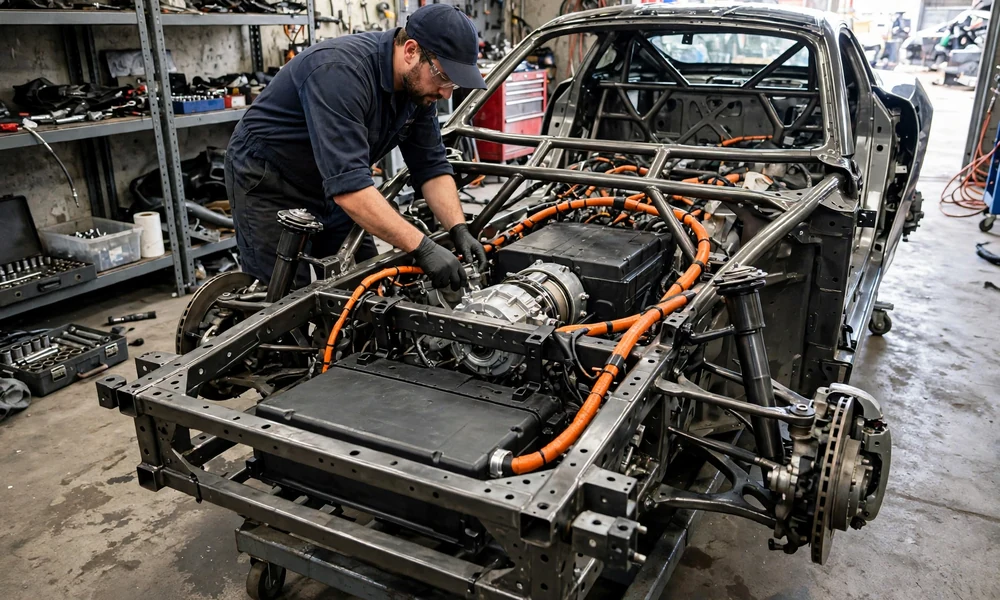
The electric side of the car is built around three motors in many hybrid sports cars: one between the engine and the gearbox, and one driving each front wheel. The rear motor fills in the gaps in the engine’s power and starts the engine silently, while the front motors give the car all-wheel drive and let it turn by sending more power to one front wheel than the other.
The battery is a compact, high-power pack mounted low in the middle of the car, usually behind the seats. It is built for bursts of power rather than long range, so it is smaller than a pure electric car’s battery, but it can discharge and recharge very quickly. How a Ferrari SF90 hybrid is made shows this layout in the car that made the three-motor hybrid sports car famous, and the pattern has been copied across the class since.
Step 4: The gearbox and the hybrid brain
The gearbox in a hybrid sports car is usually a dual-clutch unit, built to change gear in a fraction of a second while handling the combined torque of the engine and the electric motors. It is assembled with the rear electric motor built into its housing, so the motor and the gearbox arrive at the line as a single unit and are bolted to the engine and the tub together.
Once the hardware is in, the software goes in. The hybrid control unit is the brain of the car, and it decides moment by moment how to split the work between the engine and the motors. It watches the throttle, the speed, the battery charge, and the steering, and it can switch the car from silent electric running to full combined power in an instant.
Step 5: Body, aero, and the interior
With the mechanical parts in place, the body panels go on. They are carbon fibre or aluminium, shaped in wind tunnels to press the car into the road at speed, and they carry active aero: a rear wing that rises at speed, flaps that open to cool the brakes, and an underbody that channels air smoothly past the battery and the engine. Every vent on the car has a job, cooling something or cutting drag.
The interior is fitted last, and it is where the luxury shows. Leather, carbon trim, and machined aluminium fill a cabin that is tight but beautifully finished, with a digital display that shows the power flow between the engine, the motors, and the battery.
Step 6: Testing, tuning, and handover
A finished hybrid sports car is tested harder than almost any other car. It is run on a rolling road, then on a test track, then on public roads, with the engineers checking the power delivery, the braking, the battery temperatures, and the way the car switches between electric and engine power.
The car is then detailed, charged, and handed over with a full tank and a full battery. The owner gets a car that can leave home without waking the street, cruise a motorway on the engine, and attack a track with both power sources working together. How a hypercar hybrid powertrain works explains the system in the fastest cars of all, where the same three-motor idea is pushed to its limit, and this sports car is that technology made usable every day.
Specifications
| Detail | Specification |
|---|---|
| Engine | Turbocharged V6 or V8, mid-mounted |
| Electric motors | Three motors, front axle and gearbox |
| Combined power | Around 700 to 1,000 horsepower |
| Battery | Around 7 to 8 kilowatt-hours, liquid-cooled |
| Gearbox | Dual-clutch, 8-speed |
| 0 to 100 km/h | Around 2.5 seconds |
| Top speed | Around 320 to 340 kilometres per hour |
| Body | Carbon fibre monocoque |
Price
The estimated price of a new luxury hybrid sports car is around 450,000 dollars, and that figure is an estimate only, because the cost depends on the model, the power output, and the options chosen. The carbon tub, the hybrid powertrain, and the battery account for a large share, followed by the bodywork and the interior. A buyer is paying for a car that is quiet when it needs to be, ferociously fast when asked, and more usable every day than a pure petrol supercar.
A rare fact
Few people know that a hybrid sports car can fill in the gaps in its own engine. A turbocharged petrol engine has a brief pause while the turbo spools up, and the electric motors cover that pause with instant torque, so the car accelerates without any delay at all.
When the finished car rolls off the line and its engine fires for the first time, it is the sound of two technologies meeting in one machine.


