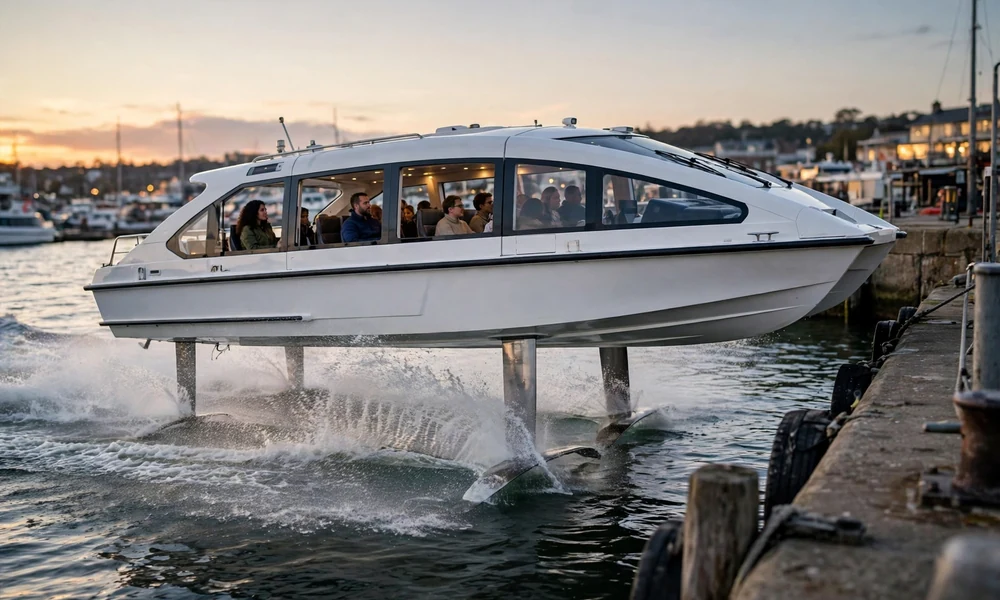
A luxury hydrofoil ferry does something no ordinary ferry can do: it flies. As it picks up speed, the hull rises out of the water on slender wings, and the boat that was pushing through the waves is suddenly skimming above them. The ride goes smooth, the spray stops, and the passengers in the lounge feel the ferry lift, the way you feel an aircraft leave the runway.
That lift is the whole idea. A hydrofoil ferry carries its passengers above the waves, on foils that work like underwater wings, and it does it with electric motors, batteries, and a control system that keeps the boat level. This is how a luxury hydrofoil ferry works, and why it feels more like flying than sailing.

The foils: wings under the water
The foils are the heart of the ferry, and they work exactly like the wings of an aircraft, only under water. Each foil is a shaped blade mounted on a strut below the hull, and as water flows over it, it generates lift. As the ferry accelerates, the lift grows until it carries the whole weight of the vessel, and the hull rises clear.
The foils are made from stainless steel or carbon fibre, shaped with the same care as an aircraft wing, because a small flaw in the shape makes the lift uneven. The front foil carries most of the weight, the rear foil steers and stabilises, and both are fitted with flaps that the control system moves to keep the boat level. How an electric hydrofoil ferry works explains the same foil system on a standard electric ferry, where the ride is built for commuters, and the luxury version adds a larger, quieter cabin on top of the same flying hull.
Take-off: from hull-borne to foil-borne
Take-off is the most dramatic part of the journey. The ferry leaves the quay on its hull, the motors push it forward, and at around 15 knots the foils begin to lift. The bow rises first, then the whole hull comes up, and the drag falls away so sharply that the boat accelerates hard with the same power. The passengers feel a gentle rise, the motion smooths out, and the ferry is flying.
The transition takes only a few seconds, and it is managed by the control system, which watches the speed, the ride height, and the angle of the boat.
The electric drive
The ferry is driven by electric motors, mounted in pods at the rear of the hull or on the foils themselves. Electric motors give their full torque from a standstill, so the ferry accelerates hard out of the harbour, and they are quiet, so the passengers hear the water rather than an engine. The motors are water-cooled and sealed, built to survive salt spray and constant immersion.
The battery bank sits low in the hull, in sealed compartments with cooling and fire protection, and it is sized for the route the ferry will run.
The control system: keeping the flight level
A hydrofoil ferry cannot fly without its control system, and it works constantly. Sensors measure the height of the boat above the water, the pitch and roll, and the speed, hundreds of times a second, and the computer moves the foil flaps to correct any tilt before the passengers feel it.
The captain sets the speed and the route, and the system does the flying. If a wave lifts one side of the boat, the flaps on that side adjust in an instant, and the boat stays level. The crew watches it all on a display at the bridge, which shows the ride height, the foil angles, and the power use. How a luxury hydrofoil works describes the same control system on a private hydrofoil yacht, where the flying is a pleasure, and on the ferry it is a timetable: the boat has to fly smoothly, every crossing, whatever the sea is doing.
The passenger cabin above the waves
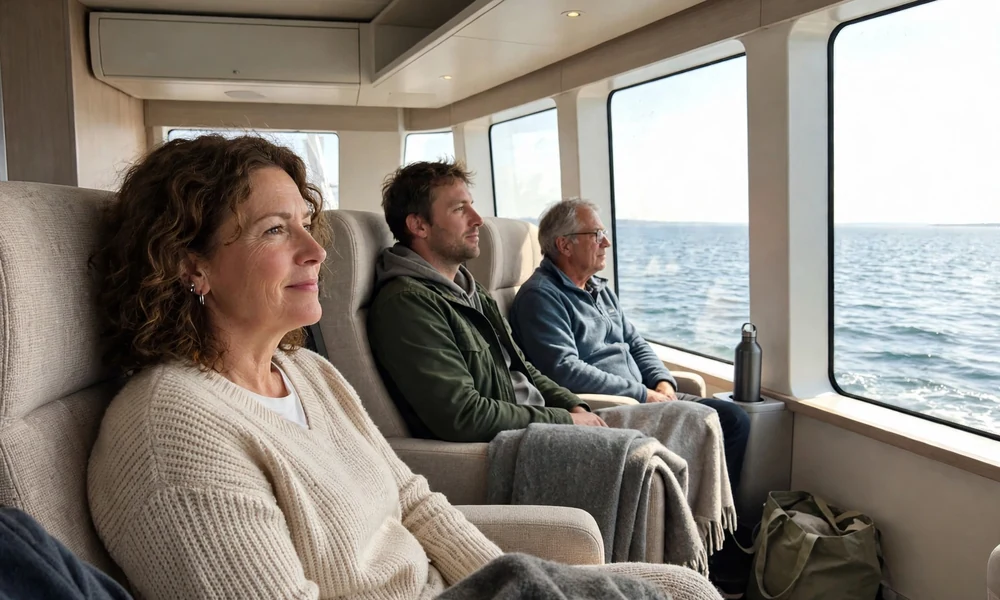
Because the hull is out of the water, the ride is smooth, and the cabin can be built like a lounge rather than a boat. The main saloon has wide windows, comfortable seats in rows or in small groups, and a quiet that no diesel ferry can match. There is no engine vibration through the floor, no exhaust smell, and no rolling in a seaway, so passengers can read, work, or simply watch the water slide past below.
Boarding is built for speed, with wide doors and level gangways, and the ferry carries the safety equipment of any passenger vessel: lifejackets, life rafts, and clear exits.
Landing, docking, and charging
At the end of the crossing, the ferry lands. The control system lowers the hull back into the water as the speed falls, the boat settles onto its hull, and it docks like any other ferry, manoeuvring on its electric motors with fine control. The whole landing takes seconds, and the passengers barely notice it, because the boat slows and settles in one smooth motion.
At the quay, the ferry plugs into a fast shore charger that tops up the batteries while passengers board for the next crossing. The ferry can turn around in minutes, ready for the next crossing.
How electric ferry propulsion works explains the motors and charging used across the electric ferry fleet, and the hydrofoil takes that same system and spends the power on flying instead of pushing water aside.
Specifications
| Detail | Specification |
|---|---|
| Length | Around 25 to 35 metres |
| Passengers | Around 150 to 250 passengers |
| Take-off speed | Around 15 knots |
| Cruising speed | Around 35 to 45 knots on the foils |
| Battery bank | Around 500 to 1,000 kilowatt-hours |
| Electric motors | Two motors, around 400 kilowatts each |
| Range on battery | Around 50 to 100 nautical miles |
| Foil material | Stainless steel or carbon fibre |
Price
The estimated price of a new luxury hydrofoil ferry is around 8 million dollars, and that figure is an estimate only, because the cost depends on length, passenger capacity, and the size of the battery bank. The foils and their control system, the batteries, and the electric drive account for a large share, followed by the hull and the passenger cabin. An operator is paying for a ferry that crosses faster than any conventional boat on the route, in a smooth, quiet ride that passengers remember.
A rare fact
Few people know that a hydrofoil ferry uses less energy the faster it goes, up to a point. Once the hull is out of the water, the drag falls so far that the boat needs less power to hold 40 knots on its foils than a normal ferry needs to hold 20 knots pushing through the waves.
When the ferry lifts off for the first time on a crossing, the passengers feel it, and they look up from their books and their phones. The boat is flying, the waves are sliding past below, and the crossing that used to take an hour is over in half the time. That is how a luxury hydrofoil ferry works, and why no one who has flown on one wants to go back to an ordinary boat.