When a luxury submarine surfaces after a dive, the first thing the crew does is open a hatch and let the divers back in. The divers have been swimming in open water, wearing tanks and fins, and they need a way to climb out of the sea and onto a wet, curved steel hull that offers almost nothing to hold on to.
A luxury submarine swim ladder is a retractable boarding ladder, usually made from marine-grade stainless steel, that folds flat against the hull when the submarine dives and swings down into the water when it surfaces. It works by pivoting on a heavy hinge, locking in the down position with a latch, and giving divers wide, non-slip rungs to climb in fins and full kit. The ladder must be strong enough for a diver plus tanks, slim enough to disappear into the hull’s shape, and simple enough to deploy with one hand in a swell.

How It Works
The ladder: a staircase that folds flat
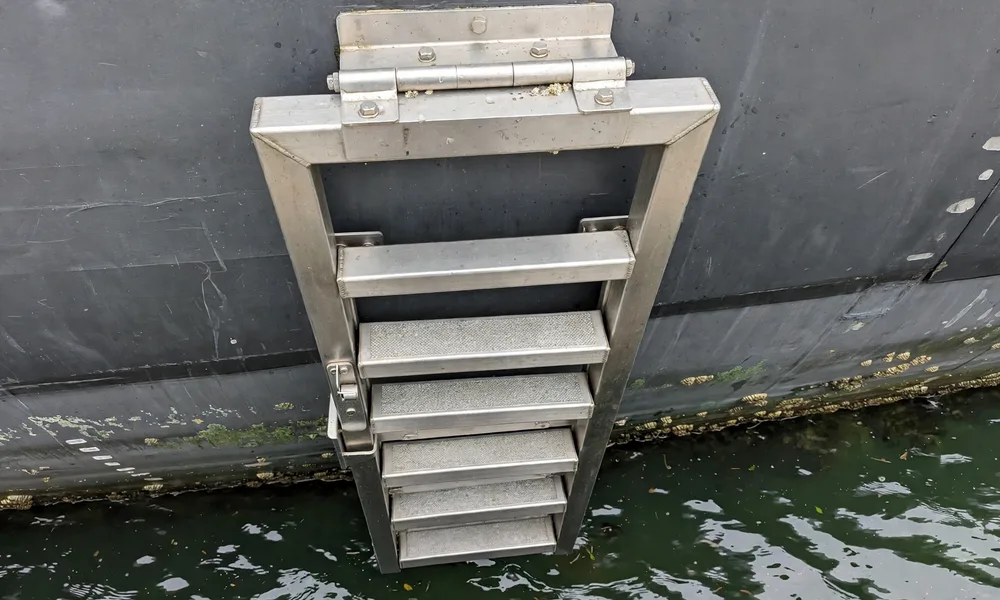
The heart of the system is the ladder itself, a frame of stainless steel tubes with four to six wide, flat rungs. The rungs are not round bars like a pool ladder: they are flat treads, often with a punched or grooved surface, so a diver in rubber fins can stand on them without slipping. The whole ladder is built to fold flat against the submarine’s casing, the outer shell that covers the pressure hull, so that when it is stowed it adds almost nothing to the submarine’s shape. That matters, because anything sticking out of the hull creates drag and noise underwater, and a luxury submarine is built to be quiet.
The hinge: swinging out over the water
The ladder pivots on a heavy stainless steel hinge, bolted through the casing to a reinforced frame inside. To deploy it, a crew member pulls a release pin, and the ladder swings down on its hinge until it hangs vertically, with its lowest rungs below the waterline. A locking latch snaps shut at the bottom of the swing, holding the ladder rigid so it cannot fold back while someone is climbing. The hinge is the most heavily loaded part of the system: when a diver stands on the lowest rung, the whole weight pulls on two small pins, so the pins are made from hardened stainless steel and checked for wear at every service.
The rungs: grip when everything is wet
Climbing a ladder in fins is hard enough on a calm day, and a submarine ladder has to work when the rungs are wet, the hull is rolling, and the climber is wearing a tank. That is why the rungs are wide, flat and textured, with a raised pattern that bites into rubber fins and bare feet alike. The rungs are also spaced closer together than on a normal ladder, so a tired diver can climb in short, easy steps instead of reaching for a high rung. The handrails curve up from the top of the ladder and over the deck edge, giving the climber something to grab as they step from the ladder onto the submarine, which is the hardest move of the whole climb.
The mounting: fixed to a hull that must not leak
Bolting anything to a submarine is a serious job, because the pressure hull underneath must never be weakened. The ladder is not bolted to the pressure hull at all: it is fixed to the casing, the light outer shell, and to a reinforced frame that spreads the load across a wide area. The bolts pass through sealed bushes, so sea water cannot reach the structure inside, and the mounting points are placed where the casing is strongest, usually near a frame or a bulkhead. This is the same care that goes into the rest of the boat, as how a luxury submarine hull is made shows, where every penetration of the hull is treated as a risk.
Getting in and out: divers, swimmers and the crew
In use, the ladder is a small piece of choreography. A crew member on deck deploys it and holds the handrail steady while the first diver climbs, fins first, one rung at a time, with a second crew member ready to take the tank at the top. Swimmers without tanks climb faster, but they still use the handrails, because the submarine is rolling and the ladder moves with it. The ladder is rated for one climber at a time, and the crew enforces that rule strictly, since two divers on a ladder built for one would overload the hinge.
Stowing and locking for the dive
Before the submarine dives, the ladder must disappear. The crew folds it up against the casing, pushes it into its recess, and locks it with a pin that can be checked from the deck. A loose ladder would rattle, create drag, and, worst of all, snag on something underwater, so the lock is tested by pulling hard on the folded ladder before the hatch is closed. Once stowed, the ladder is part of the hull’s smooth shape again, and the submarine can dive without a trace of it showing. The conning tower above, which how a luxury submarine conning tower works describes, is the only part of the boat that stays visible, and the ladder waits, folded and silent, for the next surfacing.
| Specification | Typical ladder |
|---|---|
| Material | Marine-grade stainless steel, passivated against salt water |
| Rungs | Four to six wide, flat, non-slip treads with drainage |
| Width | Under half a metre, to fit a recess in the casing |
| Hinge | Hardened stainless pins with a locking latch |
| Load rating | One climber at a time, diver plus tanks, about 150 kilograms |
| Mounting | Bolted to the outer casing and a reinforced frame, not the pressure hull |
| Stowage | Folds flat into a recess, locked with a pin before diving |
| Handrails | Curved rails over the deck edge for the step aboard |

A luxury submarine swim ladder costs an estimate of $15,000 to $60,000 fitted, depending on its size, the complexity of its folding mechanism and how much of the casing has to be rebuilt to take it. The price covers the stainless steelwork, the hardened hinge pins, the locking latch and the days of fitting and sealing on the submarine. The most expensive part is rarely the ladder itself: it is the mounting, because the casing has to be cut, reinforced and resealed without disturbing the pressure hull beneath. The bridge crew who watch the divers return, meanwhile, work in a space built to a different standard, as how a luxury submarine bridge works shows.
Here is a rare fact worth knowing. The earliest submarines had no swim ladder at all. Crew who went into the water climbed back aboard on rope ladders thrown over the side, or were hauled up by their shipmates, and divers working on the hull simply had nowhere safe to climb. The first rigid swim ladders were fitted to submarines only when leisure diving from them became common, and the design has barely changed since: a hinge, a latch and a set of flat rungs. The one part that has changed is the stowage, because a modern ladder must fold so flat that it leaves no mark on the hull’s shape, and that trick, making a staircase disappear, took longer to perfect than the ladder itself.


