Stand beside a submarine in dry dock and the first thing that strikes you is the size of the hull. It is a steel tube as wide as a house and as long as a city block, smooth and dark, with no windows and no obvious way in. Everything the crew needs to live and work for weeks underwater sits inside that tube, and the tube itself is the only thing between them and the crushing pressure of the deep sea.
A luxury submarine hull is the pressure hull of a small private submersible or a large yacht submarine, a steel cylinder built to keep the sea out while the vessel dives. It is made from thick plates of high-strength steel, rolled into rings, welded together, and stiffened with frames inside. The hull has to be strong enough to resist the pressure of the water at depth, round enough to share the load evenly, and smooth enough to move quietly through the water. Getting all three right is the work of the shipyard.

How It’s Made
Step 1: Designing the pressure hull
Before any steel is cut, the hull is designed on a computer and tested with models and calculations. Engineers work out how deep the submarine will dive, how much pressure the water will press on the hull at that depth, and how thick the steel must be to hold it back. The hull is drawn as a cylinder with rounded ends, because a round shape shares pressure evenly, while a flat panel would bend and buckle. The final design is turned into drawings for every ring, frame and hatch, and the steel is ordered in plates of exactly the right grade and thickness.
Step 2: Rolling the steel rings
The hull starts as flat steel plates, which are rolled in a giant press into curved sections, then welded into rings. Each ring is checked for roundness, because even a small flat spot becomes a weak point under pressure. The rings are laid out in a line on the shop floor, like the hoops of a barrel, and the yard checks that they line up true, so the finished hull runs straight. The steel used is a high-strength alloy, chosen for toughness as well as strength, so it bends a little under load instead of cracking.

Step 3: Welding the rings together
The rings are joined by welding, the most careful work in the whole build. Welders work in pairs, one inside the hull and one outside, laying down welds that must be perfect, because a flaw in a weld is a flaw in the hull. Each weld is checked with ultrasound and X-ray, and any weld that fails the test is ground out and done again. The work is slow and hot, and the yard keeps the hull covered and dry between shifts, because rust on a weld is a weakness that no paint can hide.
Step 4: Fitting the frames and bulkheads
Inside the hull, the yard fits ring frames, heavy steel ribs that stiffen the cylinder, and bulkheads, the flat walls that divide the submarine into compartments. The frames are welded to the inside of the hull, and the bulkheads are fitted with watertight doors, so one flooded compartment does not sink the boat. The hatches are fitted at this stage too, each one a thick steel disc with a rubber seal, tested to hold back the pressure of the water at the submarine’s maximum depth.
Step 5: Adding the outer hull and fittings
Outside the pressure hull, the yard fits a lighter outer hull, a streamlined casing that gives the submarine its smooth shape and hides the ballast tanks, the propeller shaft and the diving planes. The submarine conning tower is fitted on top, along with the periscope and antenna masts, and the whole outside is coated with a special paint that keeps marine growth off the steel. The ballast tanks are tested by flooding them and blowing them dry, so the crew knows the submarine will rise and sink exactly when it should.
Step 6: Testing the hull under pressure
The last step is the test. The finished hull is closed up and put through a pressure test, either in a test chamber or by diving the submarine in stages, a little deeper each time, while engineers watch for leaks and listen for the creaks that mean the steel is working. Every hatch, seal and weld is checked again after the test. When the hull holds at full depth and comes back dry inside, the submarine is ready for the sea, and the yard knows that the steel tube they built is the only thing standing between the crew and the ocean.
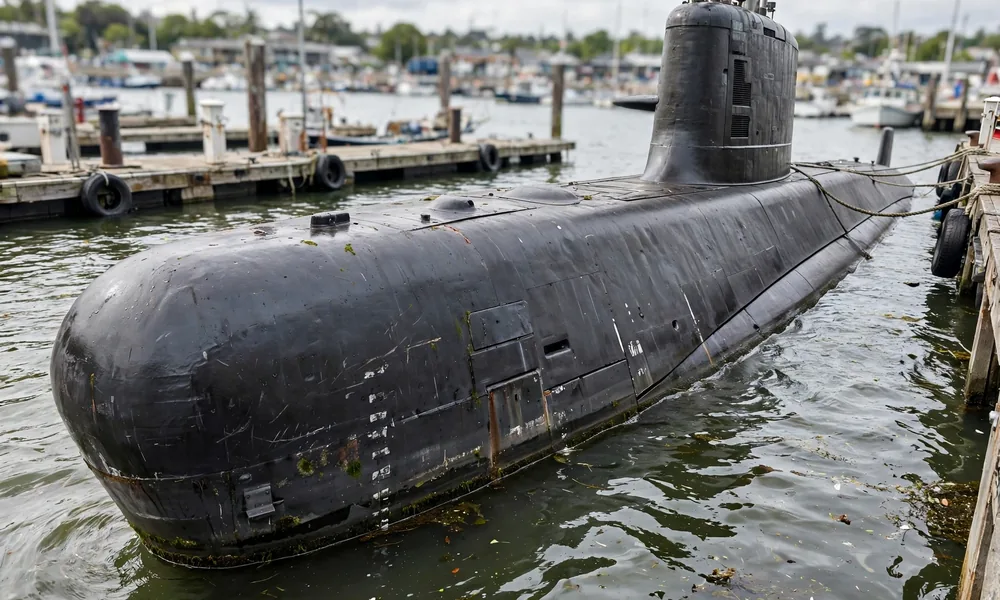
Life inside a pressure hull shapes everything about the submarine. The crew live and work in a long steel tube with no windows, breathing air that is made and cleaned by machines, and sleeping in bunks fitted into every spare corner. The hull’s round shape leaves no wasted space, yet there is never quite enough room, and every pipe, cable and locker is fitted tight against the frames. The galley is small, the bunks are narrow, and the passageways are just wide enough for one person, because every extra centimetre of hull costs weight, steel and money, and the ocean outside presses on all of it, day and night, for the whole voyage.
Submarine Hull Specifications
| Feature | Typical Detail |
|---|---|
| Material | High-strength steel plate |
| Hull shape | Cylinder with rounded ends |
| Plate thickness | 25 to 75 millimetres, thicker at the ends |
| Structure | Ring frames, bulkheads, watertight doors |
| Fittings | Hatches, ballast tanks, diving planes |
| Finish | Anti-fouling paint, anechoic coating |
How Much Does a Submarine Hull Cost?
Prices are estimates and vary with size, depth rating and yard. The hull is not sold on its own, so its cost is usually counted as part of the submarine, which for a small luxury submersible can run an estimated $2,000,000 to $10,000,000, and for a large private submarine an estimated $50,000,000 or more. A pressure test and survey of an existing hull typically costs an estimated $100,000 to $500,000. A repair to a damaged hull section, with new plate and re-testing, typically costs an estimated $500,000 to $2,000,000, depending on how much steel has to be replaced. It is expensive work, but the hull is the only thing between the crew and the sea, and a cheap hull is a false saving that no owner should ever accept.
A Rare Fact About Submarine Hulls
Here is a detail most people never hear: a submarine hull is not silent, and it is not meant to be. As the submarine dives, the steel compresses a tiny amount under the pressure, and the crew can hear the hull creak and groan as it settles. Old submariners say the creaking is the boat talking, and a sudden silence is worse than a groan, because it means the steel has stopped moving and something is wrong. The submarine snorkel mast above and the submarine torpedo tube forward both rely on that same hull staying round and true under pressure. Get the steel right, and the hull sings a little on every dive, and the crew knows the boat is working exactly as it should.


