Watch a superyacht slip away from the dock and you will notice something odd. There is almost no fuss. No roar, no churn of white water, just a smooth, silent glide as if the hull were being pulled by an invisible hand. Down below the waterline, out of sight, a set of bronze-coloured blades is turning steadily, pushing tonnes of steel and glass through the sea with a quiet efficiency that took a century of engineering to perfect. In the finest yachts and ships that propeller is made from titanium, and it works harder, and more quietly, than almost any other part of the vessel.
A propeller looks simple, just a few twisted blades on a hub, but it lives in one of the harshest places on any machine. It spins in salt water, it is hammered by pressure changes that can tear metal apart, and it must push a huge ship forward without shaking it to pieces. Titanium survives all of that where other metals slowly give up, and understanding how it works explains why a luxury ship feels so calm at speed.
How It Works
Step 1: The engine’s power reaches the shaft
It starts deep inside the ship, where the main engines turn a long steel shaft that runs through the hull to the stern. The shaft passes through seals that keep the sea out and the oil in, and it is supported by bearings along its length so it spins true even when the ship flexes in a swell. A gearbox between the engine and the shaft lets the propeller turn slower than the engine, because a big propeller works best at a few hundred revolutions a minute, not thousands. The whole line is aligned with great care when the ship is built, since a shaft that is even slightly out of line will wear its bearings and shake the ship.
Step 2: The blades bite the water like a screw
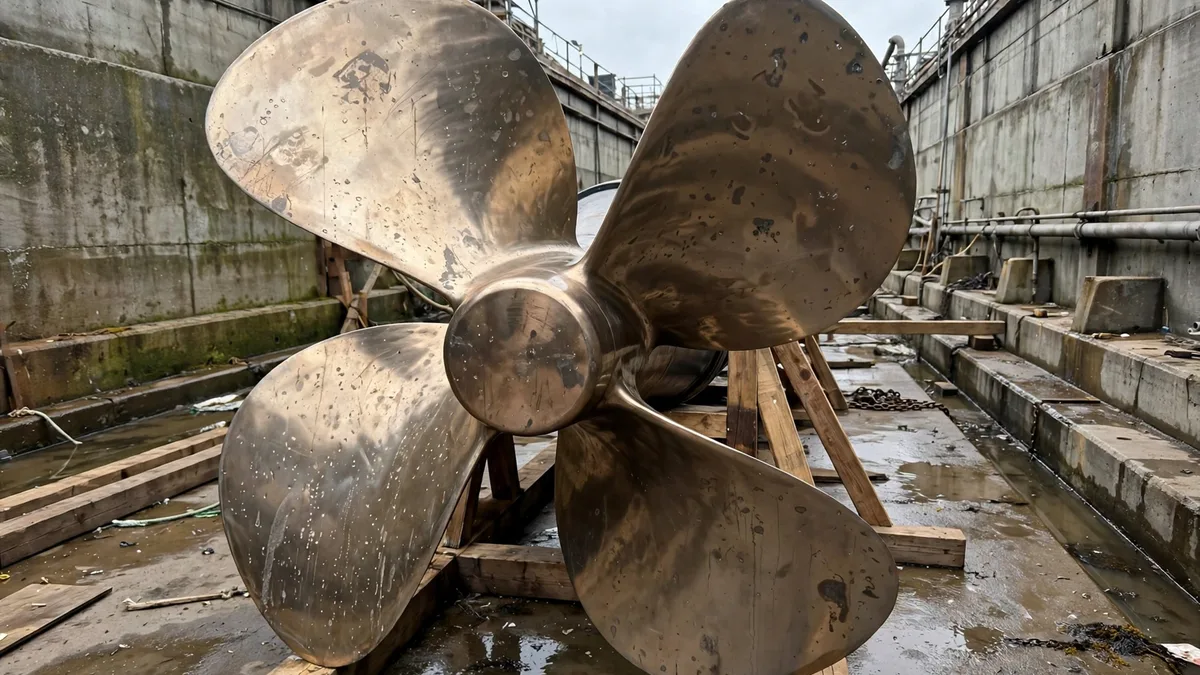
At the end of the shaft sits the propeller itself, and its blades work in the same way as a screw turning into wood. Each blade is twisted along its length, so as it turns it meets the water at just the right angle, scooping it backwards and pushing the ship forwards in reaction. The face of the blade does the pushing, while the back of the blade is shaped to let the water flow smoothly away. A luxury ship’s propeller, much like the propulsion of a big vessel in how a luxury cargo ship works, is sized to the ship: too small and it spins uselessly, too big and it strains the engine, so naval architects spend months getting the diameter and the pitch exactly right.
Step 3: Pitch controls speed without changing the engine
Many luxury propellers can change their pitch, the angle of their blades, while they are turning. Turn the blades flatter and the propeller bites less water, good for slow manoeuvring in a marina. Turn them steeper and it bites harder, pushing the ship faster without the engine working any harder. This is done by a hydraulic mechanism inside the hub, fed with oil through the hollow shaft, and it lets the captain change speed smoothly, reverse the ship by turning the blades the other way, and even hold the ship still against a current. It is the marine equivalent of a gearbox, hidden inside a spinning hub under the water.

Step 4: Titanium resists salt, wear and cavitation
Here is where the material earns its place. Salt water eats most metals, slowly pitting and weakening them, but titanium forms a thin, tough skin of oxide the moment it meets air or water, and that skin repairs itself whenever it is scratched. The same skin protects the blades from cavitation, the violent effect that happens when water pressure drops behind a fast-moving blade and tiny bubbles form and then collapse, hammering the metal with microscopic jets. On a bronze propeller cavitation slowly eats the blade edges away. On titanium the damage is far slower, so the blades keep their smooth, efficient shape for years longer, and the ship stays quieter and faster.
Step 5: The blades are shaped to stay silent and smooth
A luxury propeller must be quiet, because vibration travels straight through the hull and into the cabins. So the blades are given a curved, swept-back shape, a little like a scythe, which spreads the load evenly as each blade passes the hull and stops the rhythmic thump that a straight blade would make. The tips are thinned and polished, the edges are honed smooth, and the whole propeller is balanced so it spins without a wobble. Engineers also tune the number of blades, often five or six on a luxury ship, to spread the work and smooth the pulses of thrust. The result is a push you feel as steady motion, not as a beat.
Step 6: Steering, stopping and holding position
The propeller does more than drive the ship forward. With a rudder behind it, the wash of water from the blades gives the ship steering even at low speed, and by reversing the pitch the captain can stop a huge ship in its own length. Modern luxury ships add bow thrusters, small propellers in tunnels through the bow, that push the front of the ship sideways for docking, and some use podded propellers that can rotate a full circle, turning the whole drive unit into a rudder. The same careful balance of thrust and control shapes smaller craft too, as how a luxury catamaran ferry works shows, where twin propellers let the captain spin the vessel almost on the spot. Together these systems make a ship that weighs thousands of tonnes handle like something far smaller.

Titanium Propeller Specifications
The figures below describe a typical large titanium propeller on a current luxury yacht. Sizes vary greatly by vessel, but the working principles are the same.
| Specification | Typical value |
|---|---|
| Propeller diameter | 1.5 to 3 metres |
| Number of blades | Usually 5 or 6 |
| Operating speed | About 200 to 500 rpm |
| Propeller weight | About 500 to 2,000 kilograms |
| Weight saving over bronze | Roughly 30 to 40 percent |
| Service interval | Inspection every few years |
What It Costs
A large titanium propeller for a luxury yacht costs an estimated $80,000 to $250,000, depending on size and complexity, and a controllable-pitch hub adds considerably to that figure. Those are estimates, not quotes, and they reflect the cost of the alloy, the precision machining of the blades, and the hydraulic hub inside. The saving comes over time: a titanium propeller needs less repair, keeps its efficiency longer, and burns less fuel across the life of the ship than a bronze one that slowly loses its shape. On an explorer yacht built for long voyages, where the numbers are laid out in the explorer yacht specs, that efficiency matters every day, because fuel carried for a propeller that wastes energy is fuel that cannot be carried for anything else.
A Rare Fact
Here is a detail most passengers never guess. When cavitation bubbles collapse behind a propeller blade they can briefly reach temperatures hotter than the surface of the sun in a space smaller than a pinhead, and it is that tiny, violent hammering that slowly eats away at ordinary metal.