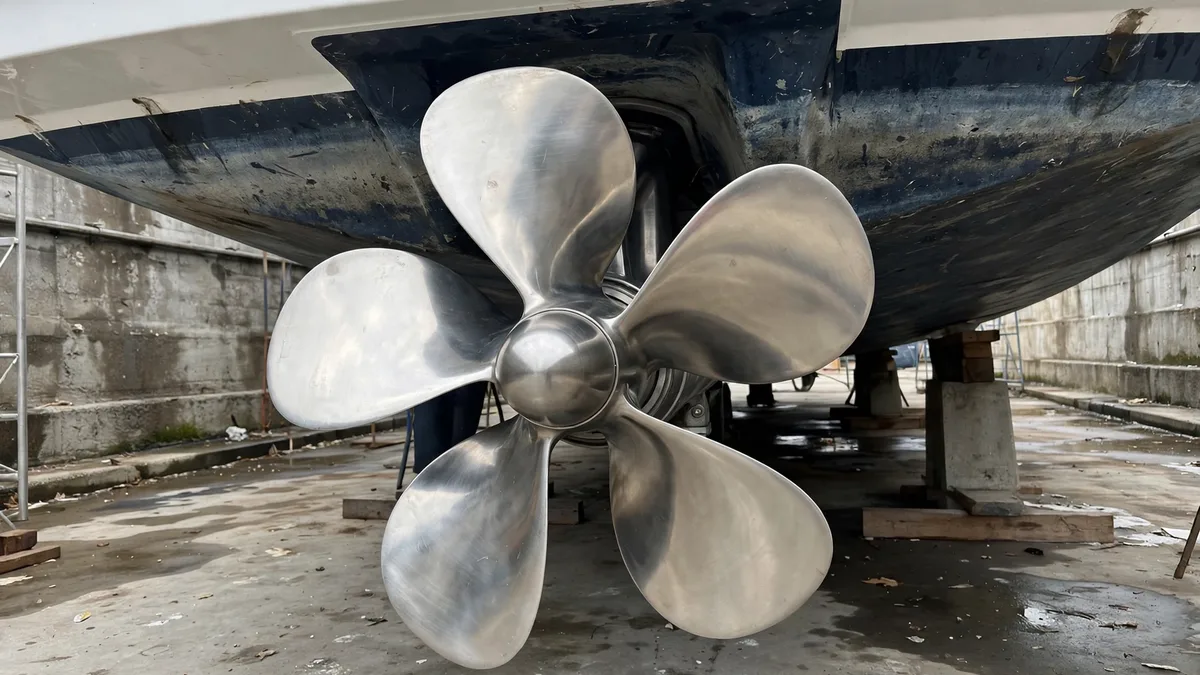
On a dry dock in late autumn, with the hull of a luxury yacht propped up on blocks and the sea held back by concrete walls, the most expensive part of the boat is often the least glamorous to look at. It hangs under the stern, grey and quiet, four or five blades curving out from a central hub like the petals of a metal flower. Visitors walk past it without a second glance, heading for the polished teak deck and the gleaming superstructure above, but the engineers in the yard know better. That dull grey propeller is made of titanium, it probably cost more than the tender sitting on the deck, and every curve on it was argued over for months before it was ever cast.
The reason is simple enough: a propeller is the only part of a yacht that turns the engine’s power into movement, and it does so in one of the harshest places on the boat. It spins underwater, in salt, at hundreds of revolutions a minute, pushing tonnes of hull through the sea while the water tries to eat it away. A bronze propeller does the job, and most boats use one, but bronze pits and corrodes, it needs regular attention, and it is heavy. Titanium does not corrode in seawater, it is far stronger for its weight, and it holds a sharper, thinner blade edge. The spec sheet of a luxury titanium propeller is really a list of the ways its makers have used those advantages, and it reads very differently from the sheet of an ordinary bronze wheel.
Diameter, Pitch and the Shape of the Blades
The first numbers on any propeller spec sheet are diameter and pitch, and they are the pair that decides how the boat behaves. Diameter is the width of the circle the blades sweep, and on a luxury yacht it usually runs from about 600 millimetres on a smaller vessel to more than 1,500 millimetres on a large superyacht. A bigger diameter moves more water with each turn, which is efficient at low speeds, but it also needs more clearance under the hull and more torque from the engine. Pitch is the distance the propeller would travel forward in one turn if it were screwing through a solid, and it is usually quoted as a ratio to the diameter. A high pitch suits a fast boat; a low pitch suits a heavy boat that needs pulling power out of harbour.
What titanium changes is the blade itself. Because the metal is so strong, the blades can be made thinner than bronze blades of the same size, and a thinner blade slices through the water with less drag. Designers also use a shape called skew, where the blade sweeps back like a scimitar, which spreads the load as each blade enters the water and cuts down on vibration and noise. On a luxury yacht, where the owner expects to hold a conversation in the saloon while the boat is running at cruising speed, that quietness is worth a great deal.
The Spec Table, in Plain Numbers
| Specification | Typical luxury titanium propeller | What it means |
|---|---|---|
| Diameter | 600 to 1,500 millimetres | The circle the blades sweep; bigger means more thrust at low speed. |
| Number of blades | 4 to 6, usually 5 | More blades means smoother, quieter running at cruising speed. |
| Pitch ratio | 0.8 to 1.2 times diameter | Higher pitch suits speed; lower pitch suits heavy pulling power. |
| Alloy grade | Titanium with aluminium and vanadium | The standard high-strength marine grade, cast in a vacuum. |
| Blade thickness | Thinner than bronze at the same size | Less drag in the water and a sharper, more efficient edge. |
| Weight saving | About 40 per cent less than bronze | Less load on the shaft bearings and less vibration. |
| Corrosion in seawater | Effectively none | Titanium forms a protective layer that salt water cannot break down. |
| Shaft speed | 400 to 1,200 revolutions per minute | The working range, matched to the engine and gearbox. |
| Blade balance | Balanced to within a few grams | Stops the shaft trembling at speed and protects the bearings. |
| Surface finish | Hand polished, near mirror | A smooth surface resists marine growth and stays efficient. |

Reading the Numbers Like an Engineer
The numbers only make sense together. A big diameter with a low pitch will push a heavy yacht out of harbour without straining the engine, but it will not give the top speed the owner might want on an open crossing. A smaller diameter with a high pitch will let the boat run fast, but it will cavitate, which is the word engineers use when the water around the blade boils into bubbles that collapse and eat pits into the metal. The way to read the sheet is to look for balance: diameter, pitch, blade count and speed should all point at the same kind of boat, doing the same kind of cruising, and if one number looks out of place, something in the design is being asked to do too much.
What a Titanium Propeller Costs
A luxury titanium propeller is not a part you buy off the shelf. Prices are estimates, and they vary widely with size, but a propeller for a mid-sized luxury yacht is generally estimated at roughly $40,000 to $120,000, while a large superyacht propeller can be estimated at $200,000 or more, with design, casting, machining and balancing all included. A comparable bronze propeller might cost a third as much, which is why titanium remains a luxury choice rather than a standard one. The running costs are lower, though: there is no corrosion to fight, the blades stay smooth for longer, and the propeller can go years between major overhauls if it is kept clean and inspected at each haul-out. Over the life of a yacht, that durability closes some of the gap, even if it never closes all of it.

A Rare Fact Worth Knowing
Here is the detail that surprises even experienced sailors: a titanium propeller can be so light and so strong that it changes the way the whole stern is built. Naval architects designing around a heavy bronze propeller must allow for its weight hanging off the shaft, and they brace the stern tube and bearings accordingly. With titanium, some of that bracing can be lightened, and the weight saved in the structure can be spent elsewhere, on fuel, on stores, or simply on a lighter boat. The propeller is not just the thing that pushes the boat; it is part of the reason the boat can be built the way it is.
For anyone comparing propellers, the advice is simple: start with the boat, not the metal. Know the cruising speed, the engine power and the weight, and then read the spec sheet to see whether the diameter, pitch and blade count match that boat. Titanium is the finest material for the job, but a badly matched titanium propeller will still be beaten by a well matched bronze one. When the numbers line up, though, there is nothing quite like it: a grey, quiet, almost invisible piece of engineering, spinning away under the water, doing the hardest work on the boat and asking for almost nothing in return. The story of how a luxury titanium propeller is made shows the casting and machining behind it, how a luxury titanium propeller works explains the physics of thrust, and yacht propeller specs explained gives the bronze comparison that makes the titanium numbers stand out.