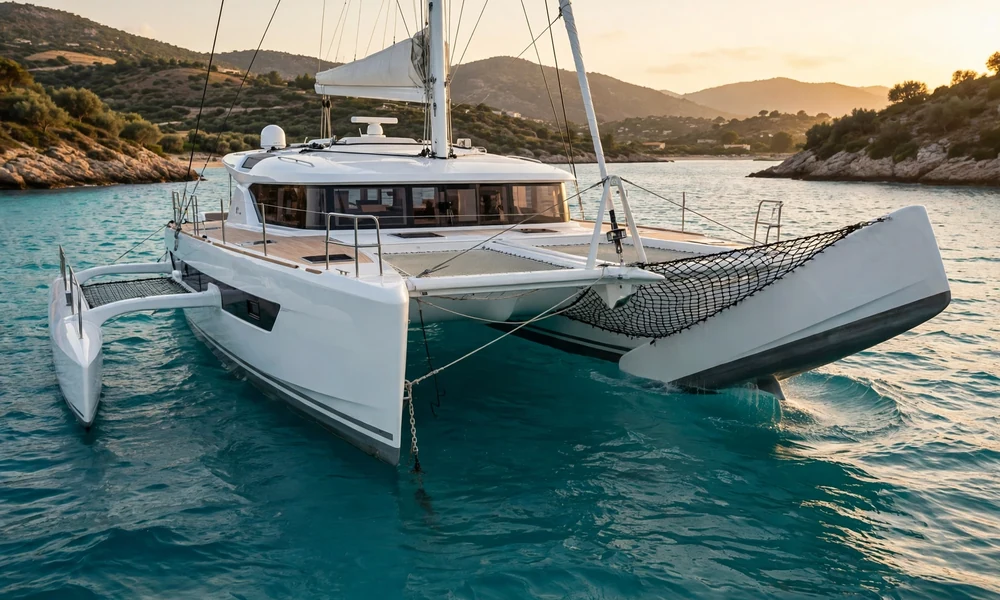
The trimaran came into the anchorage under sail alone, and it did not heel. While the single-hull yachts around it leaned into the breeze, the trimaran stayed level, its centre hull slicing a thin white line through the water and the two outer hulls barely kissing the surface. It looked less like sailing and more like a house that had learned to fly across the water, and that flat, fast ride is why a small number of owners will have nothing else.
A luxury trimaran is the rarest of the multihulls, and building one is a balancing act between speed and comfort. The centre hull is long and needle-thin, built for cutting through water with almost no drag, while the two outrigger hulls, called amas, exist mainly to stop the boat capsizing. The whole structure is held together by a crossbeam deck that takes enormous loads, and the interior has to fit into a centre hull that is barely wider than a corridor.

How a Luxury Trimaran Is Made
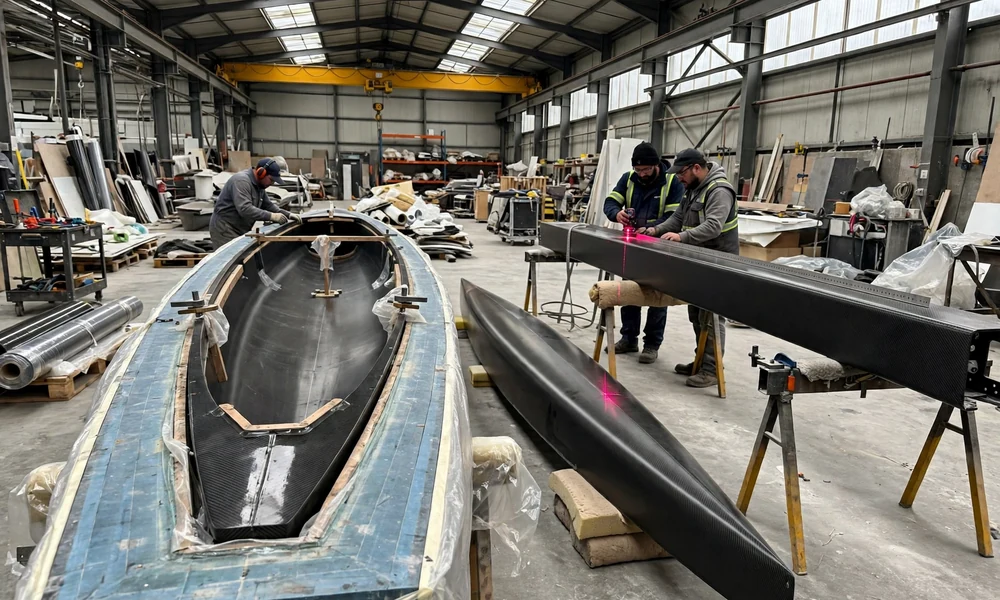
The build starts with the centre hull, and the centre hull is the soul of the boat. It is moulded as a long, narrow shell, sometimes twenty metres long and less than three metres wide, with a fine bow that parts the water rather than pushing it aside. The laminate is usually carbon fibre over a foam core, laid into a female mould and cured under vacuum, because the hull has to be stiff enough to carry the mast and light enough to reach speeds a catamaran cannot.
Step 1: Moulding the centre hull and the amas
The yard moulds three hulls, not two. The centre hull is built first, in a mould that is itself a piece of engineering, long and straight and polished to a mirror finish so the gelcoat comes out flawless. The amas are moulded separately, each one a slim, torpedo-shaped shell with almost no interior, because their job is buoyancy and nothing else.
Step 2: Building the crossbeam structure
The crossbeams are the most highly loaded parts of a trimaran, and they are built like aircraft wings. Each beam is a carbon fibre box section, laminated around a foam core and cured in an oven or under vacuum, with metal fittings bonded into the ends where it meets the hulls. The beams carry the bending loads every time a wave lifts one ama out of the water, and they also carry the mast loads down into the centre hull. The case for aluminium superyachts turns on a similar argument about weight and strength, but a trimaran beam works in carbon because no metal can match its stiffness for the same weight.
Step 3: Joining the platform and stepping the rig
The three hulls and the beams are joined on a level floor in the assembly hall, and the yard measures the alignment with lasers before a single bolt is tightened. The beams are bonded and bolted to reinforced sockets in each hull, and the deck between them is fitted as a structural panel that ties the whole platform together. The mast step sits on the centre hull, directly over the main beam, and the rig is a tall, powerful one, because a trimaran that does not heel can carry far more sail than a yacht of the same length.
Step 4: Fitting the interior into a narrow hull
The interior of a trimaran is a puzzle of narrow spaces. The centre hull holds a saloon, a galley, and the cabins, stacked in a tube that is rarely wider than two and a half metres, so the joiners build the furniture to fit the curve of the hull rather than to a rectangular plan. The saloon sits under the deck with windows in the coachroof, the galley is a single galley wall with a cooker and a sink, and the cabins are tucked fore and aft with berths that follow the shape of the bow. Why a luxury ferry is so expensive comes down to the same truth that governs a trimaran: building a specialised hull shape by hand, in small numbers, costs far more than building a standard one.
Step 5: Installing the engine, systems, and the wing deck
A luxury trimaran usually carries a single engine, set low in the centre hull on a saildrive, with a folding propeller that disappears into the flow when the boat is sailing. The electrical system is built around a lithium battery bank charged by solar panels laid across the coachroof, and the watermaker, the air conditioning, and the navigation instruments all draw from it. The wing deck, the flat area between the centre hull and the amas, is fitted with netting or solid panels, and it is where the crew work the sails and where the guests sunbathe.
Step 6: Launch, sea trials, and tuning the platform
The trimaran is launched and taken through sea trials that are as much about the platform as the boat. The crew sails it hard on every point of wind, watches the amas to see how often they fly clear of the water, and measures the speed against the wind. The rigging is tuned under load, the folding beams are opened and closed, and the engine is run at full power to check that the single propeller can push the boat against a tide. The most powerful electric yachts of 2027 show where marine power is heading, but a trimaran still wins its speed from the shape of its hulls rather than from horsepower. Only when the trial numbers match the designer’s predictions does the yard hand the boat over, usually with a delivery sail that is the fastest the new owner has ever sailed.
Luxury Trimaran Specifications
| Specification | Typical figure |
|---|---|
| Overall length | 15 to 24 metres for a luxury cruising trimaran |
| Beam, amas extended | 9 to 12 metres; about 4 metres folded |
| Displacement | 10 to 20 tonnes, fully loaded |
| Hull construction | Carbon fibre and foam core sandwich |
| Engine | Single diesel, 40 to 110 horsepower |
| Cabins | Three to four, in the centre hull |
| Cruising speed under sail | 12 to 18 knots in a good breeze |
| Top speed under sail | Over 25 knots on performance models |
What a Luxury Trimaran Costs
A new luxury trimaran in the 15 to 20 metre range typically costs an estimated $3 million to $8 million, depending on length, carbon content, and the level of finish, with larger custom builds reaching an estimated $10 million to $15 million. The price is high because so few are built, and because the carbon fibre structure, the folding beams, and the custom rig are all made in small batches by specialists. Running costs are estimated at $120,000 to $300,000 a year, covering berthing, insurance, and maintenance, and the narrow folded beam can cut marina fees, since the boat fits into a standard berth when the amas are pulled in.
A Rare Fact About Luxury Trimarans
A trimaran can sail so fast that it outruns its own bow wave, and on a good day the apparent wind on deck can be stronger than the true wind, which means the crew feel a breeze on their faces even when the boat is sailing directly downwind.