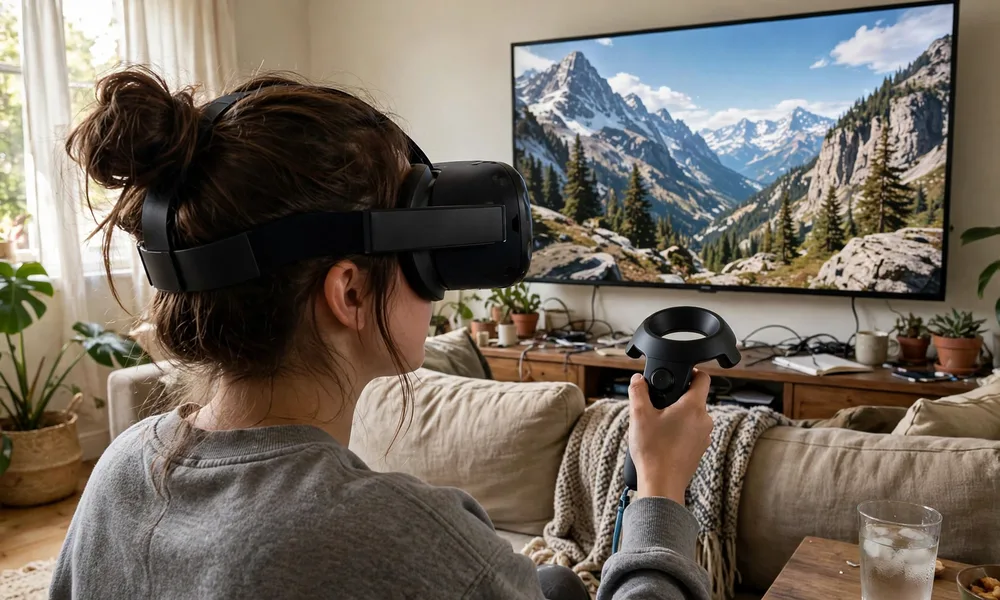
A woman stands in the middle of an empty room, wearing a white visor and holding two small controllers, and she is reaching for something that is not there. To everyone watching, she is alone on a carpet. To her, she is standing on a cliff edge above a sea that stretches to the horizon, and the wind she feels is only the air conditioning. The room has not changed. Her eyes have simply been given a better story.
This is how a luxury VR headset works, from the tracking that follows your head to the two small screens that paint a world in front of your eyes, and why the best headsets feel like a place rather than a gadget. Every part of the system is built to convince your brain, and your brain is a hard audience to fool.

Step 1: The headset tracks your head, a thousand times a second
The first job of a VR headset is to know exactly where your head is, and it does this with a set of sensors that never rest. A gyroscope and an accelerometer inside the visor measure every tilt and turn, while cameras on the outside of the headset watch the room and pick out fixed points, the corner of a table, a picture frame, a lamp, to work out where the headset is in space.
Step 2: Two screens paint two slightly different worlds
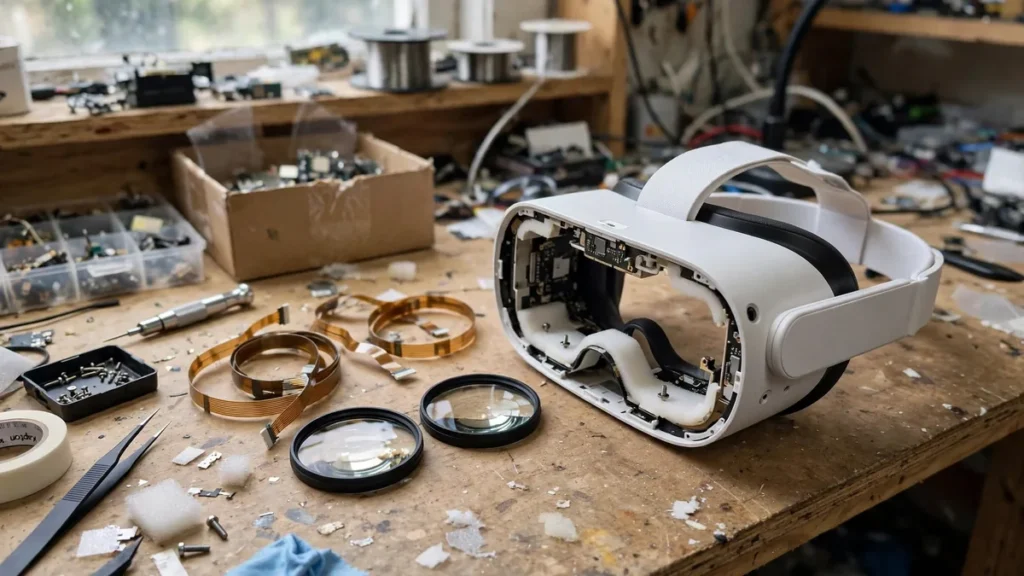
Inside the visor sit two small, very sharp displays, one for each eye, and each one shows the virtual world from a slightly different angle, exactly as your two eyes see the real world from slightly different angles. Your brain takes those two flat images and turns them into depth, which is why a virtual cliff edge feels high and a virtual ball feels close enough to catch. The lenses in front of the screens are what make the trick possible, bending the light so the tiny displays fill your whole view, and the guide to how VR headset lenses work shows how those lenses put a world in front of your eyes.
Step 3: The controllers follow your hands
Your hands are tracked just as carefully as your head. Each controller carries its own sensors and a ring of lights that the headset’s cameras watch, so the system knows where your hands are, which way they are pointing and when you squeeze the trigger or press a button. The controllers vibrate gently when you touch something in the virtual world, a small buzz that tells your brain the object is real, and that buzz is often what makes the illusion stick.

Step 4: The sound bends around you
A luxury VR headset does not just show you a world, it lets you hear it. Small speakers sit just above the ears, or earbuds plug into the visor, and the sound is processed so that a noise coming from behind you in the virtual world sounds as if it is behind you in the room. Turn your head and the sound moves with the world, not with your ears, which is what convinces your brain that the sound belongs to the place rather than to the headset.
Step 5: The computer draws the world, fast enough to believe
All of this is drawn by a powerful processor, either built into the headset itself or in a computer connected by a cable or wirelessly. The processor renders the virtual world twice, once for each eye, and it must do so fast enough that the image never stutters when you turn your head. The processor also runs the physics of the world, so a ball you throw arcs and falls, and a door you push swings on its hinges. The glasses that put directions in front of your eyes work on a lighter version of the same idea, and the guide to how smart glasses work shows how a much smaller display can still place information in the world.
Step 6: Comfort keeps you inside the world
The last part of a VR headset is the part you feel rather than see: the strap, the face cushion and the balance of the visor. A luxury headset spreads its weight across the head with a padded strap and a counterweight at the back, so it does not press on the nose or slide down during a long session. The face cushion is soft foam covered in wipeable fabric, and the lenses can be moved apart or together to match the distance between the wearer’s eyes.
The spec sheet at a glance
| Specification | Typical luxury figure | What it tells you |
|---|---|---|
| Displays | Two, 2,000–4,000 pixels per eye | How sharp the virtual world looks |
| Field of view | 100–120 degrees | How much of the world you can see |
| Refresh rate | 90–120 Hz | How smoothly the world moves |
| Tracking | Inside-out, cameras plus sensors | How it follows your head and hands |
| Optics | Pancake or Fresnel lenses | How the screens fill your view |
| Audio | Built-in spatial speakers | How sound moves around you |
| Processor | Standalone chip or PC link | Where the world is drawn |
| Weight | 500–700 grams | How heavy it feels on your head |
| Battery | 2–3 hours standalone | How long a session lasts |
Keeping it in good shape
A luxury VR headset lasts longest when its lenses are treated gently. Clean them only with a dry microfibre cloth, never with a tissue or a shirt, because a scratched lens blurs the whole world. Keep the headset out of direct sun, which can burn the displays through the lenses in minutes, and store it in its case with the controllers in their slots. Wipe the face cushion after each session and let it dry before the next, and update the software when prompted, because the tracking and the rendering improve with every update.
What it costs
A luxury VR headset typically costs an estimated $1,000 to $3,500, depending on the displays, the tracking and whether the processor is built in. The estimate covers the headset and its controllers alone, not a linked computer or any games and apps. The price of the technology around it is a story of its own, and the guide to why a luxury VR headset costs so much sets out where the money really goes.
A rare fact
One detail few wearers ever learn is that the first VR headsets were built for fighter pilots in the 1960s, and they were so heavy they had to be hung from the ceiling on a mechanical arm. The pilots used them to look at targets that were not really there, and the arm, nicknamed the Sword of Damocles, was the only thing keeping the headset from crushing the wearer’s neck. Sixty years later, the same idea fits in a visor that weighs less than a paperback, and the ceiling arm is long gone.
A luxury VR headset works by fooling your senses one at a time, tracking your head, painting two worlds, following your hands and bending the sound around you, until your brain accepts the story. It is a machine built entirely around belief, and when every part of it works together, the empty room disappears and the cliff edge is real.