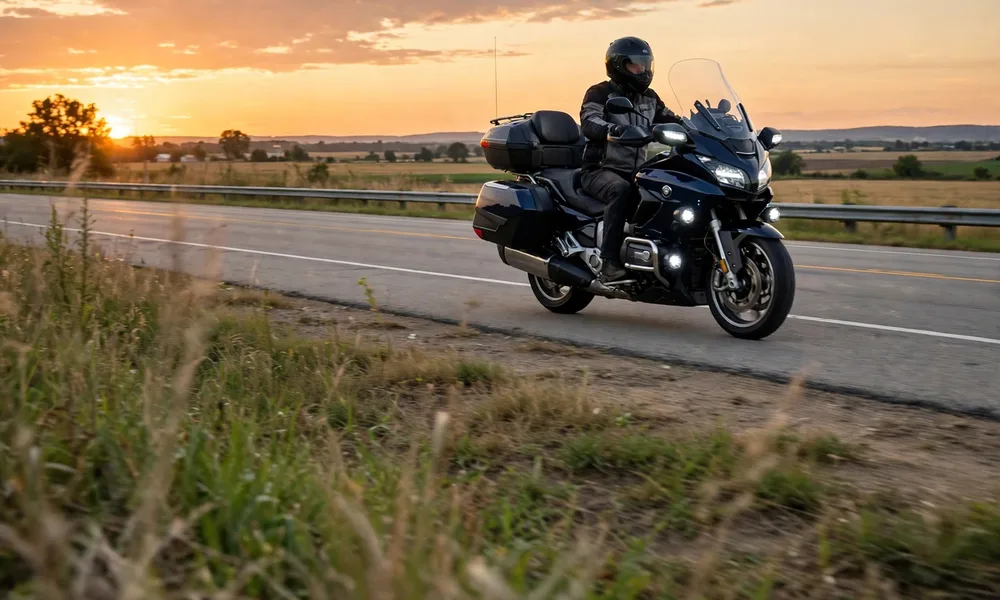
On a mountain road at dawn, a motorcycle the size of a small car sweeps through a bend, its fairing cutting the wind, its panniers packed for a week on the road, its rider sitting upright and relaxed behind a tall screen. It is a luxury touring motorcycle, built to cross a continent in comfort, and it costs as much as a well-equipped car. A passer-by at a fuel stop asks the rider what it cost, and the rider names the price, quietly, and the passer-by laughs, then looks at the bike again, more carefully. It is, after all, only a motorcycle. Two wheels, one engine, no roof, no doors.
And yet the price is not a mistake, and it is not a joke. A luxury touring motorcycle is a different machine from every other motorcycle, built for a job no other bike is asked to do: carry two people and a week of luggage across a continent, day after day, in comfort, in the rain, and at motorway speed. This is where the money goes, reason by reason.

Reason 1: A big engine, tuned for the long haul
Everything starts with the engine, usually a large flat twin, inline six or V-twin of around 1,200 to 1,800 cubic centimetres, tuned for torque rather than top speed. On the motorway the same engine cruises at speed with the revs low and the vibration damped, so the rider arrives fresh after a long day, and it must do that for a hundred thousand kilometres without complaint, fully loaded, in summer heat and winter rain. The engine is the heart of the machine, and the way it is built is set out in the guide to how a luxury touring motorcycle is made, from the frame and the engine to the fairing and the final road test.
Reason 2: The fairing and the aerodynamics
The fairing is the big bodywork that wraps the front of a touring motorcycle, and it is far more than a windscreen. It is shaped in a wind tunnel over months, tested with riders of different heights, and built to push the wind around the rider and the passenger while keeping the bike stable in a crosswind at motorway speed. The fairing carries the headlights, the mirrors, the dashboard and the speakers, and it must not buzz, rattle or flex after years of vibration. The moulds for a fairing cost a fortune to make, and they are used for only a few thousand bikes, so each bike carries a large share of that cost.
Reason 3: Electronics and rider aids
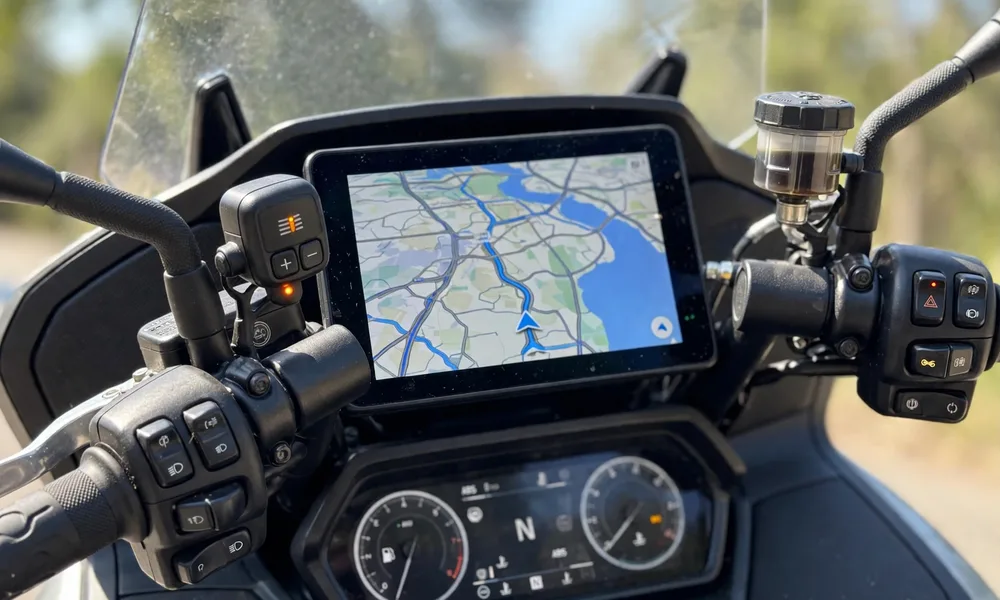
A luxury touring motorcycle carries more electronics than some cars. There is adaptive cruise control that holds a gap to the car ahead, a blind-spot warning, a hill-start aid, a tyre-pressure monitor, heated grips and a heated seat, a reversing aid for manoeuvring a heavy bike, and a dashboard with navigation, music and a phone connection, all controlled from the handlebars. Each system needs sensors, wiring and software, and each one must keep working in rain, dust and vibration for years. The software alone is a large cost, because it is written for a machine built in the thousands, not the millions, and every update must be tested on the road.
Reason 4: Suspension and comfort for two
The suspension on a touring motorcycle has a harder job than on any other bike, because it must carry two people and a week of luggage, soak up a motorway expansion joint at speed, and still feel planted in a bend. Luxury tourers use electronically adjustable suspension, which reads the road and the load and changes its damping in milliseconds, and that system alone costs more than a whole small motorcycle. The seat is shaped for two people to sit for hours, the footpegs are placed so the passenger’s knees do not ache, and the whole machine is balanced so it feels light at speed and manageable at a standstill, even though it weighs well over 300 kilograms.
Reason 5: Luggage and touring kit
A touring motorcycle is sold with its luggage, and the luggage is not an afterthought. The panniers and the top box are moulded to fit the bike, painted to match, lockable with the same key as the ignition, and shaped to hold a helmet each while keeping the bike narrow enough to filter through traffic. They are waterproof, they are lined, and they are removable with one hand. Add the crash protection, the auxiliary lights, the tall screen and the comfort seat, and the touring kit alone is worth several thousand dollars.
Reason 6: Hand finishing and materials
The materials in a luxury touring motorcycle are chosen to look good after a hundred thousand kilometres, not just on the day of delivery. The paint is applied in multiple coats, with hours of polishing between them, in a colour matched across the fairing, the panniers and the tank. The brightwork is real chrome, plated onto metal in thick layers, where a mass-market bike uses plastic coated in a thin metallic film. The seat is stitched leather, the switchgear is metal rather than plastic, and the whole machine is assembled slowly, by people who check each bike by hand. The same logic applies across the whole range, and the guide to why a luxury motorcycle is so expensive shows how the craft, the materials and the small production runs push the price of every premium bike, not just the tourers.
Reason 7: Low volumes and a lifetime of support
The final reason is the simplest: very few luxury touring motorcycles are built, and each one must pay for the factory, the engineers, the dealers and the parts supply that will support it for decades. A maker that builds a few thousand touring bikes a year cannot spread its costs the way a car maker can, and it cannot close its parts department after ten years, because a touring bike is expected to run for twenty. The dealer network is part of the price too, because a touring rider far from home needs a dealer who stocks the parts, knows the machine, and can fix it the same day. The numbers behind that promise are set out in the guide to luxury motorcycle specs explained, where the engine, the weight and the fuel figures show what a big touring machine is built to do.
A luxury touring motorcycle usually costs roughly $25,000 to $45,000, as an estimate, and the spread reflects the engine, the electronics and the finish. A rare fact worth knowing: the first true touring motorcycles were not built by factories at all, but by riders who bolted car windscreens, army surplus panniers and homemade fairings onto ordinary bikes, and the factories only caught up decades later, when they realised that the riders who crossed continents were willing to pay for a machine built for the job from the start.