At sunset in a quiet anchorage, the lights come on along the main deck and the sound of ice in a shaker drifts out across the water. Behind a curved wooden counter, a bartender works in a space no wider than a wardrobe, shaking, stirring, and pouring while the yacht rolls gently beneath her feet. It looks effortless, and that is the point: a cocktail bar is built so that a difficult job looks easy.
A luxury yacht cocktail bar is a compact mixing station where drinks are made to order, one at a time, from measured spirits, fresh fruit, syrups, and ice. It works by keeping everything the bartender needs within arm’s reach, chilling the glasses before they are filled, and running a tight routine from the first order to the last glass washed. A plain bar holds bottles; a cocktail bar is a small kitchen for drinks, and it runs on timing, ice, and muscle memory.

How It Works
The station: everything within arm’s reach
The cocktail bar is laid out like a cockpit, with the bartender standing in the middle and every tool in a fixed place. The speed rail holds the most-used bottles along the front of the counter, the ice bin sits at waist height to the bartender’s right, and the cutting board, shakers, and strainers sit on a steel top that wipes clean in one pass. Nothing is more than a step away, because the bartender cannot leave the station during a service: the moment she turns her back, a drink is forgotten or a glass is knocked over. The yacht cocktail bar build explains how the curved counter was built to fit the room, and the working layout inside that curve is what makes the bar fast.
Shaking and stirring: how a drink is actually made
Every cocktail on the menu is a recipe with a method, and the bartender knows both by heart. A shaken drink, usually one with citrus or egg white, goes into a shaker with large clear ice and is shaken hard for ten to fifteen seconds, chilling and diluting the drink at the same time. A stirred drink, usually spirit-forward, is stirred gently in a mixing glass for thirty seconds, so it goes cold without going cloudy.
Ice: the bar’s cold engine
Ice is the ingredient nobody counts, and the bar uses more of it than anything else. A yacht cocktail bar makes its own ice from filtered water, in cubes and in large clear blocks that melt slowly, so a drink stays cold without turning watery. The ice machine lives below the counter, the bin is filled before sunset, and the bartender uses a scoop, never her hands, to keep the ice clean. The yacht bar runs the same cold routine for the whole bar, and the cocktail station is the sharpest end of it: if the ice runs out, the bar closes, no matter how many bottles are left on the shelf.

Chilled glasses, fresh fruit and the garnish station
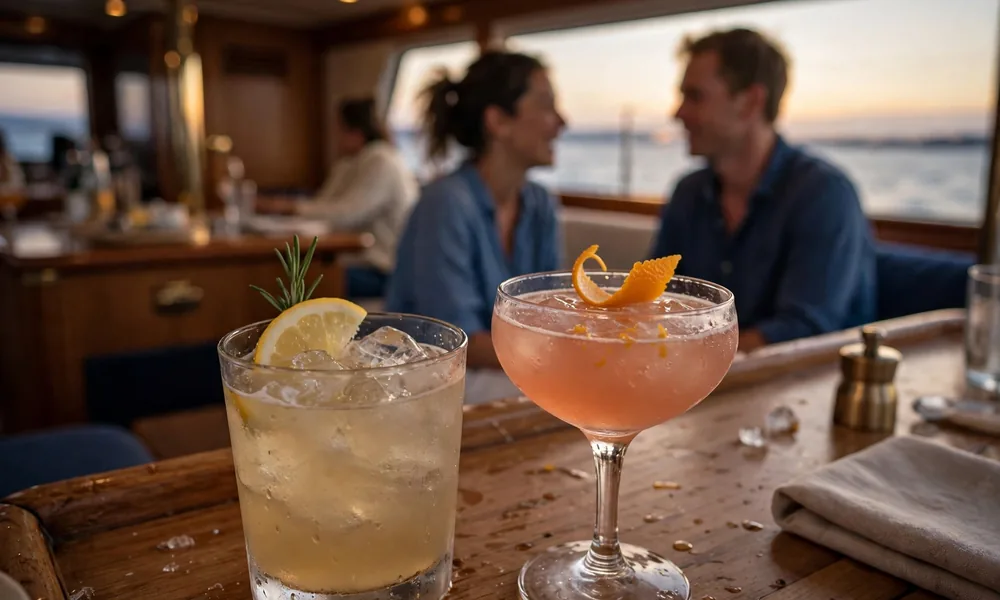
A cocktail is poured into a glass that is already cold, because a warm glass melts the ice and dulls the drink in seconds. The glasses are kept in a small fridge under the counter, or chilled with a scoop of ice that is tipped out just before pouring, and the stems are polished so the drink looks as good as it tastes. Beside the glasses sits the garnish station: limes and lemons cut fresh each evening, herbs picked and stored in damp cloth, syrups made in the galley that morning. Nothing at the garnish station is older than a day, because a tired lime makes a tired drink, and guests can taste the difference even if they cannot name it.
Working with the roll: bottles, glasses and balance
A yacht rolls, and a cocktail bar has to work with the roll instead of fighting it. Bottles sit in rails and racks that hold them upright, glasses stand in rubber-matted wells, and the shaker is never set down on the edge of the counter. The bartender learns to pour with the motion of the boat, timing the pour to the moment the yacht is level, and to hold a glass with a fingertip on the base so it cannot slide. In a swell, the bar slows down rather than speeding up, and the guests never notice, because a good bartender makes waiting look like part of the show.
Closing the bar: washing, counting and restocking
When the last guest leaves, the bar is stripped down and put back together for the next night. Glasses are washed, polished, and racked; the shakers and strainers are scrubbed and dried; the ice bin is emptied and wiped so it cannot grow mould overnight. The steward counts the bottles against the night’s orders, notes what ran low, and restocks from the ship’s store before morning. By the time the bar is closed, it looks untouched, as if nobody ever drank there at all.
A yacht cocktail bar works when nobody thinks about it. The drink arrives cold, the glass is polished, the ice is clear, and the bartender is already making the next one. That is the whole job, and it is harder than it looks from the other side of the counter.
Yacht Cocktail Bar Specifications
| Feature | Typical Detail |
|---|---|
| Station | Curved counter, bartender in the middle, tools within arm’s reach |
| Speed rail | Most-used bottles in recipe order along the counter front |
| Ice | Own ice machine below the counter, cubes and large clear blocks |
| Glasses | Chilled in a fridge under the counter, polished before service |
| Garnish station | Fresh citrus, herbs and syrups, nothing older than a day |
| Shaking | 10 to 15 seconds for citrus drinks, stirring for spirit drinks |
| Closing | Glasses washed and racked, bottles counted, ice bin wiped dry |
How Much Does a Yacht Cocktail Bar Cost to Run?
Prices are estimates and vary with yacht size, menu and port. Running a yacht cocktail bar for a week typically costs an estimated $1,500 to $6,000 in stock, including spirits, fresh fruit, syrups, and ice, on top of the bartender’s time. A single signature cocktail costs an estimated $12 to $25 in ingredients, with rare spirits and vintage champagne at the top of the range. The stock is bought fresh at every port, and the most expensive item on the shelf is usually a bottle that is opened once a season and finished by a single guest.
A Rare Fact About Yacht Cocktail Bars
Here is a detail most guests never notice: the bottles on the speed rail are arranged by recipe, not alphabetically. The bartender lays them out in the order the menu uses them, so her hand moves down the rail the way a pianist’s hand moves across keys, and she never has to look for a bottle in the middle of a rush. The yacht bar specs lists the rail length and bottle count, and the order is the quiet part of the spec: a bar that looks tidy to a guest is really a map of the menu, written in glass, and the bartender reads it without thinking.
The best yacht cocktail bars disappear into the evening once the glasses are washed and the bottles counted. Then the next day the ice goes back in, the limes are cut fresh, and the bar is busy again, one drink at a time, until the sun goes down.


