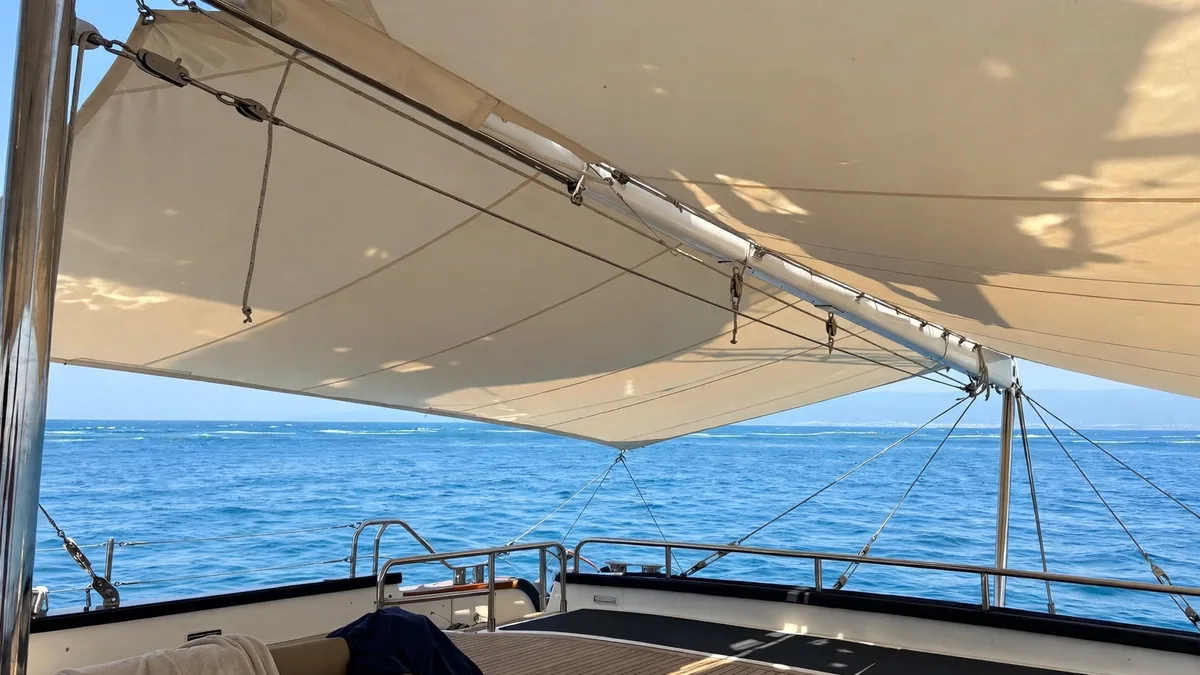
On a still afternoon in the tropics, the sun on a yacht deck is strong enough to burn in twenty minutes, and the only cool place to sit is under a great cream canopy stretched over the sun deck. Guests read in its shade, the crew serve lunch under it, and the deck below stays ten degrees cooler than the open teak. The canopy looks simple, a sheet of cloth on poles, but it was cut, sewn, and rigged by hand to fit one deck exactly.
A luxury yacht sunshade is a large fabric canopy rigged over the sun deck of a yacht to give shade, usually made from UV-stable acrylic canvas, cut and sewn to the shape of the deck, and held up by stainless steel poles, tracks, and rigging lines. It is made by choosing a cloth that blocks the sun without trapping the heat, cutting the panels to a pattern taken from the deck itself, and sewing them into a single canopy that can be tensioned drum-tight and taken down in minutes. It is not a sail and not an awning: a sunshade is a flat or gently curved canopy built for shade at anchor, rigged only when the boat is still.
How It’s Made
Step 1: Choosing the canvas that blocks the sun
The sunshade starts as a roll of solution-dyed acrylic canvas, the cloth sailmakers use for anything that must live in the sun. The colour is dyed into the fibre itself rather than printed on the surface, so it does not fade to grey after a season in the tropics, and the weave is open enough to let the breeze through while blocking almost all of the ultraviolet light. The cloth is also treated to shed rain, so a passing shower runs off instead of soaking through.
Step 2: Measuring the deck and cutting the pattern
No two yacht decks are the same, so a sunshade is never bought off the shelf. The sailmaker climbs aboard with a tape and a patterning cloth, measuring the deck from rail to rail, marking where the poles will stand and where the rigging lines will anchor. The pattern is drawn on the floor of the loft, and each panel is cut with a hot knife that seals the edge as it cuts, so the weave cannot fray. The yacht sunbed below it was measured the same way, and the shade is cut to cover the loungers without blocking the walkway to the stern.
Step 3: Sewing the seams and reinforcing the corners
The panels are sewn together on a heavy sailmaker’s machine, with double-stitched seams and a UV-resistant thread that will not rot in the sun the way ordinary cotton thread does. Every corner gets a patch of extra cloth and a stainless steel ring, because the corners take all the tension when the canopy is rigged, and a corner that tears will run across the whole shade. The edges are finished with a bolt rope, a cord sewn into a pocket along the hem, which slides into a track on the poles and spreads the load evenly.

Step 4: Making the poles, tracks, and rigging
The canopy needs something to hang from, and that is a set of stainless steel poles, usually two or four, with a track along the top that the bolt rope slides into. The poles are cut from 316 marine-grade stainless tube, polished so salt water sheds off them, and each one ends in a deck socket that locks it upright and a fitting at the top for the rigging lines. The lines themselves are low-stretch rope, the same kind used for sail control lines, because a line that stretches will let the canopy sag by noon.
Step 5: Tensioning the shade on deck
Rigging the shade is a crew job that takes about ten minutes. The poles go into their sockets, the canopy is unrolled and clipped to the tracks, and the rigging lines are pulled tight, one corner at a time, until the cloth is drum-tight and the water would run off it like a roof. The best yacht sun decks lists sun decks built for exactly this kind of shade, and the tension is what keeps the canopy quiet: a loose shade flaps in the breeze and wears itself out in a week.
Step 6: Folding, stowing, and the first hot afternoon
When the wind rises or the yacht gets under way, the shade comes down just as fast as it went up. The crew ease the lines, slide the canopy out of the tracks, fold it along its seams, and stow it in a breathable bag below decks, because a damp canopy folded wet will grow mildew in days. The yacht deck chair on the same deck folds away the same way, and by the next hot afternoon at anchor the shade is back up, the loungers are in its shadow, and lunch is served out of the sun.
A yacht sunshade earns its place by making the hottest part of the day the most comfortable. It is cloth, thread, and steel, cut to fit one deck, and it turns a baking sun deck into a cool room with no walls and the sea all around. It is the simplest luxury on the boat, and on a still afternoon it is the one everyone gathers under.
Yacht Sunshade Specifications
| Feature | Typical Detail |
|---|---|
| Canvas | Solution-dyed acrylic, pale cream, UV-stable and water-shedding |
| Weave | Open enough to let the breeze through, blocking most ultraviolet light |
| Seams | Double-stitched with UV-resistant thread, reinforced corners |
| Edge | Bolt rope sewn into a hem pocket, sliding into a pole track |
| Poles | 316 marine-grade stainless steel tube, deck sockets, locking tops |
| Rigging | Low-stretch rope lines, rigged without tools in about ten minutes |
| Stowage | Folded along its seams into a breathable bag below decks |
How Much Does a Yacht Sunshade Cost?
Prices are estimates and vary with size, cloth and maker. A luxury yacht sunshade typically costs an estimated $6,000 to $25,000, including the canvas, the poles, the tracks, and the rigging, with large multi-panel shades for a wide sun deck at the top and a single small canopy lower. A spare canopy and a replacement set of lines can add an estimated $1,500 to $5,000. It sounds like a lot for a piece of cloth, but a cheap shade fades, sags, and tears in its first season.
A Rare Fact About Yacht Sunshades
Here is a detail most guests never notice: a yacht sunshade is taken down in winds over about twenty-five knots, not because the cloth would tear, but because the shade starts to act like a sail. A taut canopy over a sun deck catches the wind like a wing, and in a gust it can pull a pole out of its socket or heel the yacht at anchor. The crew watch the wind the way they watch the weather, and the shade comes down before the breeze builds, even on a sunny day. It is the only fitting on the boat that is rigged for calm and struck for wind.

The best yacht sunshades are the ones nobody notices, because the shade is cool, the cloth is quiet, and the breeze still finds its way through. Lunch is in the shade, the sea is all around, and the sun is somebody else’s problem.


