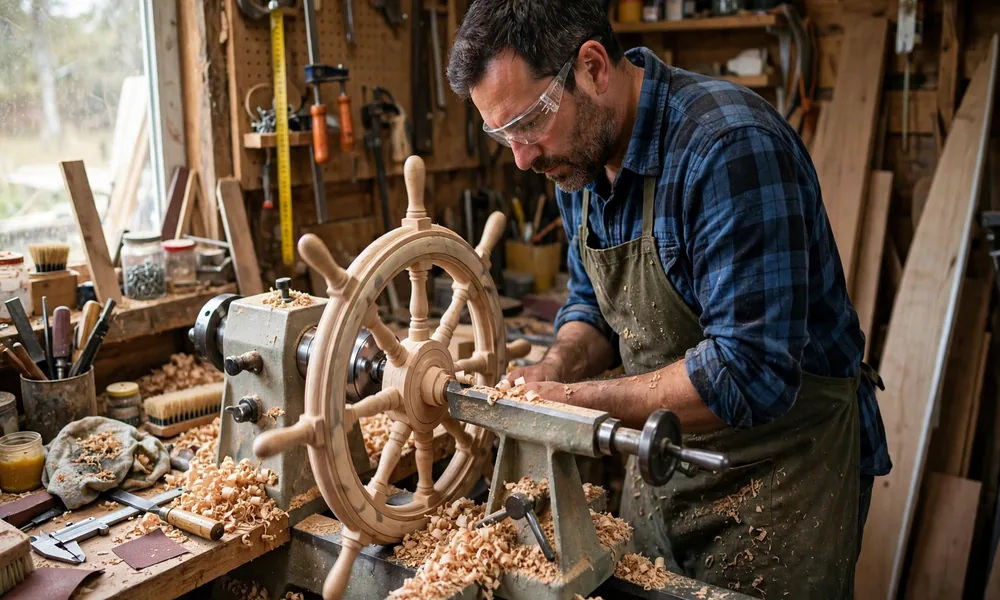
In a small workshop above a boatyard in southern England, a craftsman turns a length of teak on a lathe, and a yacht helm begins to take shape. The wood spins, shavings curl to the floor, and slowly a circle appears, smooth and warm to the touch. It will become the wheel a captain holds on a fifty-metre superyacht, and it has to feel as good as it looks.
A luxury yacht helm is not bought off a shelf. Each one is made to order for a particular yacht, matched to the size of the rudder, the style of the bridge, and the taste of the owner. Some are classic wooden wheels with brass fittings, others are sleek steel wheels paired with touchscreens and joysticks, but all of them are built the same way: by hand, in stages, with the steering mechanism tested long before the yacht ever touches the water.
Here is how a luxury yacht helm is made, from a stack of timber to the finished wheel on the bridge.
1. Choosing the timber and cutting the wheel
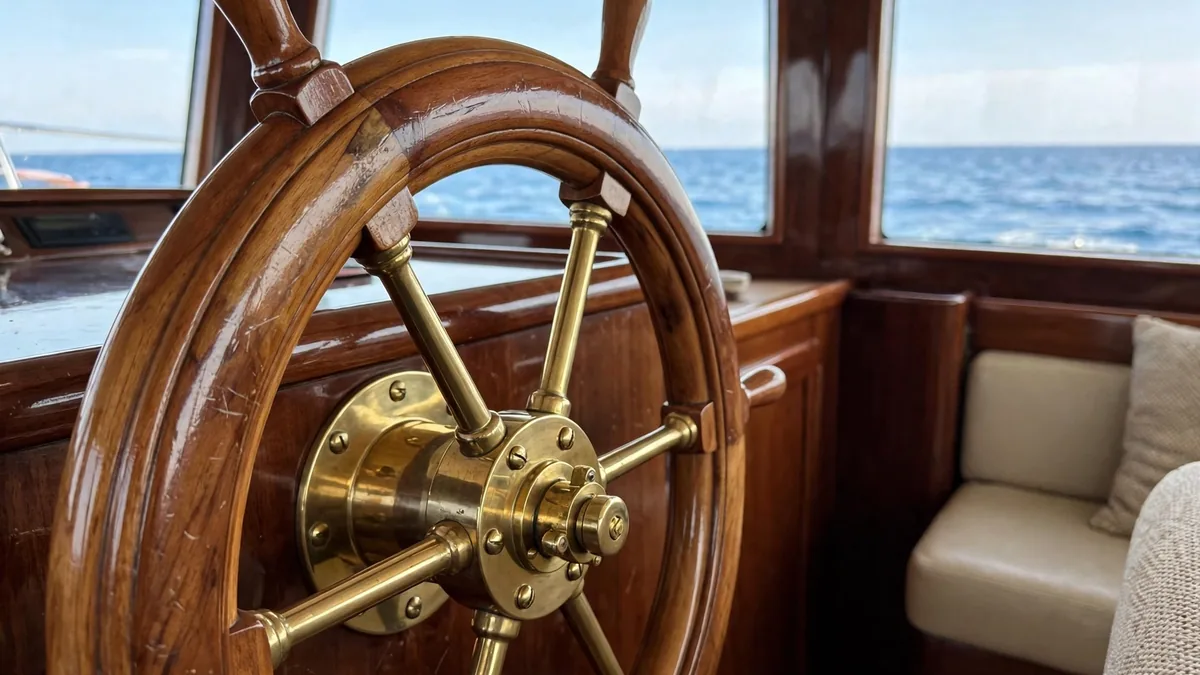
The wheel starts with timber, usually teak, mahogany, or stainless steel clad in wood, chosen for strength, stability, and beauty. The timber is seasoned for months so it will not warp or split when the yacht sails from a cold northern harbour to the heat of the tropics. Only straight-grained, knot-free boards are used, because a flaw in the wood becomes a weak point in the wheel.
The wheel is built from segments, not a single piece of wood, so that it stays round as temperature and humidity change. Each segment is cut, shaped, and joined with marine glue and dowels, then the whole rim is turned on a large lathe until it is perfectly circular. The spokes are shaped by hand, tapered so they are strong at the hub and slim at the rim, and fitted into the central hub with tight, glued joints.
2. Building the pedestal and steering gear
While the wheel takes shape, the pedestal is built: the column that holds the wheel, the engine throttles, and the instrument panel. The pedestal is usually fabricated from stainless steel or aluminium, welded and polished, then fitted with a waterproof top that keeps spray and rain out of the electronics below. Inside the pedestal sits the steering mechanism itself.
On most modern yachts that mechanism is hydraulic. Turning the wheel drives a pump that sends oil through pipes to a cylinder at the rudder, and the cylinder pushes the rudder over. The pump, pipes, and cylinder are fitted and bled of air in the workshop, then tested on a bench rig that simulates the load of the rudder in the water. The ship version of this machinery is explained in how a luxury ship helm works, where the same choice between feel and power shapes the design.
3. Fitting the wheel to the pedestal
Once the wheel and pedestal are ready, they are joined together. The wheel is mounted on a shaft that runs through the pedestal to the steering pump, and the shaft is balanced so the wheel turns smoothly with no wobble. A brake is often fitted, so the wheel can be locked in place when the yacht is at anchor or under autopilot.
The fit is checked by hand, again and again. The craftsman turns the wheel lock to lock, feeling for any tight spot or play in the shaft, and the gap between the wheel and the pedestal is set so that fingers cannot be caught. On a sailing yacht the wheel may be more than a metre across, and it must clear the cockpit seats and the engine controls by a comfortable margin. The loads this system must handle are set out in the luxury ship helm specifications, where rudder angles and steering forces are listed in detail.
4. Adding the controls and instruments
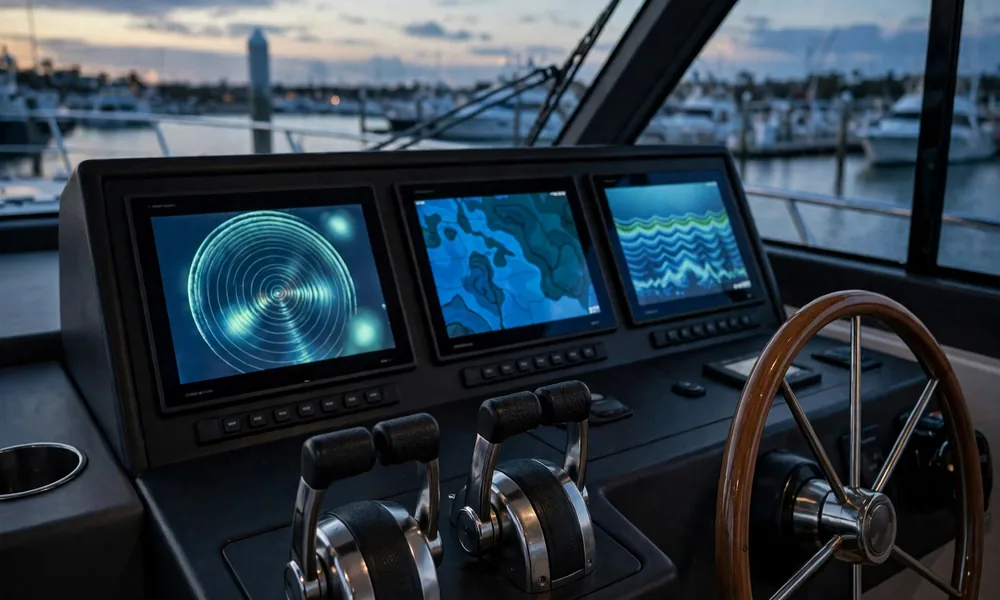
A helm is more than a wheel. Around it sit the engine throttles, the bow thruster control, the autopilot panel, and the navigation screens, all fitted into the pedestal top and the console beside it. Each control is placed where the helmsman can reach it without taking a hand off the wheel, and the layout is agreed with the captain before a single hole is cut.
The wiring is run through the pedestal in sealed conduits, protected from salt spray and vibration, and every connection is labelled and tested. The navigation screens that complete the helm station are described in how a luxury yacht navigation display works, the helmsman’s window on course, depth, and traffic.
5. Polishing, testing, and sea trials
The final stage is finishing. The wooden wheel is sanded through finer and finer grades, oiled or varnished until it glows, and polished by hand. The brass fittings are polished, the stainless steel is buffed, and the pedestal is cleaned until it looks like a piece of furniture rather than a machine.
Then the whole helm is tested. The wheel is turned lock to lock under load, the hydraulics are checked for leaks, and the autopilot is run through its paces. At sea trials, the captain steers the yacht through turns at speed, checks that the wheel feels right, and confirms that the rudder answers promptly. Only when the helm feels perfect in the captain’s hands is the yacht handed over to its owner.
The Yacht Helm: Specs
| Specification | Typical range |
|---|---|
| Wheel diameter | About 0.8 to 1.4 metres |
| Wheel material | Teak, mahogany, or stainless steel |
| Wheel turns lock to lock | About 1.5 to 3 turns |
| Steering type | Hydraulic, or cable and chain |
| Hydraulic pressure | About 70 to 140 bar |
| Timber seasoning | Several months before shaping |
| Helm stations | Main helm plus flybridge and wing stations |
| Build time | About 2 to 3 weeks per wheel |
What Does a Luxury Yacht Helm Cost?
A helm for a luxury yacht is estimated to cost roughly $20,000 to $150,000, depending on the size of the yacht, the steering type, and the electronics fitted around it. A hydraulic steering system with autopilot for a 25-metre yacht is estimated at roughly $20,000 to $50,000, while a full dual-station helm with joystick docking and integrated navigation for a 50-metre superyacht can be estimated at $100,000 to $150,000. The wheel itself is estimated at roughly $2,000 to $10,000, with custom teak and stainless wheels at the top of that range.
A Rare Fact
On some of the largest sailing yachts, the helm wheel is so large that it is fitted with a brake, because if it were left free in a gust, the rudder could spin the wheel fast enough to injure the helmsman. In the age of sail, wheels were even bigger, and a ship’s wheel could be two metres across, turned by two sailors standing side by side in heavy weather.
The helm is the part of a yacht that guests remember, because it is the part they are allowed to touch. It is also the part that connects a person to the sea, through wood, steel, oil, and water, and the reason it feels so good in the hands is that every piece of it was shaped, fitted, and polished by someone who knew exactly what it had to do.