Stand on the bridge of a luxury ship and the first thing you reach for is the helm. It is usually a big wooden wheel with brass fittings, and it looks like something from another century. That is deliberate. Ship owners love the traditional look, and helmsmen love the way a real wheel tells them what the ship is doing through their hands.
Behind that simple wheel sits a serious piece of engineering. The wheel itself does almost none of the work; it sends a signal, and great hydraulic rams at the stern do the heavy pushing. This is how a luxury ship helm works.

How It Works
Step 1: The helmsman turns the wheel
Everything starts with the wheel. Turn it to port and the ship is ordered to turn left; turn it to starboard and she is ordered to turn right. The wheel is sized so a helmsman can hold it with both hands and feel, through the wood, the small tremors that say how the sea is pushing against the rudders far below.
The wheel does not connect to the rudder by ropes or chains any more, the way it did on old sailing ships. It connects to a transmitter, a small device that reads how far the wheel has turned and how fast, and sends that order down to the steering gear as an electrical signal.
Step 2: The signal reaches the steering gear
The order travels from the bridge to the steering flat, the compartment at the stern where the steering gear lives. There, the signal is read by a control unit that compares the ordered rudder angle with the angle the rudder is actually at, and works out how far the rudder still has to move.
If the difference is small, the system moves the rudder gently. If the difference is large, as in a hard turn, it moves it fast. The control unit watches the rudder all the time, so the blade stops exactly where it was ordered and does not overshoot and swing back.
Step 3: The hydraulic rams push the rudder
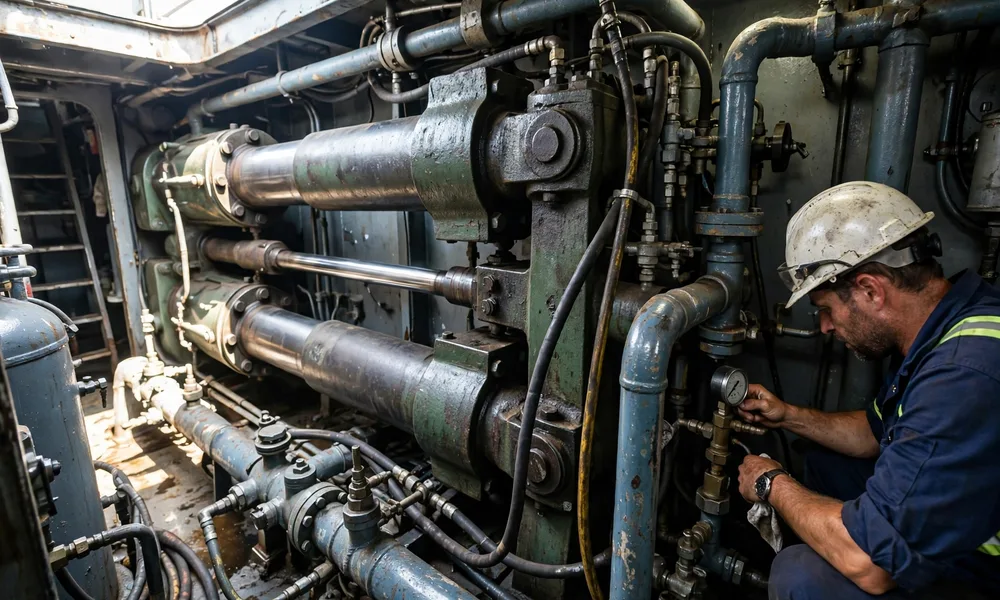
The muscle of the helm is hydraulic. Pumps in the steering flat push oil at high pressure into great cylinders, and the rams inside those cylinders push on a tiller arm fixed to the top of the rudder stock. Push one side and the rudder swings to port; push the other and it swings to starboard.
The rams are enormously strong, because a rudder the size of a house, moving through water at speed, pushes back with hundreds of tonnes of force. A luxury ship carries more than one pump and more than one set of rams, so if one fails, another takes over without the helmsman ever noticing.
Step 4: The rudder turns the ship
When the rudder swings, it deflects the stream of water coming off the propeller. The water pushes back on the blade, and that push turns the stern one way and the bow the other. A small rudder angle gives a gentle turn; a large angle gives a hard turn, but it also slows the ship, because the rudder is dragging sideways through the water.
The helmsman feels this through the wheel. As the ship begins to turn, the wheel grows heavier, then lighter again as the turn settles. An experienced helmsman reads that weight the way a driver reads a steering wheel, and eases the rudder back before the ship has turned too far.
Step 5: The ship is steadied on her course
Turning is only half the job. Most of the time the helm is holding a course, and that means constant small corrections. A gust of wind pushes the bow off, a wave lifts the stern, and the helmsman nudges the wheel a degree or two to bring her back, then nudges it back again before she overshoots. On a calm day the corrections are tiny, a finger’s width of wheel, but in a crosswind they come every few seconds and the helmsman never quite rests.
On a long ocean passage the autopilot does most of this work, holding the ordered course and making the same small corrections on its own. The helmsman stays at the wheel, watching, and takes over by hand whenever the ship is near land, in traffic, or in bad weather, when a human eye is worth more than a machine.
Step 6: The backups take over if anything fails
A helm that fails at sea is an emergency, so a luxury ship helm is built with layers of backup. If the main pumps fail, standby pumps start on their own. If the power fails, an emergency supply keeps the steering alive long enough to get the ship clear of danger.
And if everything electrical fails, there is still a last resort: a local control in the steering flat itself, where a crew member can work the rams by hand levers, following orders shouted down a voice pipe from the bridge. It is slow and hard work, but it has brought ships home when nothing else would.
| Part | Detail |
|---|---|
| Wheel | A wooden wheel with brass fittings that reads the helmsman order and its feel |
| Transmitter | Sends the wheel angle as an electrical signal to the steering flat at the stern |
| Steering gear | A control unit that compares the ordered angle with the real rudder angle |
| Rams | High-pressure hydraulic cylinders pushing the tiller arm on the rudder stock |
| Rudder | A steel blade that deflects the propeller stream and turns the ship |
| Backups | Standby pumps, emergency power and hand control in the steering flat |
The hardest part of a ship helm is the feel. A wheel that is too light gives the helmsman no warning, and one that is too heavy wears him out, so the yard tunes the gearing and the feedback until the wheel talks back just enough, heavy in a turn and light on a straight course, the way a good helm should.
What One Costs
Fitting a luxury ship helm typically costs an estimated $1 million to $4 million, set mostly by the size of the rudders, the power of the hydraulic gear and the number of backup systems. A simple helm with one steering gear sits near the bottom, while a large ship with twin rudders and full redundancy costs far more. The figures on the specification sheet run alongside it, and luxury ship helm specs explained walks through wheel size, turns lock to lock and steering power, while how a luxury ship bridge is made covers the room the helm stands in.
A Rare Fact
On old ships the helmsman steered by a compass and a set of orders shouted from the quarterdeck, and the wheel was so heavy that two men were sometimes needed to hold it in a gale. The word starboard itself comes from the steering oar, the steerboard, that hung on the right side of those ships long before rudders were invented.

A luxury ship helm is a wooden wheel that sends an order, a control unit that compares it with the rudder, hydraulic rams that do the pushing, and a blade that turns the ship, all backed up twice over. It looks like the past, but it steers with the power of the present. The eyes that check the course the helm holds are a separate instrument, and how a luxury ship radar works shows how the bridge sees what lies ahead.


