Fresh sheets appear on the beds each evening, clean towels hang in every bathroom, and nobody ever sees where they come from. Behind a plain door low in the hull, a small room of humming machines works through the night while the guests sleep above it, washing, drying and pressing everything they touch. It is the hardest-working room on the boat, and one of the most expensive rooms to build and to run.
That surprises people, because a laundry sounds like the cheapest room on a yacht. Ashore, a washing machine is an ordinary appliance, and a laundry is a corner of a house.
This is why a luxury yacht laundry costs so much, from the machines themselves to the water, the labour and the linen that never stops wearing out.
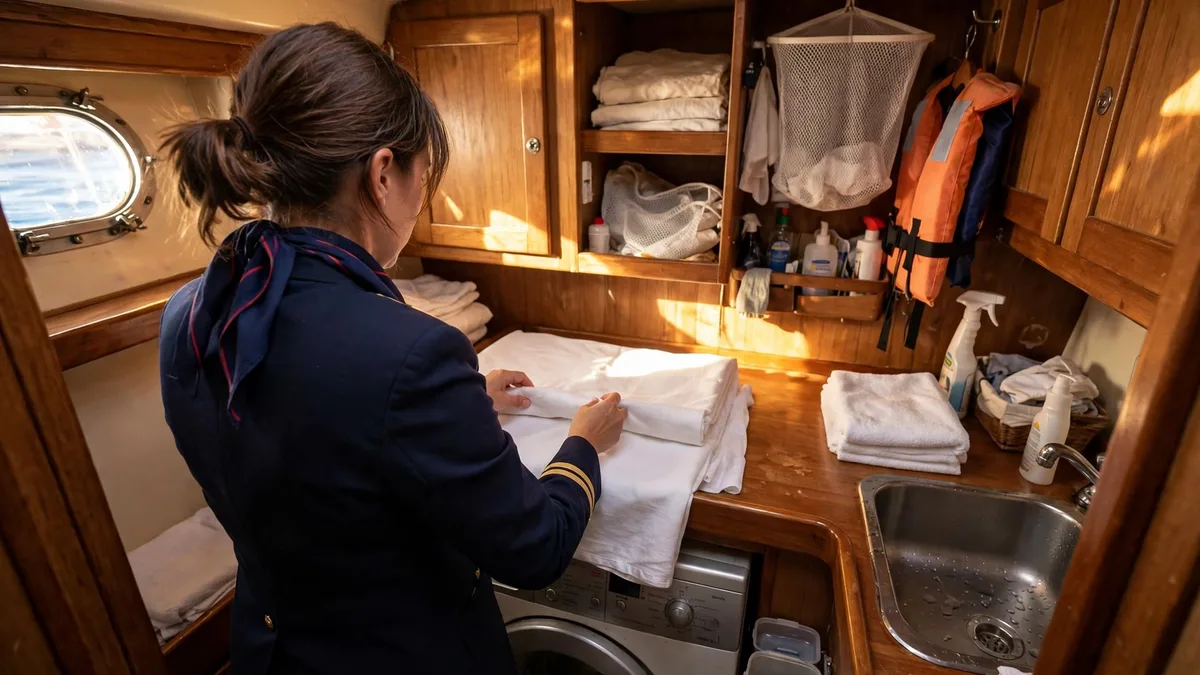
The Machines Are Not Household Machines
The first cost is the machines, and they are not the machines in a house. A yacht washer is a marine-grade machine, built to run on the yacht’s power supply, to cope with the pitch and roll of the sea, and to survive salt air that would eat an ordinary appliance within a season. Each one is bolted through the deck on rubber mounts, because a spinning drum in rough weather can shake itself across a room if it is only sitting on the floor, and its door locks with a heavy latch that cannot pop open in a swell.
That engineering is expensive, and so is the small production run. Yacht machines are made in the hundreds, not the millions, and every part is built to a marine standard: sealed electronics, stainless fittings, drums balanced to spin true when the yacht rolls.
The Room Around Them Costs More Than the Machines
The second cost is the room itself, and it is the part owners forget. A yacht laundry starts as a bare steel compartment deep in the hull, and builders must seal it with a waterproof coating, line it with soundproofing, lay a rubberised floor that drains to a central sump, and cut a vent to the outside air, because a laundry that cannot breathe fills with steam within minutes.
None of that work is standard, and all of it is done by hand, in a room a fitter can barely turn around in. The soundproofing alone is a serious line: thick insulation in the walls and ceiling, a heavy sealed door, and floating mounts under the machines, all so the spin cycle never reaches the cabins above. The room is built step by step in how a yacht laundry is made, from the sealed compartment to the finished counter, and every step is skilled labour in a tight space, which is the most expensive kind of labour on a yacht.
Fresh Water, Power and the Daily Running Bill
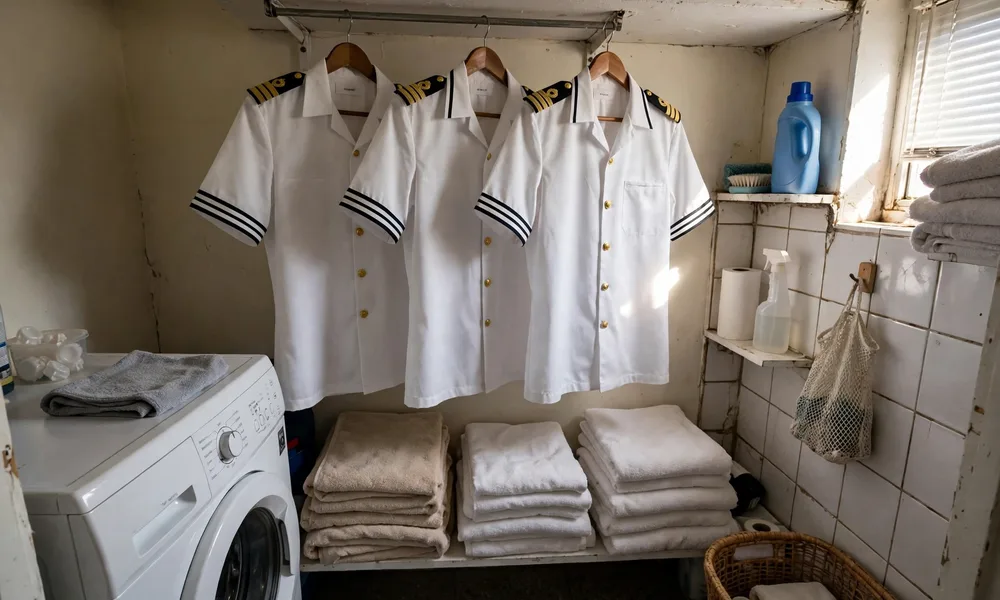
The third cost is the running bill, and water is the biggest part of it. Fresh water at sea is made, not found, and the laundry is one of the biggest users of it on the yacht. A busy laundry may run eight or ten cycles a day, hundreds of litres before anyone has had a shower, and every litre is made by the watermaker, heated by the yacht’s own system, and pumped through insulated pipes.
Power is the quieter half of the same bill. Most of it goes into heating the water and running the dryer, because drying towels at sea means driving the damp out with hot air, and the dryer is the hungriest machine in the room. Add the ventilation that carries the steam outside, the lighting, and the press in the corner, and the little room draws more power than many cabins. The full working cycle, from metered water to vented dryers, is followed in how yacht laundry works, and the meter on the water line is there for a reason: the crew can see exactly what each load costs.
The Labour Nobody Sees, and the Linen That Wears Out
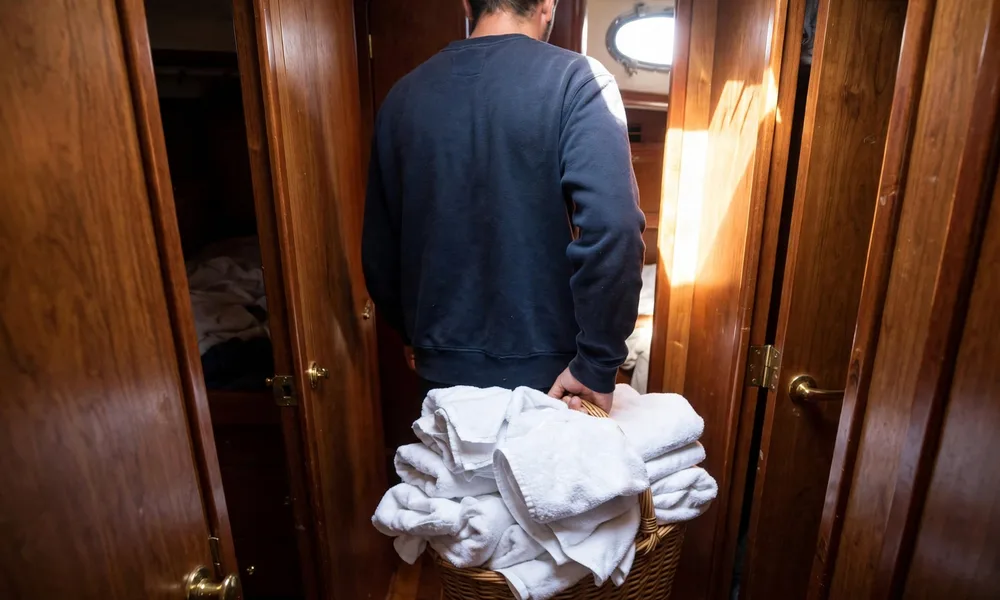
The fourth cost is labour, and it is the one that never stops. A stewardess does not just press a button: she sorts every load by how dirty it is, treats stains by hand, chooses the cycle for delicate fabrics, presses shirts and uniforms, and folds every stack by cabin, so the right linen reaches the right room without a search.
The fifth cost is the linen itself. Sheets, towels, tablecloths and uniforms are washed far more often at sea than ashore, in hotter water and faster cycles, and they wear out fast. White linen shows every mark, so stained pieces are replaced rather than kept, and the yacht carries spares for a week at sea, which means buying the same linen several times over. The rooms the fresh linen is carried to each morning are just as costly to keep, and why a yacht guest cabin is so expensive shows what goes into the cabins where those folded stacks end up.
| Cost driver | Typical share | Why it costs so much |
|---|---|---|
| Marine machines | Largest share | Small production runs, sealed electronics, bolted mounts |
| The fitted room | Large share | Waterproofing, soundproofing, hand-built joinery |
| Water and power | Daily running cost | Watermaker fuel, heating, drying and venting |
| Crew labour | Daily running cost | Sorting, stain work, pressing and folding by hand |
| Linen replacement | Steady ongoing cost | Hot fast cycles wear white linen out quickly |
A Rare Fact About Yacht Laundry Costs
Here is a detail few guests ever learn. Some superyacht laundries wash the owner’s clothes in fresh water made by the yacht itself, because seawater run through the watermaker is often softer and cleaner than the tap water in many ports, so white shirts stay whiter for longer. The crew say the soft water also means less detergent per load, so the shirts stay bright and the machine stays cleaner for longer. The yacht is, in effect, running a small water factory to keep the laundry soft, and the fuel that factory burns is part of the price of every clean shirt.
What the Price Really Buys
Add it up, and a luxury yacht laundry typically costs an estimated 40000 to 150000 dollars to fit out, depending on whether it is a simple two-machine room or a full laundry with a drying cabinet, a press and a separate linen store, and then it costs crew time, water and linen every single day it runs. The machines, the room, the water and the hands are all priced for the sea, not for a house, and none of them can be swapped for a cheaper version without the guests noticing.
That is the real answer to the price. A yacht laundry is not an expensive washing machine: it is a small factory, built into a steel room, staffed around the clock, and judged by a standard no hotel laundry faces, because its customers are sleeping a few metres above it. When the sheets are crisp, the towels are soft and nobody has heard a spin cycle all night, the money has done its job, and the little room low in the hull has earned its place as the hardest-working space on board.