On a dark night, or in fog so thick the bow disappears, a yacht’s crew cannot see what is around them. The radar can. From a small spinning bar above the bridge, it sends out invisible pulses and listens for their echoes, building a picture of the sea no pair of eyes could match.
A luxury yacht radar is a navigation system that finds other vessels, land, buoys and rain by sending out radio pulses and timing the echoes. The scanner turns, the echoes return, and the display paints them as glowing marks around the yacht’s own position. This is how that system works, from the pulse leaving the scanner to the alarm that warns the crew of a ship on a collision course.
How It Works
Step 1: The scanner sends out a pulse
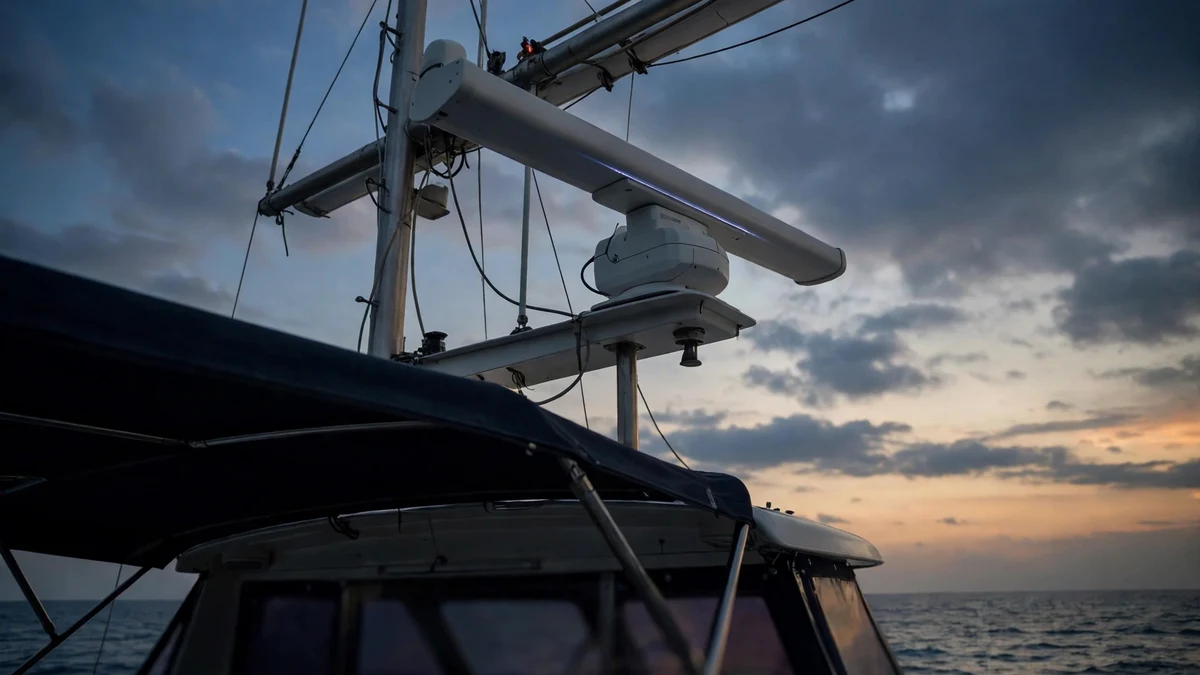
Everything starts at the scanner, the long flat bar that turns on the mast. Inside it, a transmitter makes a short burst of radio waves and sends it out in a narrow beam, like a torch flashing across the water. The beam is only a few degrees wide, so the scanner must turn to cover the whole circle around the yacht, sweeping round about once every two or three seconds. Each pulse travels out at the speed of light, and the transmitter then goes quiet and listens. The scanner sits high on the mast, so it can see further over the curve of the sea.
Step 2: Echoes come back from the sea
When a pulse hits something solid, a little of its energy bounces back towards the yacht. A steel ship returns a strong echo, a wooden buoy a weaker one, and a wave top a scatter of faint ones the system must learn to ignore. The receiver measures how long each echo took to return, and from that time it works out the distance: the longer the wait, the further away the target. The direction tells the bearing, because the scanner knows which way it was pointing when it sent the pulse. The ship radar mast works on the same idea at a larger scale, but a yacht radar is tuned for the short ranges that matter most: other boats, the coast and the harbour entrance.
Step 3: The display paints the picture
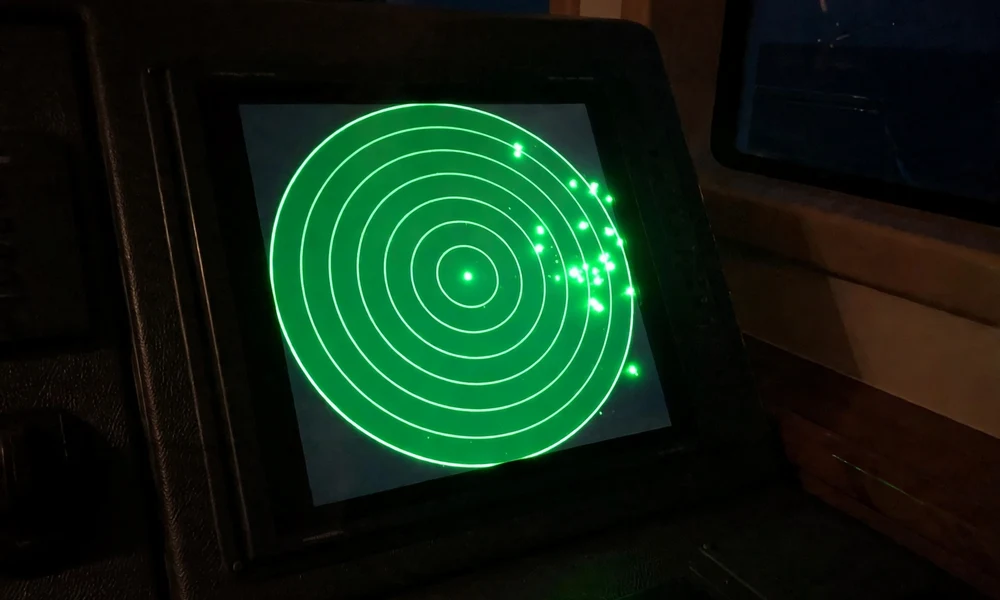
The echoes are turned into a picture on the bridge display. The yacht sits in the middle, and every target appears as a bright mark at its true bearing and distance, ringed by faint lines that show the range. The picture updates with every sweep, so moving targets creep across the screen and the crew can see which way they are going. The display can show the yacht pointing up, with the world turning around it, or north pointing up, with the yacht turning instead. Most crews use the first way at sea and the second in a harbour, where the chart and the radar need to line up. The yacht navigation display often shares its screen with the radar, so the echoes sit on top of the chart.
Step 4: The system tracks other vessels
Modern yacht radars do more than paint marks: they track them. The crew can tap a target, and the system follows it from sweep to sweep, working out its course and speed. If that course will bring the target close to the yacht, the system sounds an alarm and shows how long until the closest approach. This is the part of the radar that saves the most trouble, because it watches while the crew are busy with other jobs. It works best on big, steady targets such as ships, and less well on small, bouncing ones such as fishing boats in a chop.
Step 5: Cutting through rain and waves
Not every echo is useful. Rain shows up as a bright smear that can hide a ship behind it, and rough seas throw back a ring of clutter that can hide a small boat close by. The radar has controls to fight both. A rain control dulls the echoes from showers, and a sea control trims the near-in clutter, each tuned by hand until the real targets stand out. Turn the controls too far and real targets vanish as well, so the crew adjust them little by little. The yacht navigation system ties the radar picture to the chart and the compass, so a target that looks wrong on the radar can be checked against what the chart says should be there.
Step 6: The alarm and the watch at night
At night, or in fog, the radar becomes the crew’s main watchkeeper. The officer on watch sets a guard ring around the yacht, and any target that crosses into it sounds an alarm. The alarm wakes a sleeping crew member if needed, and the officer checks the screen, works out the target’s course and decides whether to alter course. In a busy shipping lane the alarms come often, and the crew learn to read them quickly: a ship passing a mile away is routine, while a target heading straight for the yacht is not. The radar never sleeps and never gets tired, which is why the crew trust it when human eyes are at their worst.
A yacht radar does not steer the boat or make decisions for the crew. It only shows them what is out there, honestly and without pause, in weather where eyes are useless. Used well, it turns a dark sea into a readable picture and a nervous night watch into a calm one. The crew still keep a lookout with their eyes, but on a foggy night it is the little spinning bar on the mast that keeps them safe.
Yacht Radar Specifications
| Feature | Typical Detail |
|---|---|
| Scanner | Rotating bar, 1.2 to 1.8 m long |
| Range | Up to about 24 nautical miles |
| Rotation | About 20 to 30 sweeps a minute |
| Power | 4 to 25 kW pulse output |
| Display | Colour screen, shared with the chart |
| Tracking | Automatic tracking of up to 10 targets |
| Guard ring | Alarm zone set by the crew |
How Much Does a Yacht Radar Cost?
Prices are estimates and vary with the scanner size, the power and the display. A radar for a luxury yacht typically costs an estimated $8,000 to $40,000 fitted, with the biggest scanners and the brightest displays at the top of that range. The scanner and its mast mounting are a large part of the bill, and the display and the tracking software add more. Fitting it well costs extra too, because the scanner must sit high and clear of the rigging, with clean power and a dry cable run to the bridge. It is a serious sum for one instrument, but it is the one the crew reach for first when the fog comes down.
A Rare Fact About Yacht Radars

Here is a detail most people never hear: a yacht radar can see rain, and old hands use that to read the weather. A rain squall shows up as a bright patch moving across the screen, and its shape tells the crew whether it is a light shower or a hard downpour heading their way. Some crews even steer around the brightest patches to stay dry. A clear ring around the yacht on a rainy night means the radar is looking through a gap in the weather, and the crew know the squall has passed. It is a weather forecast drawn by the boat itself, updated every few seconds, and it costs nothing extra.


