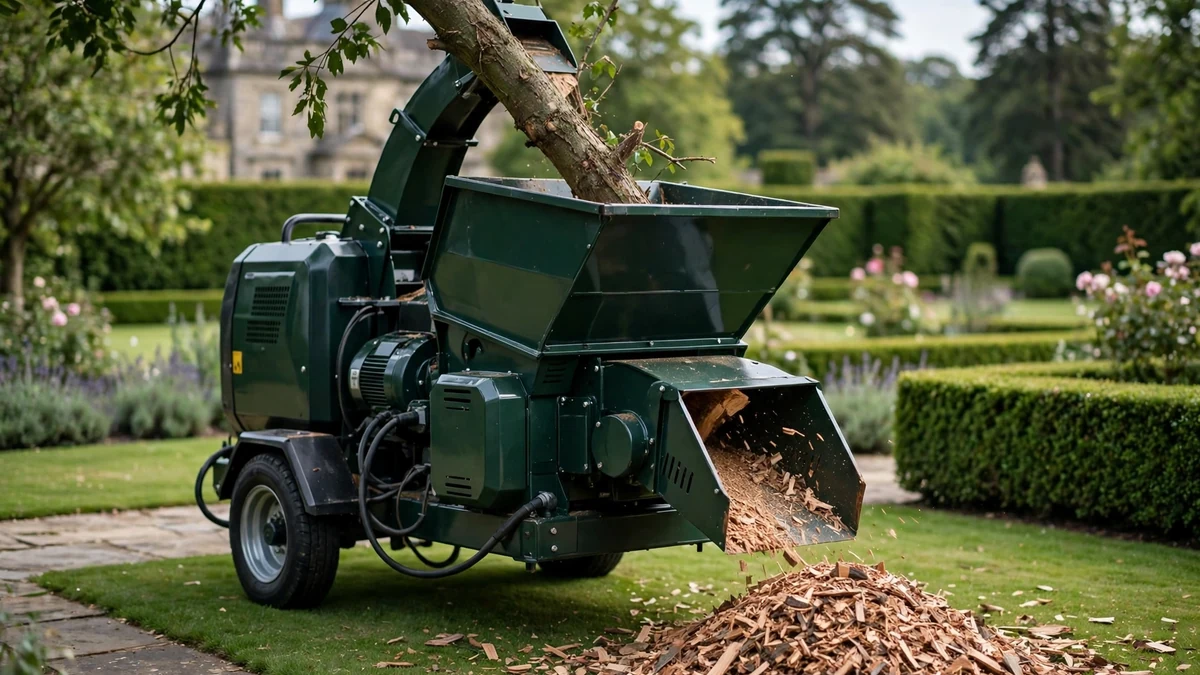
On a large estate, the gardeners arrive after a storm with a trailer full of fallen branches, and by lunchtime the pile has vanished. What is left is a neat heap of mulch, dark and sweet-smelling, ready to be spread under the hedges it came from. The machine that did the work sits quietly on the lawn, a compact steel box with a wide mouth and a chute, and it looks far too small for the job it has just finished. Yet the numbers on its spec sheet explain the trick, and they are worth reading before you buy one for a serious garden.
A luxury electric wood chipper is a machine that turns branches, twigs and garden waste into wood chips, using an electric motor to drive a spinning drum or disc fitted with hardened steel blades. You feed a branch into the hopper, the blades slice it into small pieces, and the chips fly out of the discharge chute into a bag or a pile. Its figures describe the motor, the size of branch it can swallow, the speed of its blades, and the safety systems that protect the person feeding it, and each one changes how the machine behaves in a real garden.
Motor and Power
The motor is the first number on the sheet, and it is usually listed in watts or kilowatts, commonly between 2,000 and 3,000 watts on a luxury electric model. That figure decides how fast the blades spin when they meet a thick branch, and how quickly the motor recovers after each cut. A stronger motor holds its speed under load, so the blades keep slicing instead of slowing and jamming, which is the difference between steady work and constant stops to clear a blockage. The sheet may also list the motor type, and a brushless motor is the premium choice, because it runs cooler, lasts longer and delivers more torque for the same power than a brushed motor. Torque matters more than the headline wattage when the branch is green and heavy, because it is the twisting force that keeps the drum turning through dense wood.
Feed Capacity and Chipping
Feed capacity is the maximum branch diameter the chipper can take, and it is usually listed in millimetres, commonly 40 to 50 millimetres on a luxury electric model. That number is a hard limit, not a suggestion, and forcing a thicker branch into the hopper risks jamming the drum and stalling the motor. The sheet also describes the cutting system, which is usually either a drum with blades or a disc with knives, and a drum system tends to pull branches in more eagerly, while a disc system gives a finer, more even chip. Chip size matters if you plan to use the mulch on beds, and the electric hydrofoil on the same estate faces a similar trade-off between power and finesse, since a stronger machine is not always the gentler one. The feed opening is often wide and funnel-shaped, so awkward, forked branches slide in without catching on the edges, and some models add a self-feeding roller that grips the branch and draws it in at a steady pace, which keeps your hands well away from the blades.
Safety Systems
Safety is where a luxury chipper earns its price, and the sheet lists several systems that a cheap machine simply does not have. The most important is the interlock on the hopper, which stops the motor the moment the feed cover is opened, so no hand can reach the blades while they spin. There is usually a large emergency stop button within easy reach, and a reverse function that backs the drum up to free a jammed branch without opening the machine. The blades sit behind a long feed chute, so the distance between your hands and the cutting drum is greater than an arm can reach, and the sheet may quote that distance. Overload protection is another standard feature, cutting the power if the motor draws too much current, which protects both the motor and the person holding the branch.
Noise, Vibration and Build
Noise is a real consideration in a garden, and the sheet lists it in decibels, usually between 85 and 95 decibels at the operator position on a luxury electric model. That is loud enough to need ear protection, but it is noticeably quieter than a petrol chipper, which can reach well over 100 decibels. The electric motor also produces far less vibration, so a long session leaves your hands less tired, and the machine itself suffers less wear on its bearings and fixings. Build quality shows in the materials, and a luxury chipper uses a thick steel housing, hardened tool-steel blades that can be sharpened or reversed, and a weather-resistant finish that survives being left in a garden shed. The electric surfboard stored in the same shed shares that sealed, weatherproof thinking, and the electric seascooter beside it is built the same way, because machines that live near water and weather need protection that a fair-weather tool never gets. Weight is listed too, usually 25 to 45 kilograms, and large wheels and a handle matter more than the number, since that is how the chipper actually moves around a garden.
Wood Chipper Specifications
| Feature | Typical Detail |
|---|---|
| Motor power | About 2,000 to 3,000 watts, brushless on premium models |
| Maximum branch diameter | Commonly 40 to 50 millimetres |
| Cutting system | Drum or disc with hardened steel blades |
| Noise level | Usually 85 to 95 decibels at the operator |
| Safety features | Hopper interlock, emergency stop, reverse, overload cut-out |
| Weight | About 25 to 45 kilograms |
| Power supply | Standard household supply, some models need a dedicated circuit |
| Collection | Discharge chute into a bag or pile |

How Much Does a Luxury Electric Wood Chipper Cost?
Prices vary with motor power, feed capacity and build quality. A luxury electric wood chipper typically costs an estimated $1,500 to $4,000, with the strongest brushless models, able to take 50-millimetre branches, sitting at the top of that range. A smaller domestic model may cost an estimated $400 to $900, but it will usually jam on thicker branches, cut more slowly and wear out sooner. A spare set of blades typically adds an estimated $60 to $150, and a proper collection bag an estimated $40 to $100. The chipper is a modest purchase beside an estate, but the numbers on its sheet decide whether a storm’s worth of branches becomes useful mulch by lunchtime or a frustrating afternoon of clearing jams.
A Rare Fact About Wood Chippers
Here is a detail most gardeners never notice: the mulch a chipper makes is not just waste disposal, it is a slow-release soil treatment. Fresh wood chips lock up nitrogen as they decay, which can starve young plants if the chips are dug straight into the soil, but spread as a surface mulch they do the opposite, keeping moisture in, weeds down and the soil cool, while the fungi that break them down build the soil beneath. Old estate gardeners knew this long before the science was written down, and they aged their chips for a season before spreading them. A luxury chipper does not change that chemistry, but its even, fine cut means the chips age faster and spread more neatly, so a machine bought for clearing branches quietly becomes a tool for feeding the garden it came from.


