Walk down any marina pontoon and look at the yachts from behind, and you will see the stern doing quiet work. It is the flat back of the boat, the part that carries the name, the swim platform, and the tender, and it is where the wake begins. A good stern is wide and steady, with room for a swim platform, a garage for a small tender, and stairs down to the water. A bad stern drags, throws spray, and makes the whole yacht feel clumsy at anchor.
A luxury yacht stern is the aft section of the hull, built to give the yacht a broad, stable platform at the back while letting water flow cleanly away behind it. It is made in a mould from fibreglass and resin, stiffened with frames and a transom beam, then faired and painted to the same mirror finish as the rest of the hull. The stern has to be strong enough to carry the tender and the weight of people standing on the swim platform, and shaped so the water leaves it without fuss. That balance of strength and shape is the work of the boatyard.

How It’s Made
Step 1: Designing the stern shape
Before any fibreglass is cut, the stern is designed on a computer and tested with a scale model in a towing tank. Naval architects shape the transom, the flat back panel, and the curve of the hull beneath it so the water releases cleanly at speed and the stern does not squat or drag. The swim platform is drawn in at the same time, with its height set so it sits just above the water at rest. The final shape is turned into a full-size plug, a solid model of the stern that is polished until it is smoother than the finished yacht will ever be.
Step 2: Building the mould
From the plug, the yard builds a mould, a hollow negative of the stern, usually in fibreglass itself. The mould is waxed and polished so the finished stern will release cleanly, and it is checked for fairness, because every bump in the mould becomes a bump in the hull. The mould also carries the stern’s hidden details, such as the recesses for the swim platform hinges, the tender garage opening, and the drains that keep the deck dry. A good mould is a major investment, and it is kept clean, dry and covered when it is not in use, so it can serve many sister yachts.
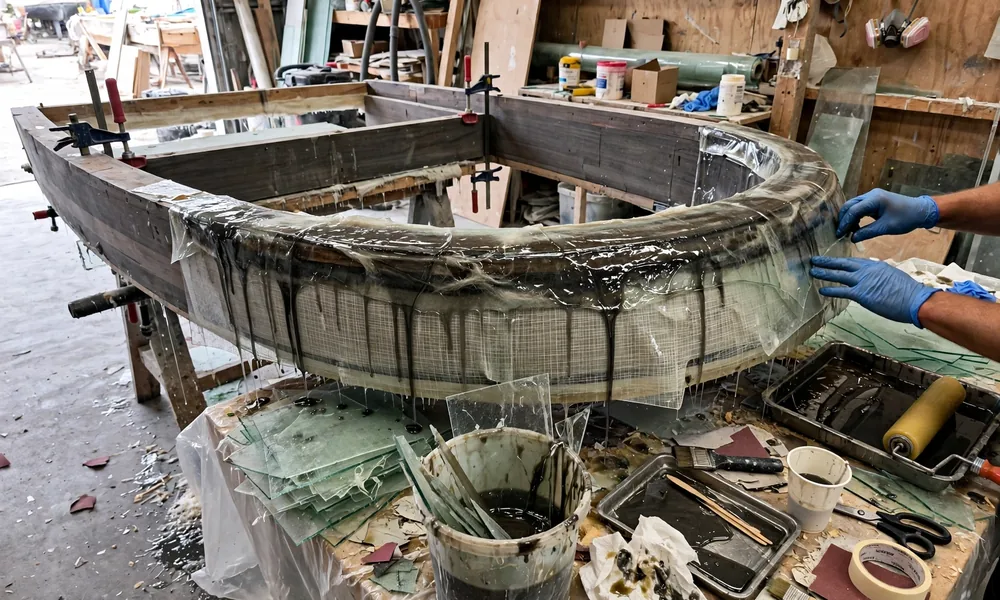
Step 3: Laying the fibreglass and resin
The stern is laid up by hand, layer after layer, with fibreglass cloth and mat wetted with resin and rolled flat to remove air. The first layer is the gelcoat, a coloured resin skin that will become the glossy outside of the yacht, sprayed into the mould before any glass goes in. Behind it go layers of glass and resin, thicker around the transom and the platform mounts, where the loads are greatest. Workers roll each layer carefully, because a trapped bubble becomes a weak spot that can blister years later.
Step 4: Fitting the transom and frames
While the laminate is still in the mould, the yard fits the transom beam, a heavy horizontal member that carries the flat back panel, along with frames and stringers that stiffen the whole stern. The transom itself is often a cored panel, with a lightweight core sandwiched between skins of glass, which makes it stiff without adding much weight. The swim platform supports are bonded in at this stage, and the openings for the tender garage and the lazarette, the storage space under the aft deck, are cut and reinforced.
Step 5: Joining the stern to the hull
The stern is then joined to the rest of the yacht hull, either as part of a single hull moulding or as a separate section bonded and bolted into place. The joint is glassed over from the inside, so the hull and stern become one continuous structure, and it is checked for fairness from the outside, so no step or ridge shows in the paint. The rudder posts and the propeller shaft exits pass through the stern area, and their seals are fitted and tested before the hull is painted.
Step 6: Fairing, painting and fitting out
The last step is the finish. The stern is faired with filler, sanded smooth, primed and painted in a dust-free booth, usually in white or a deep custom colour, with several coats and a clear topcoat. The swim platform is fitted with its teak or synthetic decking, the stairs and handrails go on, and the tender garage door is hung and tested. When the stern shines like glass and the platform sits level, the yacht is ready for the water, and the yard knows that the back of the boat is the part every guest will see first when they step aboard.

The stern also decides how the yacht behaves at anchor. A wide stern with a big swim platform gives the yacht a steady, level feel when guests are moving about, and it makes boarding from a tender easy, even in a small chop. The crew like it too, because the lazarette under the aft deck holds fenders, lines and dive gear close to where they are used. A narrow stern, by contrast, rolls more and offers nowhere to stand, which is why modern luxury yachts have grown wider at the back with every generation.
Yacht Stern Specifications
| Feature | Typical Detail |
|---|---|
| Material | Fibreglass and epoxy or vinylester resin |
| Transom | Cored panel, stiffened with a transom beam |
| Shell thickness | 10 to 25 millimetres, thicker at the transom |
| Structure | Frames, stringers and swim platform supports |
| Features | Swim platform, tender garage, lazarette, stairs |
| Finish | Hand polished, mirror gloss |
How Much Does a Yacht Stern Cost?
Prices are estimates and vary with yacht size, material and yard. The stern is not sold on its own, so its cost is usually counted as part of the hull, which for a large luxury yacht can run an estimated $500,000 to $2,000,000 or more. A swim platform refit, with new teak decking and a hydraulic lift, typically costs an estimated $20,000 to $80,000. A repair to a damaged transom, with new laminate and repainting, typically costs an estimated $15,000 to $60,000, depending on how much of the structure has to be replaced. It is expensive work, but the stern is where guests board, swim and relax, and a cheap stern is a false saving that shows up every time the yacht is at anchor.
A Rare Fact About Yacht Sterns
Here is a detail most owners never notice: the flat transom stern that every modern yacht wears was once thought to be slow. For centuries, boats had pointed sterns, because sailors believed a sharp back cut the water better. Then designers found that a wide, flat transom lets the water release cleanly at speed, and gives the yacht a broad, stable platform at rest. The yacht keel below and the ship stern of a larger vessel work on the same idea at a different scale, but the yacht stern is tuned for living space as much as speed. Get the transom right, and the yacht runs fast, sits level at anchor, and gives its guests a proper back porch on the sea.


