The broker slid the spec sheet across the table, and the pool was reduced to a row of numbers. Length in metres, depth in centimetres, a volume in litres, and a filtration rate that belonged on a hotel pool, not a moving boat.
A luxury yacht pool is a small swimming pool built into the deck of a large yacht, filled with fresh water and kept clean by pumps and filters below. Every number means something extra at sea, because the water weighs tonnes, the deck moves, and the space around it is precious. This is a plain translation of the figures that matter, and the ones that are mostly decoration.
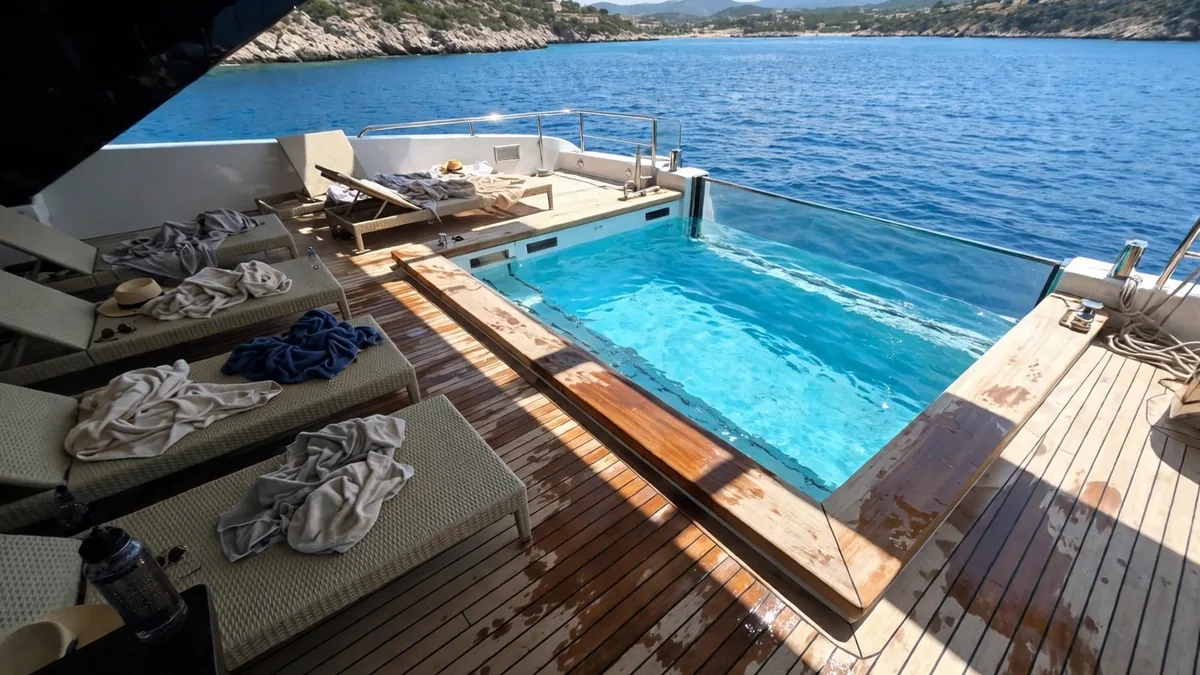
1. Length and width, and why a pool is measured in water, not deck
The first numbers on the sheet are length and width, and on a luxury yacht they usually fall between 3 and 7 metres long and 2 and 3 metres wide. The useful figure is the swimming length, the clear water between the steps at one end and the wall at the other.
Width matters for a different reason. A pool wider than 3 metres starts to steal deck space from the loungers and the walkway around it, and on most yachts the deck is already spoken for. The width to look for is the clear width at the waterline, not the width of the surround, because the stone or teak border can add 40 centimetres on each side without adding a single stroke of swimming. How the shell itself is put together is described in how a luxury yacht pool is made.
2. Depth, and the shallow secret of a pool at sea
Depth is the number that surprises most buyers, because a yacht pool is far shallower than a pool on land. The water is usually between 1 and 1.4 metres deep, and many pools are only 1.1 metres at their deepest point. That is deep enough to float and cool off, but never deep enough to dive into.
The reason is weight and stability. Every extra 10 centimetres of depth across a 5 by 2.5 metre pool adds about 1,250 litres of water, which is 1,250 kilograms sitting high on the yacht, above the waterline, where it makes the boat roll more in a swell. A shallow pool keeps the centre of gravity low, and empties faster before a rough passage. If a sheet quotes a depth of 1.5 metres or more, ask where that depth is measured, because it is often the depth of the shell, not the depth of the water.
3. Volume and weight, and what the yacht really carries
Volume is measured in litres, and a typical yacht pool holds between 8,000 and 20,000 litres of water. A litre of fresh water weighs a kilogram, so a 12,000 litre pool is 12 tonnes of water, before the steel shell, the glass edge and the people in it. That is roughly two large cars carried on the deck, and the main reason a pool changes how a yacht is designed.
The figure to check next to volume is the fill time, because a pool that holds 15,000 litres takes hours to fill from the yacht’s fresh water makers, which usually produce a few thousand litres per hour while also supplying showers, galleys and laundry. The figures for the deck beside the pool are explained in luxury yacht beach club specs explained.

4. Filtration rate and turnover, and how clean the water stays
Filtration is measured by turnover, which is how long it takes the pumps to pass the whole volume of the pool through the filters once. On a luxury yacht the turnover is usually between 2 and 4 hours, so a 12,000 litre pool needs pumps moving 3,000 to 6,000 litres per hour. Faster turnover means clearer water after sunscreen and sand, but also bigger pumps, more noise and more power drawn from the generators.
The number to look for next to turnover is the filter type. Sand filters are common, cartridge filters catch finer dirt, and some yachts add ultraviolet light that kills bacteria without extra chemicals. A pool with automatic dosing stays clear with far less crew attention than one dosed by hand. A sheet that quotes only the pump power, without a turnover time, is hiding the figure that matters.
5. Heating and temperature, and the energy behind warm water
Heating is measured in kilowatts, and a yacht pool heater usually runs between 9 and 24 kilowatts, warming the water to 26 to 30 degrees Celsius. That sounds modest until you remember the pool sits in open air, on a moving deck, losing heat to wind and to the cool steel of the shell, so holding temperature overnight can take as much energy as heating it in the first place. A cover that slides away under the deck cuts that loss sharply.
The temperature figure to check is the one measured at dawn, not at noon, because a pool warmed by the afternoon sun will read warm on any sheet. Ask how long the heater takes to raise the water by 5 degrees from cold, and whether it runs only in port. The deck at the waterline has its own numbers in luxury yacht swim platform specs explained.
6. The numbers at a glance, the price, and the rare fact
| Figure | Typical range | What it means |
|---|---|---|
| Length | 3 to 7 metres | Swimming length is shorter than the sheet |
| Width | 2 to 3 metres | Clear width at the waterline |
| Depth | 1 to 1.4 metres | Shallow by design, for stability |
| Volume | 8,000 to 20,000 litres | One litre weighs one kilogram |
| Turnover | 2 to 4 hours | Full volume through the filters |
| Heating | 9 to 24 kilowatts | Holds 26 to 30 degrees Celsius |
A yacht pool is not a line item a buyer picks from a catalogue, so there is no fixed price for one, but as a typical and indicative range, adding a pool to a new build usually adds roughly 250,000 to 1,000,000 dollars to the build cost, depending on size, glass work and machinery, before running costs for water, heat and maintenance. A retrofit costs more, since cutting a pool into a finished deck means rebuilding structure never drawn to hold it.
The rare fact is that a yacht pool is often emptied before a long passage, not because the water is precious, but because a full pool sloshing in a swell can push tonnes of water from side to side in rhythm with the waves, and that moving weight can make the yacht roll harder instead of steadier. The crew drain it, cover it, and fill it again at anchor, which is why the fastest fill time on the sheet is worth more than the prettiest glass edge. Read the depth, the volume and the turnover before the length, and the pool will tell you the truth about itself.


