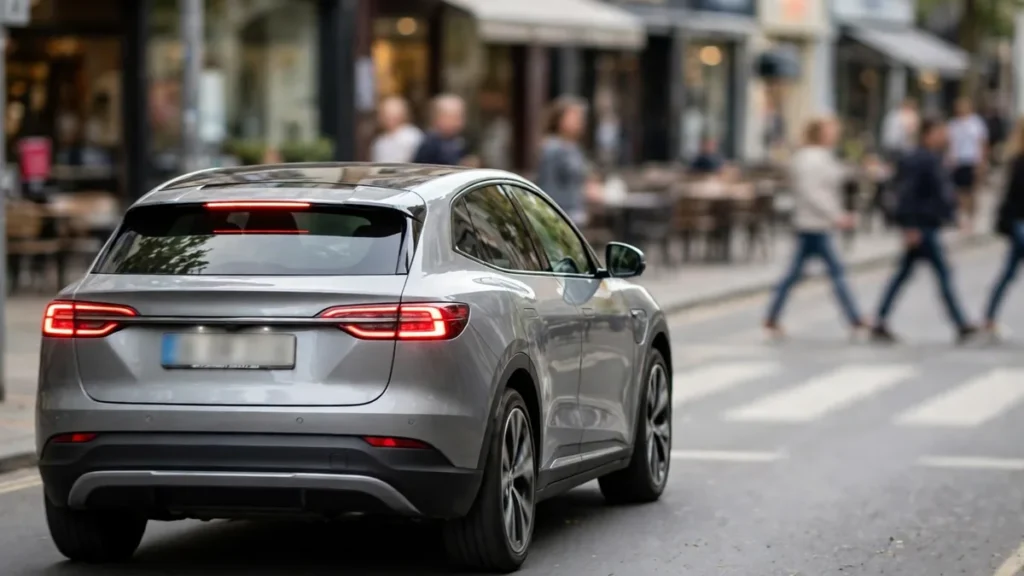
The electric car is rolling down a long hill, and the driver has not touched the brake pedal. Yet the car is slowing, gently and smoothly, and something strange is happening on the dashboard: the range number is going up. The car is gaining energy while it slows down, recovering motion that an ordinary car would throw away as heat.
That trick is regenerative braking, and it is one of the cleverest ideas in the electric car. Instead of pressing brake pads against a disc and turning speed into wasted heat, the car runs its electric motor backwards, turning it into a generator. The wheels drive the motor, the motor makes electricity, and the electricity flows back into the battery. Slowing down becomes charging.
The idea is old, but only modern electronics made it smooth and powerful enough for everyday driving. Today it recovers a large share of the energy used in city driving, extends range, and lets drivers slow the car with a single pedal. Here is how it works.

How It Works
Step 1: The driver lifts off
It starts with the driver’s foot. When the driver lifts off the accelerator or presses the brake pedal, the car’s controller reads the request and decides how much slowing is needed. In many electric cars, simply lifting off is enough: the car begins to slow at once, as if it were coasting uphill. The brake pedal, when it is used, asks for stronger slowing, and the controller splits the work between regeneration and the ordinary friction brakes.
Step 2: The motor becomes a generator
The heart of the trick is the electric motor, which is the same machine whether it is driving or generating. When power flows into it, it turns and drives the wheels. When the wheels turn it instead, it generates electricity. The controller reverses the flow, and the motor begins to resist the turning of the wheels, which is what slows the car. The stronger the resistance, the harder the braking and the more electricity is made. It is the same principle as a bicycle dynamo, scaled up to move a two-tonne car, and it works because an electric motor and a generator are the same machine running in opposite directions.
Step 3: The inverter changes the current
The electricity the motor generates is alternating current, but the battery stores direct current, so it must be converted on the way. That job belongs to the inverter, a power electronics unit that switches thousands of times a second to shape the current precisely. It controls how much power flows back to the battery, keeping the voltage and current within safe limits, and it does the reverse job when the car accelerates. The way the battery itself is built to accept that charge is laid out in how ev battery pack works.
Step 4: The battery takes the charge
The converted electricity flows into the battery pack, where it is stored as chemical energy for later use. In city driving, with its constant stopping and starting, this recovered energy can add up to a large share of the power the car uses, and it is the reason electric cars are so efficient in traffic. The battery management system watches the charge closely, because a cold battery or a nearly full battery cannot accept power as quickly.

Step 5: Blending with the friction brakes
Regeneration alone cannot stop a car in an emergency, so it works alongside ordinary disc brakes. The controller blends the two seamlessly: gentle slowing is handled by the motor, harder braking adds the discs, and a panic stop uses the discs alone. This blending is one of the hardest parts of the system to get right, because the driver must never feel the car hesitate or surge as the balance shifts. The full factory story, from motor winding to final testing, is told in how regenerative braking system is made.
Step 6: One pedal, and the limits
In many electric cars the system goes one step further, with one-pedal driving: lift off fully and the car slows all the way to a stop without the driver touching the brake at all. It takes a day to learn and then feels natural, especially in traffic. But regeneration has limits. It cannot recover energy when the battery is full, when the battery is very cold, or when the car is already crawling. It also fades at very low speeds, so the friction brakes always make the final stop. Knowing those limits is part of driving an electric car well, and it is why the brake pedal is still there, ready for the moment regeneration cannot do the job alone.
| Core principle | The drive motor runs in reverse as a generator when the car slows |
| Energy recovered | Often 60 to 70 percent of the braking energy in city driving |
| Range gain | Typically 10 to 20 percent more range in stop-start traffic |
| Key parts | Electric motor, inverter, battery pack, and brake blending controller |
| Peak regen power | From around 50 kilowatts in small EVs to over 200 in performance models |
| Friction brakes | Still fitted for hard stops, emergencies, and the final stop |
| Main limits | Full battery, cold battery, and very low speeds reduce regeneration |
| Driver control | Adjustable levels, including one-pedal driving on many models |
What Does a Regenerative Braking System Cost?
Regenerative braking is estimated to add roughly $1,000 to $3,000 to the cost of an electric car’s drivetrain, mostly in the inverter, the motor controls, and the software that blends it with the friction brakes. It is not sold as a separate part, because it is built into the motor and electronics the car already needs. The running savings are real: brake pads on an electric car are estimated to last two to three times longer than on a petrol car, because the discs do so much less work. Over the life of the car, the energy recovered and the brakes saved are estimated to be worth far more than the system cost.
A Rare Fact
Regenerative braking is far older than the modern electric car. Electric vehicles in the 1890s experimented with using their motors to slow down and recharge their batteries, and electric trains and trams have recovered braking energy for more than a century. The idea then faded, because petrol cars had no battery worth charging and no motor to run backwards. It returned with the hybrid car in the late 1990s, and only then did electronics become fast and cheap enough to make it smooth. A driver coasting down a mountain pass today can watch the range climb by several miles, using an idea that is older than the petrol car itself.
Regenerative braking turns the most wasteful moment in driving into a useful one. Every red light, every downhill stretch, every slow queue of traffic becomes a small charging session, and the car arrives with more energy than it would have had otherwise. It is a quiet piece of engineering, invisible to the driver, and it is one of the main reasons an electric car can be so efficient where a petrol car is at its worst. The production line that builds these systems is described in inside regenerative braking system production.