Stand beside an electric car with its floor removed and you are looking at a skateboard, a flat slab of steel and aluminium that carries the whole car on its back. Inside that slab, sealed against water, dust and crashes, sits the battery pack, the single most expensive and most important part of the car. It holds the energy for every kilometre, it sets the car’s weight and balance, and it is the reason an electric car feels the way it does: low, quiet, and heavy in exactly the right place.

How an EV Battery Pack Works
A battery pack is a battery of batteries. Thousands of individual cells, each one a small chemical store about the size of a finger or a can, are grouped into modules, and the modules are wired together into a pack that delivers several hundred volts. Between the cells sit cooling channels, sensors, fuses and a computer, all packed into a crash-proof case that also forms part of the car’s structure. The pack does not just store energy; it manages it, protects it, and hands it out on demand.
Step 1: Cells store the energy chemically
Each cell is a lithium-ion cell, and it works by moving lithium ions between two electrodes. When the car charges, ions travel from the cathode to the anode and wait there, stored in layers of graphite. When the car drives, the ions flow back, and the electrons forced to take the long way around the outside circuit become the current that turns the motor. A single cell holds only about four volts, so the pack’s power comes from putting many of them together. The cells inside an EV battery are where the chemistry happens, and every improvement in range starts with a better cell.
Step 2: Modules group the cells together
Cells are welded or clamped into modules, rigid frames that hold dozens of them in a fixed pattern, with their own wiring and temperature sensors. The module is the unit a factory can test, swap and repair, and it is also the unit that contains a failure: if one cell overheats, the module’s design slows the heat spreading to its neighbours. Most packs have between four and sixteen modules, depending on the car’s size and range.
Step 3: The pack wiring sets the voltage
Modules are wired in series to raise the voltage and in parallel to raise the capacity. A typical pack runs at 400 volts, and newer designs run at 800 volts, which halves the current for the same power and lets the car charge faster with thinner, lighter cables. The main contactors, heavy-duty switches the size of a fist, connect the pack to the motor only when the car is ready to drive, and snap open in a crash or a fault. A manual service disconnect lets a technician break the high-voltage circuit by hand before working on the car.
Step 4: The cooling system keeps the cells calm
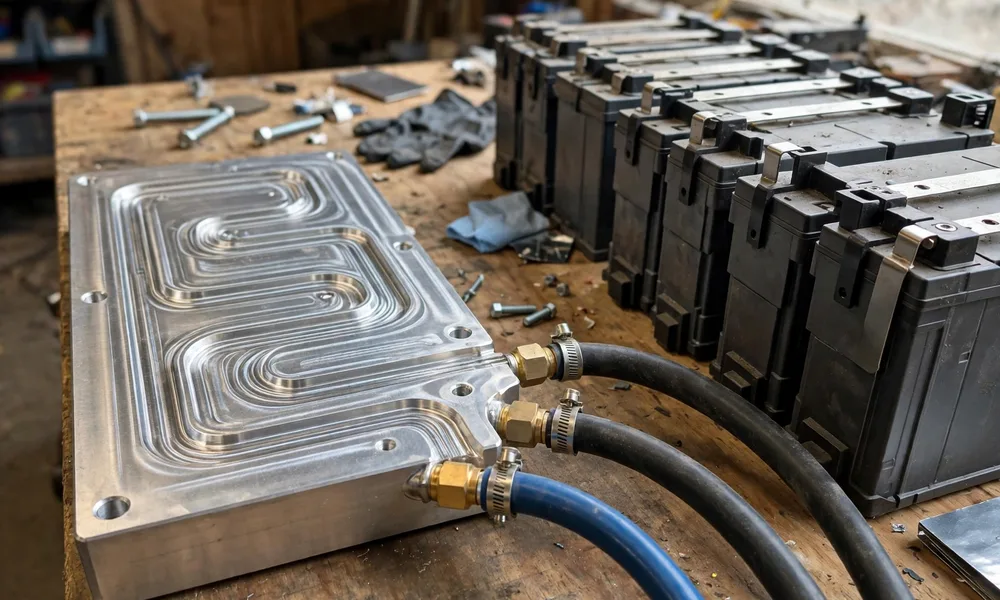
Batteries hate heat and cold in equal measure. Too hot and they age fast or, in the worst case, catch fire; too cold and they cannot deliver their power. So coolant, usually a water-glycol mix, flows through plates or channels between the modules, carrying heat away on a fast charge and warming the pack on a freezing morning. The cooling system of an EV battery pack is a whole second machine inside the first, with its own pump, radiator and valves, and it is one of the main reasons a modern pack can fast-charge again and again without damage.

Step 5: The battery management system watches every cell
The battery management system, or BMS, is a computer that watches the voltage and temperature of every group of cells, hundreds of readings a second. It balances the cells, bleeding a little charge from the strongest so they all age together, and it decides how much power the car may draw and how fast it may charge. If it sees a cell drifting out of line, it warns the driver and limits the power.
Step 6: Charging turns the motor into a generator in reverse
Charging reverses the flow: current from the wall or a fast charger pushes lithium ions back to the anode, storing the energy again. On a direct-current fast charger, power goes straight into the pack at up to 350 kilowatts, filling most of the battery in twenty to thirty minutes. The pack’s computer negotiates with the charger the whole time, asking for more current when the cells are cool and empty, and less as they fill and warm.
Step 7: The case protects everything at once
The case is the unsung hero. A steel or aluminium tray with a sealed lid, it keeps out water to a depth that would drown the rest of the car, shields the cells from stones and crashes, and carries the car’s structural loads, stiffening the whole body. In a crash it is designed to deform in a controlled way, absorbing energy before it reaches the cells, and vents release gas if a cell ever fails. The assembly of an EV battery pack ends with this sealing, a leak test, and a full electrical check before the pack ever meets a car.
| Specification | Typical value |
|---|---|
| Pack capacity | 60 to 100 kilowatt-hours in a family car |
| Pack voltage | 400 volts, or 800 volts on newer cars |
| Cell count | Several thousand small cells, or a few hundred large ones |
| Pack weight | 400 to 600 kilograms |
| Energy density | About 150 to 270 watt-hours per kilogram at cell level |
| Fast-charge power | Up to 250 to 350 kilowatts |
| Operating temperature | Roughly minus 20 to 45 degrees Celsius |
Price is the pack’s most famous number. Estimates from industry analysts put a complete pack at roughly 100 to 140 US dollars per kilowatt-hour at the time of writing, so a 75 kilowatt-hour pack costs a carmaker about 7,500 to 10,500 dollars, and a replacement pack fitted outside warranty can cost a driver 10,000 to 20,000 dollars depending on the model. Those are estimates, not list prices, and the figure has fallen by roughly ninety percent over the last decade. The pack is still the most expensive part of an electric car, usually a third of its cost.
A rare fact: an EV battery pack can outlast the car around it. Taxi fleets have run packs past 300,000 kilometres with most of their capacity intact, and when a pack is finally too weak for driving, its cells are often still good enough for a second life, storing solar power in a home or a grid battery for another decade. The pack that once carried a family across a country can end its life quietly holding the sun’s energy in a garage,
The battery pack works because it is more than a box of cells. It is a managed system, cooled, watched, balanced and armoured, that turns chemistry into motion and back again thousands of times without complaint. When it works well, the driver never thinks about it at all, which is the highest praise any piece of engineering can get. The pack’s quiet competence is the whole reason the electric car stopped being a curiosity and became the car most people will drive next.


