Hold your phone up to your eye and look at the camera bump. Inside that small square of glass sits a lens stack thinner than a coin, lighter than a paperclip, and more precisely made than the optics in many professional cameras. It bends light from the world onto a sensor the size of a fingernail, and it does it sharply enough to print a photograph on a wall. It is this tiny lens, made to tolerances measured in fractions of a wavelength of light.
Most smartphone lenses are not made of glass at all. They are made of plastic, moulded one at a time in machines that work in the dark, cooled for exactly the right number of seconds, and checked by lasers before a human ever touches them. The process is fast, quiet, and almost entirely automated, and it has to be: a single flagship phone needs three or four of these lens stacks, and factories make them by the hundreds of millions. Here is how a smartphone camera lens is made, step by step.
What makes it hard is the size. A lens element in a phone camera can be less than five millimetres across, with a curved surface that must be accurate to within a few hundred nanometres. A speck of dust is a boulder. The whole build happens in rooms cleaner than an operating theatre, and the people who work there wear suits that cover every inch of skin.
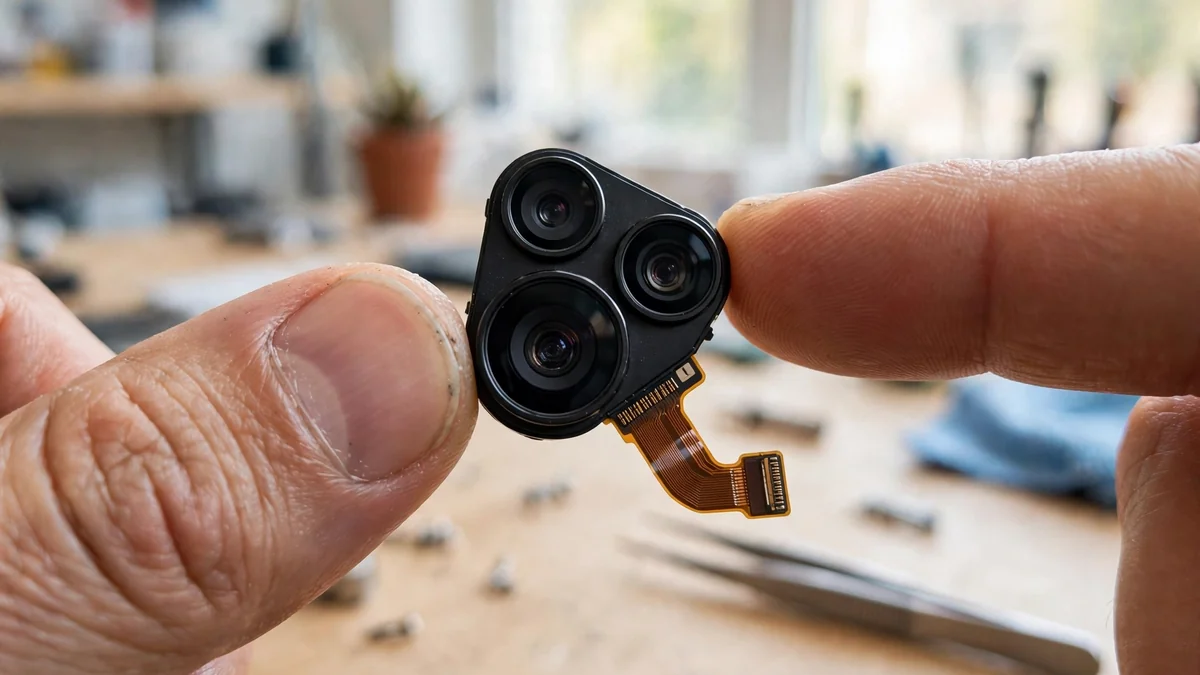
How It’s Made
Step 1: Moulding the plastic elements
The journey starts as a pellet of optical plastic, usually a clear resin chosen for how it bends light and how little it changes shape with temperature. The pellets are melted and injected into a steel mould polished to a mirror finish, where the lens shape is formed in a fraction of a second. The mould is then cooled in a controlled curve, because cooling too fast warps the lens and cooling too slow wastes time.
Step 2: Coating the glass
Both kinds get coated. In a vacuum chamber, the elements are coated with layers of material only a few atoms thick, built up one layer at a time. These anti-reflective coatings stop light bouncing off the surface of the lens, which is what causes ghosting and flare in photographs. The coatings are so thin that they are measured by the colour they reflect: a good lens element shows a faint blue or green sheen when you tilt it, which is the coating doing its job.
Step 3: Stacking the elements
No single lens element can make a good photograph. A phone camera lens is a stack of five, six, or seven elements, each correcting the flaws of the ones before it: one fixes the curvature, another the colour fringing, another the distortion at the edges. The elements are stacked into a tiny black barrel, separated by thin spacer rings, in an order that is never allowed to vary. A robotic arm places each element with a precision of a few microns, and a camera checks the alignment after every placement. Fitting this much optics into this little space is the same kind of packaging puzzle as fitting a smartphone titanium frame around everything else in the phone.
Step 4: Adding focus and stabilisation
A fixed lens can only focus at one distance, so the stack is mounted on a tiny motor that slides it back and forth to focus, the same voice-coil principle used in a loudspeaker. Many phones also add optical image stabilisation, which floats the whole lens on tiny springs and shifts it in real time to cancel the shake of your hand. These mechanisms are assembled under a microscope: the springs are thinner than a human hair, the magnets are the size of a grain of sand, and the coils are wound from wire you can barely see.

Step 5: Marrying the lens to the sensor
The finished lens stack is bonded to the image sensor, the silicon chip that turns light into a digital picture. This is the most delicate marriage in the phone: the distance between the last lens element and the sensor must be accurate to within a few microns, or the whole image is soft. The two parts are glued together with an adhesive that cures under ultraviolet light, and the alignment is checked by taking a test photograph of a chart and measuring its sharpness. The sensor itself is a marvel of its own, a grid of tens of millions of light-sensitive pixels, and the guide to cinema camera sensor materials explains how such chips are built.
Step 6: Testing every single module
Every finished module is tested, not one in a hundred. It is mounted on a rig and pointed at test charts: grids, colour patches, and a light box that simulates everything from a candlelit room to bright sunlight. The rig measures sharpness at the centre and the corners, checks for dust inside the barrel, and hunts for dead pixels on the sensor. Modules that fail any test are rejected on the spot. The lenses in a virtual reality headset face a similar test-or-scrap regime, as described in how VR headset lenses work.
Smartphone Camera Lens Specs
| Specification | Typical range |
|---|---|
| Elements in the stack | 5 to 7, some flagships use 8 |
| Element diameter | About 4 to 7 millimetres |
| Element material | Optical plastic, glass for the outer element |
| Barrel height | About 4 to 6 millimetres |
| Aperture | Around f/1.5 to f/2.4 |
| Focus travel | A fraction of a millimetre |
| Surface accuracy | Within a few hundred nanometres |
| Coating layers | Several, each a few atoms thick |
What Does a Smartphone Camera Lens Cost?
The glass and plastic in a single lens element cost only a few cents, and even a finished multi-element lens stack in a flagship phone is estimated at only a few dollars per unit in volume production. The real cost is in the tooling: the polished steel moulds, the coating chambers, and the test rigs. A replacement camera module bought as a spare part is estimated at roughly $20 to $60, depending on the phone, which is mostly the cost of the sensor rather than the lens. The lens itself is one of the cheapest parts of a flagship phone, and one of the hardest to make.
A Rare Fact
The first camera phone, sold in Japan in 2000, had a camera of 0.11 megapixels, and its lens was a single fixed piece of plastic with no focus and no stabilisation. It took photographs 352 pixels wide, barely enough to fill a postage stamp. Today’s flagship phones carry lenses with seven elements, coatings a few atoms thick, and motors that shift the lens hundreds of times a second to cancel handshake.

The next time your phone takes a sharp photograph in a dim restaurant, remember what is inside that little bump: seven pieces of plastic and glass, each curved to within a few hundred nanometres, stacked in a barrel the height of a matchstick, and tested one by one before it ever met your phone.