Pick up a flagship phone and run your thumb along its edge. That cool, faintly grained band of metal is not decoration. It is the skeleton of the phone, the part that takes the drop, holds the glass, and keeps everything inside in exactly the right place. For years that band was aluminium or stainless steel. Then the best phones switched to titanium, a metal that once belonged to jet engines and spacecraft, and the frame in your pocket became one of the hardest small objects in the world to manufacture.
Titanium is famously stubborn. It is strong for its weight, it does not rust, and it shrugs off scratches that would scar softer metals. It is also terrible at shedding heat, it eats cutting tools for breakfast, and it demands patience at every stage. A titanium phone frame is not stamped out like a bottle cap. It is carved, slowly and precisely, out of solid metal, and every one of the millions made has to be identical to within a hair’s breadth. This is how that happens.

How It’s Made
Step 1: Choosing the alloy
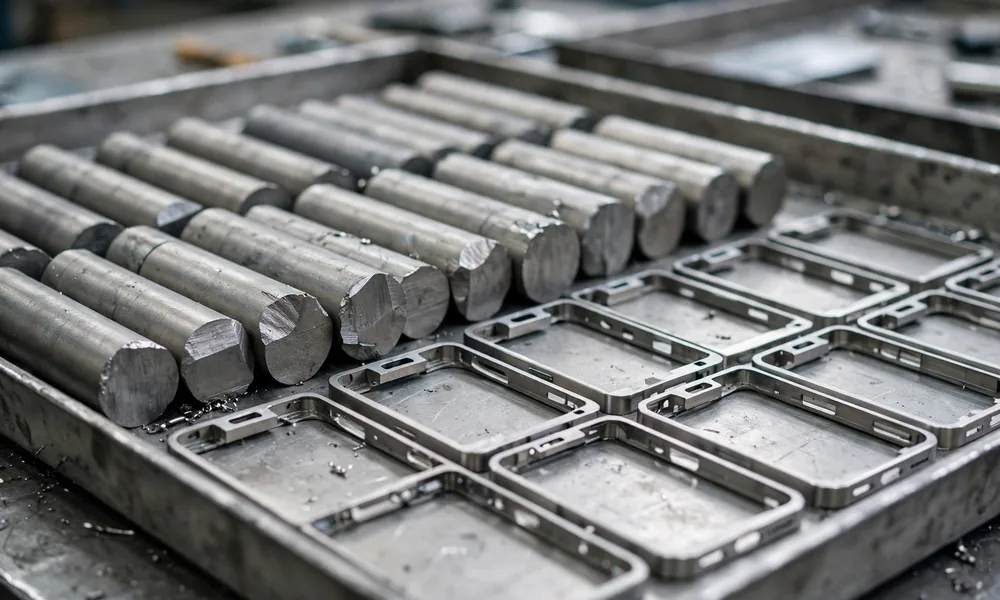
Almost every titanium phone frame starts with the same recipe: Grade 5 titanium, also known as Ti-6Al-4V, an alloy of titanium with about six percent aluminium and four percent vanadium. Pure titanium is too soft for the job; the alloy is roughly twice as strong while staying light. The metal arrives at the factory as solid billets and bars, each one checked for composition before anything is cut. A frame that fails here fails everywhere, so the material is tested before a single machine spins up. Getting titanium to behave under a cutter is a discipline of its own, and the people who do it face the same problems described in our guide to titanium machining challenges.
Step 2: Forging and cutting the blank
The billet is first forged or sawn into a rough rectangular blank, a little larger than the finished frame. Forging squeezes the metal’s grain structure into alignment, which makes the final part tougher. The blank is then squared up on a mill so that every face is flat and true. What leaves this stage looks nothing like a phone: a plain grey slab with sharp edges, several times heavier than the delicate band it will become. Most of that weight is about to become metal chips.
Step 3: CNC milling the frame
Now the real work begins. The blank is clamped into a five-axis CNC milling machine, a machine that can tilt and rotate the part while cutters spin at tens of thousands of revolutions per minute. Over several hours, the cutters carve away the middle of the slab to form the hollow band, shape the outer profile, and cut the recesses where the screen, battery, and circuit boards will sit. Titanium holds heat at the cutting edge instead of carrying it away in the chips, so coolant floods the cut and the tools are changed often. This is the slowest, most expensive step in the whole process, and it is the reason a titanium frame costs far more to make than an aluminium one.
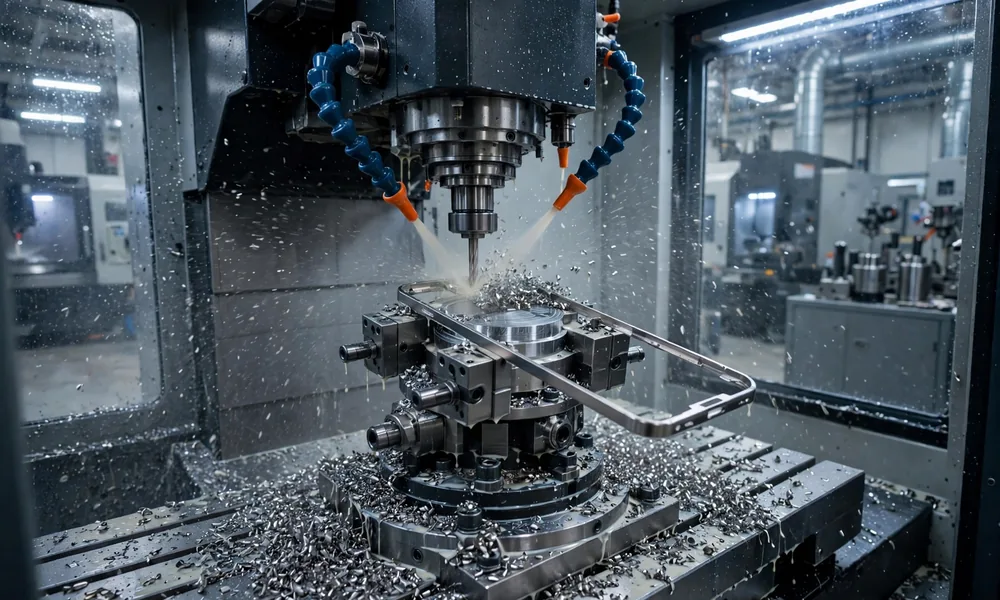
Step 4: Drilling the details
With the band roughed out, smaller machines take over. Holes are drilled for the buttons, the charging port, the speaker grilles, and the SIM tray. The camera plateau, the raised island that holds the lenses, is shaped and blended into the frame. Then come the antenna breaks: thin slots filled with a plastic-like resin that split the metal band into separate antenna segments. Get one of these wrong and the phone’s signal suffers, so each slot is cut and filled to a tolerance measured in hundredths of a millimetre. It is the same obsession with tiny tolerances that makes the phone’s imaging hardware possible, as our look at stacked camera sensors shows.
Step 5: Brushing, blasting, and colouring
A raw machined frame is bright and streaked with tool marks, so the surface is finished by hand and machine. Many frames are bead-blasted with fine particles to give them a soft matte texture, then brushed in one direction to create the fine grain you can feel with a fingertip. Colour comes last, usually from an anodising bath or a physical vapour deposition coating that lays down a microscopically thin layer of colour without hiding the metal underneath. Natural titanium, blue titanium, white titanium: the difference is a coating a fraction of a hair thick.
Step 6: Inspection and assembly
Every finished frame is measured, scanned, and weighed. Laser scanners check the profile against the design file; probes test the button holes and port openings; a human inspector turns the band over in the light looking for scratches. Frames that pass are bonded to the phone’s internal chassis, fitted with glass on both faces, and sent on to final assembly. A frame that fails at this point is scrapped, because there is no way to re-machine a finished band back to size. Keeping a phone this powerful cool inside such a tight metal shell is its own engineering problem, and it is why phone makers work so hard on cooling for sustained performance.
Specs
| Specification | Detail |
|---|---|
| Material | Grade 5 titanium alloy (Ti-6Al-4V) |
| Density | 4.43 g/cm³, about 40% lighter than steel |
| Tensile strength | Approximately 900 MPa |
| Melting point | 1,668°C |
| Corrosion resistance | Excellent; forms a protective oxide layer |
| Machining | Five-axis CNC milling from a solid blank, several hours per frame |
| Tolerances | Measured in hundredths of a millimetre |
| Finish | Bead-blasted and brushed, anodised or coated for colour |
Price
A titanium frame is one of the most expensive single parts in a flagship phone to manufacture, which is why it appears only on the most expensive models. Flagship phones with titanium frames typically retail from around $999 (estimate, based on typical launch pricing of titanium-frame flagship phones). The frame itself is a small share of that price, but its machining time, tool wear, and scrap rate push its cost far above an aluminium band, and that cost is part of what you pay for.
Rare Fact
Titanium is named after the Titans of Greek mythology, but its most remarkable trait is invisible: it is a terrible conductor of heat. During milling, almost all the heat of the cut stays at the cutting tool instead of flowing away into the metal or the chips. That is why titanium frames take so long to machine, why the cutters wear out so fast, and why the factories that make them flood every cut with coolant. The metal that keeps your phone cool to the touch is, ironically, one of the hardest metals on Earth to keep cool while you cut it.


