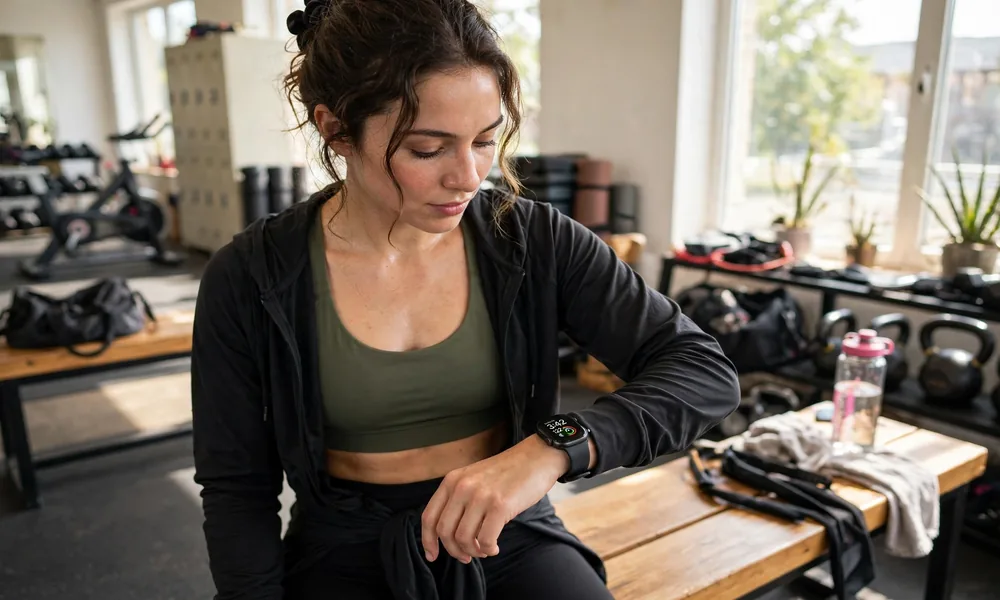
It is six in the morning and your wrist is already awake. Before your eyes have properly opened, the small black slab strapped to your arm has counted your pulse through the night, watched your blood oxygen dip and recover, and decided how well you slept. It did all of this without a needle, without a cuff, and without you noticing. A decade ago this kind of monitoring needed a hospital ward. Now it lives in a case the size of a matchbox, pressed against your skin.
The trick is light. A smartwatch health sensor is mostly an optical instrument: it shines light into your wrist and reads what comes back. Blood absorbs light in a very particular way, and as your heart beats, the volume of blood in the tiny vessels under your skin rises and falls. The sensor watches that rise and fall thousands of times a minute and turns it into a heartbeat.
It is also one of the hardest sensors in consumer electronics to get right. The wrist is a terrible place to measure anything: skin tone, tattoos, hair, sweat, temperature, and movement all change the signal. Here is how it does it.

How It Works
Step 1: Shining light into the skin
Everything starts with a cluster of tiny light-emitting diodes on the back of the watch, pressed against your wrist. The most important are green LEDs, because haemoglobin — the molecule that carries oxygen in your blood — absorbs green light strongly. When the LEDs flash, green light travels a few millimetres into the skin and scatters through the tissue and the tiny blood vessels beneath it. The watch flashes these LEDs hundreds of times a second, and each flash is a fresh measurement.
Step 2: Catching the light that comes back
Beside the LEDs sit photodiodes, exquisitely sensitive light detectors. Most of the green light is absorbed or scattered away, but a small fraction bounces back to the surface, and the photodiodes measure exactly how much. Between heartbeats, when the vessels under the skin hold less blood, more light returns. With each beat, a surge of blood fills the vessels, more light is absorbed, and less returns. That rise and fall in reflected light is the pulse, written in photons. Like the light-capturing layers inside stacked camera sensors, they pack extraordinary sensitivity into a package only millimetres across.
Step 3: Turning flickers into a heartbeat
The raw signal is a wavy line, and software turns it into a heart rate. Each peak in the wave is one beat, and the time between peaks gives the rate — typically 60 to 100 beats per minute at rest. But the watch does much more than count: it measures the shape of each wave, the variation between beats, and how the rate changes over minutes and hours. The sensor samples fast enough to catch every beat, even during a sprint when your pulse is racing past 170.
Step 4: Cancelling out the noise of movement
A watch on a moving wrist is a noisy place to measure. Every swing of your arm, every footstep, every bump shakes the sensor and changes how much light reaches the photodiodes. Left alone, that noise would drown out the pulse entirely. So the watch carries an accelerometer that records every movement, and the software subtracts the motion pattern from the optical signal. It is the same principle as noise-cancelling headphones: measure the interference separately, then remove it. Keeping the sensor cool and stable while it works this hard is a packaging challenge in its own right, one that shares DNA with the problem of cooling sustained performance in any hard-working piece of electronics.
Step 5: Reading the heart’s electricity
Light alone cannot show the electrical pattern of a heartbeat, so many watches add a second kind of sensor entirely. Metal electrodes on the back of the case and on the crown or bezel touch your skin, and when you hold a finger on the crown for thirty seconds, the watch records a single-lead electrocardiogram — an ECG. It measures the tiny voltages produced as the heart’s electrical signal sweeps through the muscle, and it can spot an irregular rhythm, such as atrial fibrillation, that an optical sensor alone might miss. The metal case itself is part of the instrument, which is why the machining and sealing of a watch case matters as much as the chip inside — a precision problem not unlike the ones explored in titanium machining challenges.
Step 6: Measuring oxygen with a second colour
To estimate blood oxygen, the watch adds red and infrared LEDs alongside the green ones. Oxygen-rich blood and oxygen-poor blood absorb red and infrared light differently, so by comparing how much of each colour comes back, the sensor can estimate the percentage of your haemoglobin carrying oxygen. The measurement is taken in short bursts, often during sleep when the wrist is still, because movement corrupts it even more than it corrupts heart rate.
Step 7: Turning signals into health numbers
The final step is not hardware at all. Algorithms combine the optical pulse, the ECG, the oxygen reading, the accelerometer, and a skin-temperature sensor into the numbers you see each morning: resting heart rate, sleep stages, recovery score, stress level. None of these numbers is a medical diagnosis, and the watch is careful to say so. What it offers instead is a continuous baseline: months of your own normal, against which any change stands out.
Smartwatch Health Sensor Specs
| Specification | Typical range |
|---|---|
| Optical sensor | Green, red, and infrared LEDs with photodiodes |
| Heart-rate sampling | Up to about 100 readings per second during workouts |
| ECG | Single-lead, 30-second recording, electrodes on case and crown |
| Blood oxygen range | About 70 to 100 percent SpO2 |
| Motion sensor | Three-axis accelerometer and gyroscope |
| Skin temperature | Continuous overnight tracking on many models |
| Water resistance | Typically 5 ATM, about 50 metres |
| Sensor power draw | Roughly 1 to 5 milliwatts while measuring |
What Does a Smartwatch Health Sensor Cost?
The sensor itself is a small part of the price of a watch. A mainstream health-focused smartwatch is estimated to cost roughly $200 to $400, while premium models with ECG, blood oxygen, and temperature sensing are estimated at $400 to $800. The optical sensor module inside — LEDs, photodiodes, and its chip — is estimated to cost the manufacturer only a few dollars in volume, which is remarkable for an instrument that replaces equipment that once cost thousands. Prices are estimates only and vary widely by brand, model, and region.
A Rare Fact
The idea of measuring blood oxygen with light dates to 1974, when Japanese engineer Takuo Aoyagi noticed that the pulse itself could be used to separate arterial blood from everything else in the fingertip. His insight — that only the pulsing part of the signal comes from arteries — made the modern pulse oximeter possible, and every smartwatch sensor is a direct descendant of it.

A smartwatch health sensor is a hospital instrument folded into a wristwatch: light to see the pulse, electricity to read the heart, and mathematics to make sense of both. It will never replace a doctor, but it has done something no clinic can — it made measuring your body as ordinary as checking the time.