Look at the bow of a modern cargo ship from the front and you will see something that should not be there: a great rounded snout of steel bulging forward from the hull below the waterline, like the ship is sticking its nose out in front of itself. It looks like a mistake, or a repair. It is neither. It is one of the most valuable shapes in shipbuilding, and it saves its owners more fuel in a year than the steel in it cost to build.
That snout is the bulbous bow, and its job is to fool the water. A ship moving through the sea pushes a wave up at its bow, and that wave costs energy to make. The bulb makes a second wave of its own, timed to cancel the first one out, so the ship slips forward on flatter water.
The size, the length and the height of the bulb are tuned to one hull, one speed and one loaded draught. Our guide to how a ship bow bulb is made explains the shape and the physics; this is the factory story — how a bulb goes from flat plate to welded steel, and from the workshop floor to the front of a ship.

Building a Ship Bow Bulb
Step 1: Designing the shape
Before any steel is cut, the bulb exists as a set of numbers. Naval architects run the hull shape through tank tests with a scale model and through computer simulations of water flow, trying bulb after bulb until the wave pattern flattens at the ship’s normal cruising speed. The result is a three-dimensional shape defined by hundreds of points, and the factory receives it as a set of drawings and cutting files.
Step 2: Cutting and forming the plates
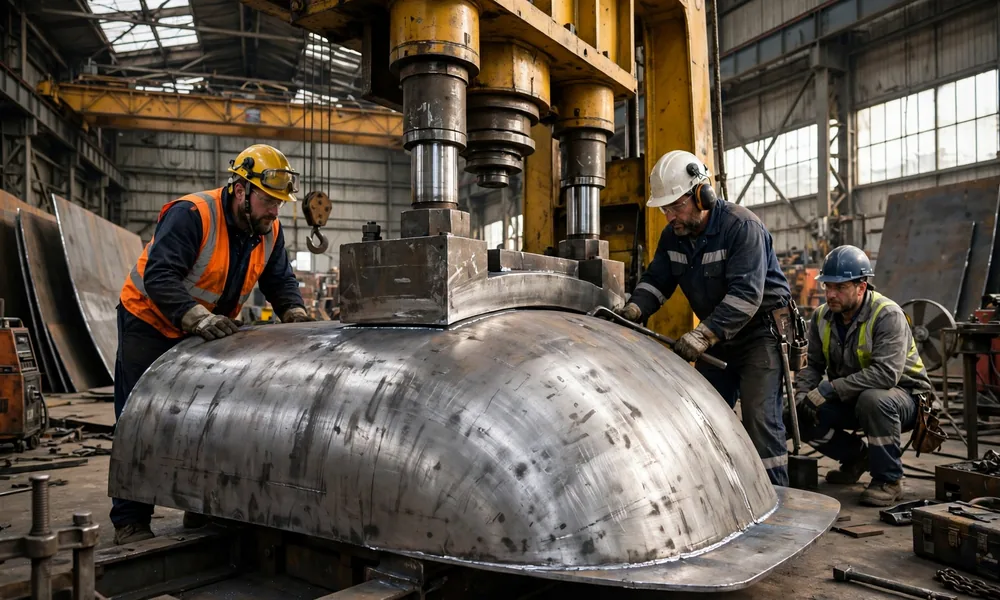
The bulb is built from steel plates, most of them between 15 and 30 millimetres thick, and the factory cuts them with computer-controlled plasma or flame cutters that follow the design files. The flat plates then go to the press, where they are bent into the bulb’s compound curves — curved in two directions at once, which is the hardest kind of plate to form. Workers check each plate against wooden or steel templates of the finished shape, and a plate that springs back too far goes back to the press.
Step 3: Assembling the sections
The sections are fitted together on the shop floor, or directly against the ship’s bow in the dry dock, and the fitting is done with jacks, wedges and a great deal of patience. The edges of neighbouring plates must meet within a few millimetres, because any step or gap in the skin becomes drag in the water, and drag is exactly what the bulb is meant to kill. When a section sits true, it is tacked in place with small welds, and the assembly grows, ring by ring, from the stem of the ship forward to the tip of the bulb. Each section is numbered and its position recorded, so the yard knows exactly which plate goes where when the bulb is assembled against the bow.
Step 4: Welding the shell
The full welds come next, and they are long, heavy and hot. Welders work in pairs on opposite sides of the bulb so the heat does not pull the shape to one side, and the seams are welded in short runs that are allowed to cool before the next run begins. Inside the bulb, stiffeners and frames are welded to the shell to stop it flexing under the pounding of the sea, because the bulb is the first part of the ship to meet every wave.
Step 5: Fairing and coating
A welded bulb is strong but it is not yet smooth, so the factory fairs it. Grinders smooth the weld caps flush with the plate, and any small hollow is filled and sanded until a straight edge laid across the surface shows no gap. Then comes the coating: several layers of primer and antifouling paint, applied in the dry dock under cover, because the paint has to stick to steel that will spend its life underwater.
Step 6: Fitting out and final survey
The last step is fitting the bulb into the life of the ship. Surveyors then walk the whole structure with the yard’s inspectors, measuring the shape against the design and signing off the welding records. The materials behind the shape — why the yard chooses one grade of steel over another — are covered in our guide to ship bow bulb materials, and the rudder at the other end of the ship is built to the same heavy standard, as described in our guide to how a ship rudder is made. When the dock floods and the ship floats for the first time, the bulb disappears under the water, and the yard will not see it again until the next dry docking years later.
Ship Bow Bulb Specs
| Specification | Typical range |
|---|---|
| Bulb length | About 3 to 8 metres forward of the stem on a large ship |
| Bulb diameter | About 3 to 6 metres on a large cargo ship |
| Plate thickness | About 15 to 30 mm of marine-grade steel |
| Bulb weight | About 50 to 150 tonnes on a large ship |
| Design speed | Tuned to the ship’s normal service speed, often 14 to 22 knots |
| Fuel saving | About 5 to 15 percent at design speed, depending on hull and bulb |
| Internal structure | Frames and stiffeners welded inside the shell |
| Coating | Primer plus antifouling paint, several coats |
What Does a Ship Bow Bulb Cost?
Building and fitting a bulbous bow on a large ship is estimated to cost roughly $200,000 to $800,000, depending on size, steel grade and whether it is fitted during a new build or added in a refit. Prices are estimates only and vary by yard, ship size and steel prices.
A Rare Fact
The bulbous bow was first fitted to warships more than a century ago, and one of the earliest famous examples was on a battleship launched in 1912. Designers still argue over the ideal bulb shape for each new hull, and every new generation of ship brings a slightly different answer. Today almost every large ocean-going ship has one, and the bulge that looks like an afterthought is often the single most carefully shaped piece of steel on the whole vessel.

The bulb is a reminder that shipbuilding is still a craft of curves. A bulb is easy to overlook and hard to build well, and the ships that carry one repay the yard’s patience on every voyage. It is not the biggest part of a ship, and it is not the most visible — most of its working life is spent underwater, out of sight — but it is the part where a few centimetres of shape decide how much fuel the ship burns for the next twenty-five years. The factory that builds it works to the millimetre for a reason: on the open sea, the water notices every mistake, and it charges for them in fuel.


