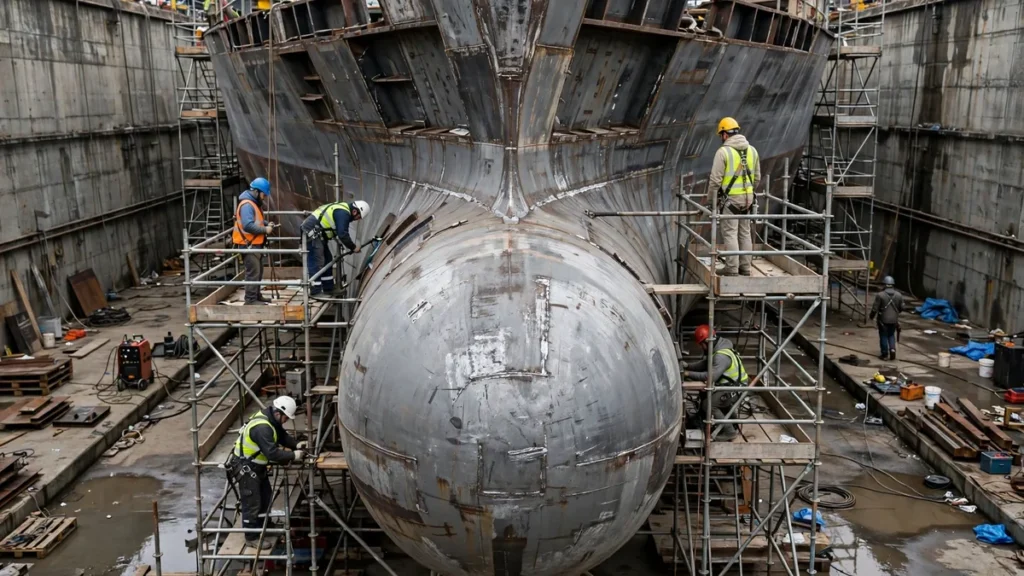
Stand on the bridge of a ship in heavy weather and watch the helm. The helmsman turns the wheel a few degrees, and somewhere far below, under tonnes of water, a huge steel blade swings to match. That blade is the rudder, and it is the only thing that keeps a ship of ten thousand tonnes pointing where its captain wants it to go. It has no engine of its own, no glamour, and no crew. It is a slab of steel, shaped like a wing, hanging off the stern, and it is one of the most brutally loaded parts on any vessel.
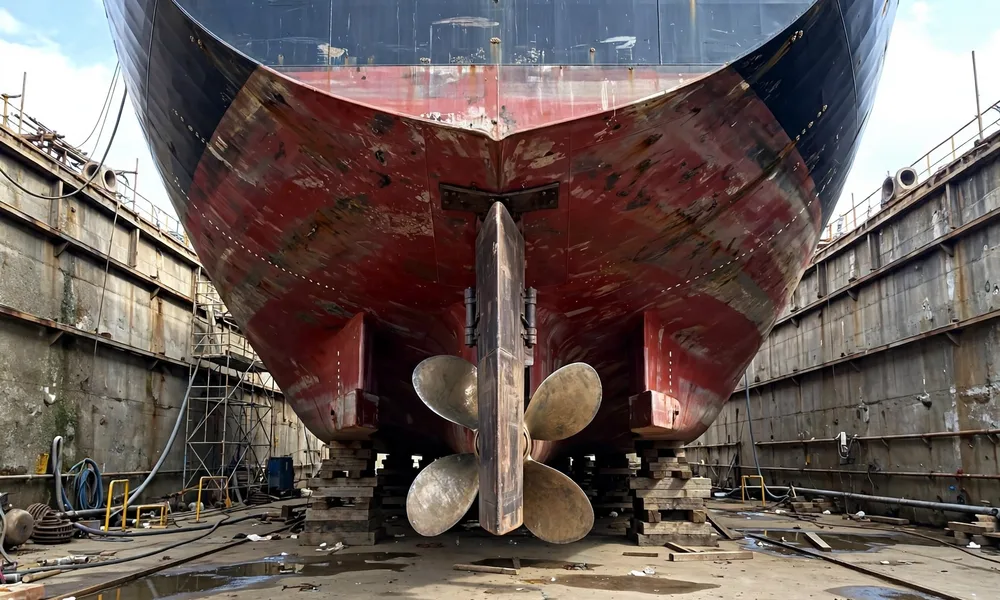
A ship’s rudder lives in the worst place on the ship. It sits in the propeller’s wash, where the water moves fastest and hits hardest, and it must turn against that flow while carrying the full weight of the ship’s steering forces. It is slammed by waves, scraped by debris, and eaten by corrosion, yet it is expected to work flawlessly for decades. This is how such a blade is made, from flat steel plate to the steering heart of a ship.
How It’s Made
Step 1: Designing the blade
Before any steel is cut, naval architects design the rudder’s shape. A rudder is not a flat board; it is a hydrofoil, with a rounded leading edge and a tapered trailing edge, so water flows smoothly around it instead of breaking away into turbulence. The size depends on the ship: a rudder must be large enough to steer at low speed in harbour, yet small enough not to drag at full speed at sea. The design is tested in towing tanks and computer simulations, and only then is the shape handed to the shipyard as a set of cutting plans. The same hydrofoil thinking shapes the smaller steering blades on yachts, as our guide to yacht rudder specs shows.
Step 2: Cutting and rolling the steel
The rudder is built from high-strength shipbuilding steel plate, typically 20 to 40 millimetres thick. The plates are cut to shape with plasma or oxy-fuel torches, then rolled and pressed into the curved sections that will form the rudder’s skin. Because a rudder is hollow, the skin is made in two halves, port and starboard, each one a curved shell that mirrors the other. The plates are checked for flatness and thickness as they are formed, because a dent in the skin becomes a dent in the water flow, and a dent in the flow becomes drag.
Step 3: Building the internal frame
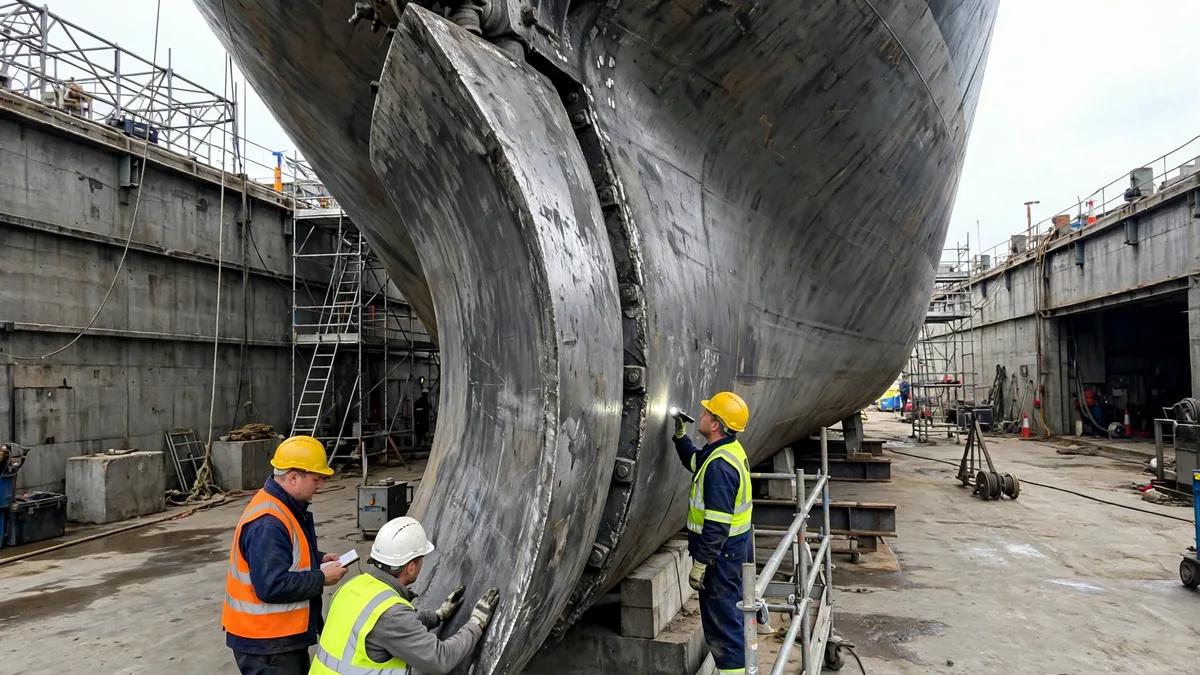
Inside the hollow shell sits the skeleton: horizontal and vertical webs of steel plate, welded into a rigid grid, and a massive vertical rudder stock, a forged steel shaft that runs through the centre of the blade and up into the ship. The stock is the part that actually turns the rudder, and it is the most heavily loaded piece of the whole assembly. The webs are welded to the stock first, then the two skin halves are fitted around the frame and welded shut, seam by seam, until the blade is a single sealed box. Every weld is inspected, because a cracked weld inside a sealed rudder can fill the blade with seawater unnoticed.

Step 4: Fitting the bearings and seals
The rudder stock passes through the hull in a watertight trunk, riding on bearings that let it turn while keeping the sea out. These bearings are fitted with extreme care, because a stock that binds or wobbles will wear out in months. Seals are installed at the top and bottom of the trunk, and the stock is connected to the steering gear, usually a hydraulic ram system that can push the blade from hard port to hard starboard in under thirty seconds. The steering gear is tested on the bench before it ever meets the rudder, and the whole assembly is aligned so the blade hangs dead true behind the propeller.
Step 5: Coating against corrosion
Steel and seawater are natural enemies, so the finished rudder is blasted clean and coated with a marine paint system several layers thick, often including an epoxy primer and an antifouling topcoat that stops barnacles and weed from growing on the blade. Sacrificial anodes, blocks of zinc or aluminium, are bolted to the rudder to corrode in place of the steel. The inside of the hollow blade is filled with a corrosion inhibitor or sealed with a protective coating, because once the two skins are welded shut, nobody can see inside again. The hull the rudder steers is built to the same standards of steel and coating, as our look at container ship hull materials explains.
Step 6: Hanging, aligning, and sea trials
The finished rudder, which on a large ship can weigh more than a hundred tonnes, is lifted by crane and hung on the ship’s stern frame, its stock slid up into the trunk and coupled to the steering gear. Divers or dry-dock crews check the gaps between the rudder and the hull, and the blade is swung through its full range to prove it moves freely. On sea trials the ship is put through hard turns at full speed, crash stops, and harbour manoeuvres, while engineers watch the steering gear pressures and the rudder’s response. A rudder that passes those trials will steer the ship for twenty years or more. It works alongside the ship’s main propulsion, the subject of our guide to cruise ship engine materials.
Specs
| Specification | Detail |
|---|---|
| Material | High-strength shipbuilding steel plate |
| Plate thickness | Typically 20 to 40 mm |
| Construction | Hollow, double-skin blade with internal web frame |
| Rudder stock | Forged steel shaft through the blade centre |
| Typical weight | 10 to 150 tonnes depending on ship size |
| Turning range | Usually 35 degrees each side of centre |
| Steering gear | Hydraulic rams, full swing in under 30 seconds |
| Corrosion protection | Epoxy and antifouling coatings plus zinc anodes |
Price
A ship’s rudder is priced by the tonne of steel and the hours of skilled welding it contains. A rudder for a medium cargo ship typically costs $150,000 to $400,000 (estimate, based on typical shipyard fabrication pricing), while the rudder of a very large container ship or cruise ship can cost $800,000 to $1.5 million (estimate). The steering gear that drives it adds a similar amount again, and a full replacement in dry dock, including removal, transport, and reinstallation, can push the total well past $2 million (estimate). It is a lot of money for a single blade, but it is the cheapest insurance a shipowner ever buys.
Rare Fact
A rudder only works because it cheats. When a ship moves forward, the rudder does not push the stern sideways by brute force; it acts as a wing, and the water flowing past it creates lift, just like air over an aeroplane wing. That lift is what turns the ship. The strange consequence is that a rudder is almost useless when the ship is stopped, because with no water flowing past the blade there is no lift at all. That is why ships manoeuvre in harbour with tugs and bow thrusters rather than their rudders, and why a ship that loses its engine in a narrow channel is in far more trouble than a car that loses its engine on a straight road: without speed through the water, the captain has no steering at all.