The fin stands on its stand like a shark’s dorsal fin cut from steel, taller than the men working on it, and it does not look like it belongs on a ship at all. A worker runs a torch along the weld where the fin meets its base, looking for a flaw no wider than a hair, while another checks the hydraulic arm that will one day swing this fin against the sea. This piece of steel will spend its life underwater, folding out of a ship’s hull to fight the roll of the waves, and it has to be right the first time.
A ship stabilizer is a fin that steadies a vessel. Most large ships carry a pair of them, one on each side of the hull, and they work like the wings of an aeroplane turned on their side: as the ship rolls, the fins tilt to push back against the water and level the ship out. Without them, a big ship in heavy seas can roll far enough to throw passengers across a deck and send cargo sliding. Building one means joining heavy steelwork with precision engineering, and the factory floor is where those two worlds meet.
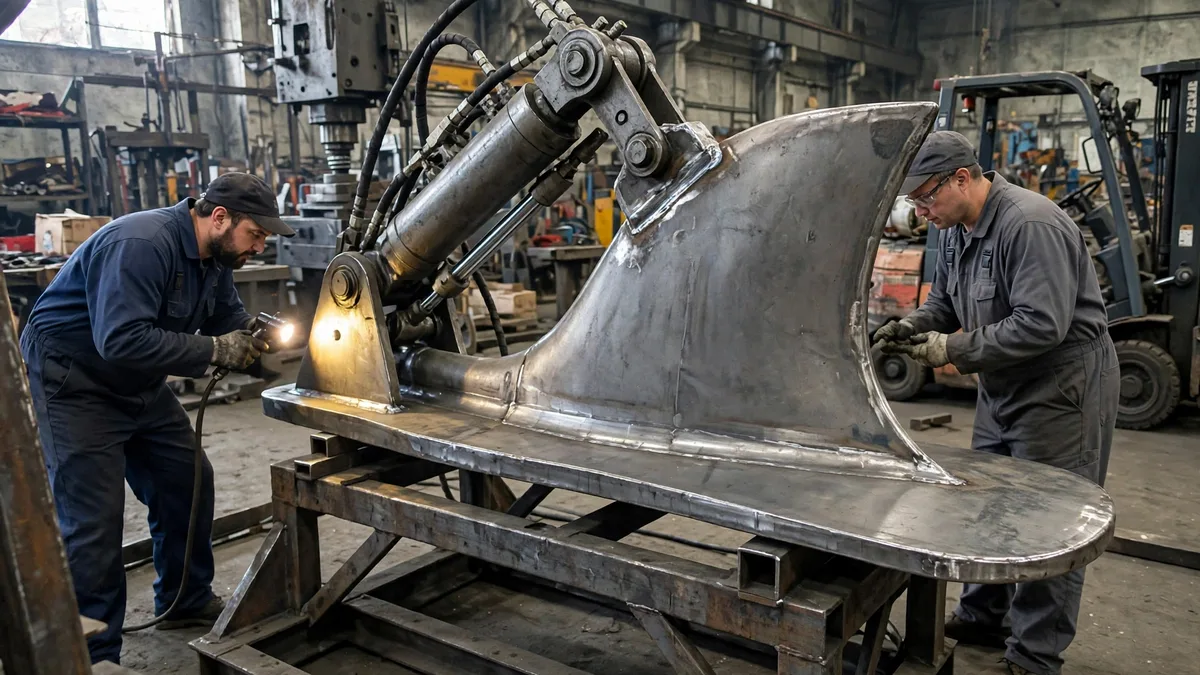
How a Ship Stabilizer Is Made
Step 1: The fin is cut and shaped from steel plate
Everything begins as flat plate. The fin’s shape — a swept, tapered foil, thicker at the root and thinner at the tip — is cut from thick steel plate with a plasma cutter or a flame cutter, following a template traced from the design. The plates are heavy, and moving them takes a crane and a crew who know exactly where to stand. Once cut, the plates are pressed and rolled to give the fin its curved cross-section, the shape that lets it bite into the water cleanly instead of dragging. The shape is checked against the template again and again as the plates are formed.
Step 2: The fin is welded into a hollow shell
The shaped plates are then welded together into a hollow shell, with internal ribs and webs fitted inside to give the fin its strength. This is the heaviest welding in the whole build, and it is done by welders who are certified for marine work, because every weld will be inspected and many of them will be tested with ultrasound to check for hidden flaws. The internal structure matters as much as the skin: a stabilizer fin takes enormous loads when the ship rolls, and the ribs spread those loads out so no single weld carries more than its share.
Step 3: The root and shaft are machined to fit
The root of the fin, where it joins the ship, is where the precision lives. A shaft runs through the root, and the fin pivots on that shaft so it can swing up and down. The shaft housing is machined on a large lathe or milling machine to a tolerance measured in hundredths of a millimetre, because a loose fit here means play in the fin, and play means hammering loads every time the ship rolls. The machinists work slowly, taking light cuts and measuring after each pass.

Step 4: The hydraulic actuator is built and fitted
While the fin is being machined, another team builds the actuator that will drive it. This is a hydraulic cylinder, sometimes as thick as a man’s body, with a piston inside that pushes and pulls the fin through its range of movement. The cylinder barrel is honed to a mirror finish inside, the seals are fitted by hand, and the whole unit is filled with hydraulic oil and run through its stroke on a test bench. The actuator has to deliver enormous force smoothly and quickly, and it has to do it for years without leaking, so the testing is unforgiving: any weep of oil at a seal means the unit comes apart again.
Step 5: The fin is coated and protected
A bare steel fin would not last a season in salt water, so the finished assembly is coated. First the surface is blasted clean to bare metal, then a series of protective coatings is applied: a primer that grips the steel, build coats that seal it, and a tough topcoat that resists abrasion and marine growth. Some fins also carry a sacrificial anode — a block of a softer metal that corrodes first, protecting the steel — bolted to the surface. The coating is checked for thickness with a gauge and for holidays, the tiny pinholes that let salt water in, with a spark tester that buzzes wherever the coating is thin. The anode is checked at every dry-docking and replaced when it has corroded away.
Step 6: The full assembly is tested on a rig
The finished stabilizer is bolted to a test rig that mimics the side of a ship. The rig swings the fin through its full range while sensors measure the force, the speed, and the smoothness of the movement, and the hydraulics are run through the same cycles the fin will see at sea: hard over one way, hard over the other, again and again. Engineers watch for hesitation, for vibration, for any sign that the fin is not moving exactly as the control system commands.
Ship Stabilizer Production at a Glance
| Feature | Detail |
|---|---|
| Fin material | Steel plate, welded hollow shell |
| Drive | Hydraulic actuator and linkage |
| Typical span | Several metres per fin |
| Key tests | Ultrasound weld check, rig swing test |
| Protection | Marine coatings and sacrificial anode |
| Build time | Several weeks per fin |
How Much Does a Ship Stabilizer Cost?
The price is an estimate, because stabilizers are built to order for specific ships and the price depends on the size of the fin and the power of the hydraulics. A pair of stabilizers for a large ship, with their actuators and control systems, is generally estimated to cost in the region of several hundred thousand to a few million dollars, with installation at the shipyard adding to the bill. The price is broken down in detail in why a ship stabilizer costs so much, and the materials that survive salt water are covered in the materials behind a ship stabilizer. For how the fins actually steady a vessel once they are fitted, see how a ship stabilizer keeps a vessel steady.

A Rare Fact About the Ship Stabilizer
Early stabilizers were not fins at all: some of the first attempts to steady a ship used huge spinning gyroscopes mounted deep in the hull, machines that weighed many tonnes and hummed like power stations. They worked, but they were so heavy and so hungry for power that they were soon overtaken by fins, which use the sea itself as their lever. A modern fin stabilizer can cut a ship’s roll by more than four-fifths in heavy weather, The fins spend most of their working life unseen, underwater, doing a job that passengers only notice when it stops.


