Out in open water, a big ship begins to roll. A swell catches her broadside, she leans to one side, hangs there for a breath, and comes back — too far, too fast — and leans the other way. Deep inside the hull, a pair of steel fins swings out into the sea and pushes back. The roll softens. The ship steadies.
Those fins are the ship stabilizer, one of the most expensive pieces of equipment on a modern vessel. A single system for a large cruise ship or ferry can cost several million dollars, and the price is not about the size of the fins. It comes from what the fins must do — fight the whole weight of a rolling ship, in salt water, without ever failing — and from how few workshops in the world can build one.
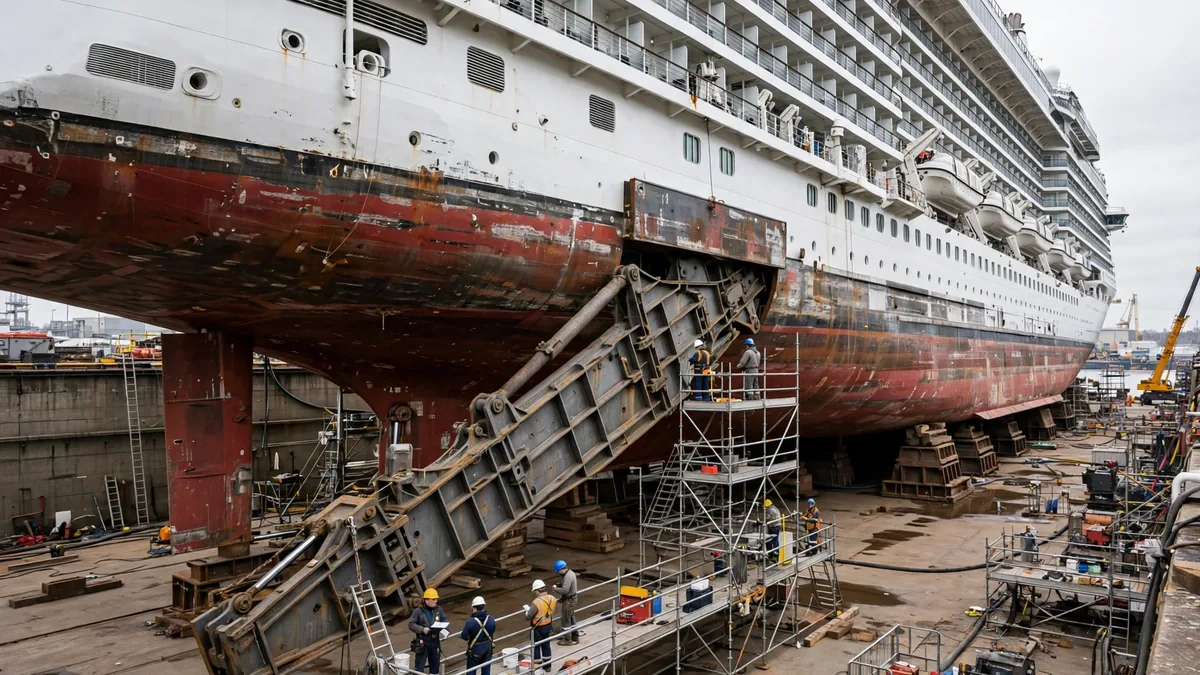
Why a Ship Stabilizer Costs So Much
A stabilizer looks simple from the outside: a fin, a hinge, and something that moves it. Inside, it is a precision machine working under brutal conditions. The fin must swing fast enough to catch a roll as it starts, hard enough to push thousands of tonnes of steel back upright, and smoothly enough not to add a new motion of its own. If you want the full picture of how a ship stabilizer works, the mechanism is only half the story.
Materials: steel that fights the sea and the load
The fins are built from high-strength marine steel, shaped like aircraft wings. A fin on a large ship can weigh several tonnes, and it hangs off the hull on a shaft that must carry not only that weight but the enormous twisting force the fin generates when it bites into the water. The shaft, its bearings and its seals use specialist alloys and hardened steels, because a failure here does not just stop the stabilizer — it can open a hole in the hull. Inside, hydraulic cylinders and valves move the fin at pressures high enough to demand thick-walled steel pipework and seals that hold for years without leaking.
Labour: fitting a machine into a moving ship
Installing a stabilizer is not a bolt-on job. The fin housing must be cut into the hull and welded in place with the precision usually reserved for pressure vessels, because the hull around it carries the loads of the whole ship. Shipyard welders work inside cramped, curved compartments, joining thick steel plate that must be tested before the ship returns to sea. The hydraulic and control systems are fitted by specialist teams, and commissioning takes weeks, with engineers running the fins through their full range of movement and then taking the ship to sea for trials in real weather. It is slow, skilled work.

Rarity: a small club of builders
Only a handful of companies in the world design and build fin stabilizers for large ships. The market is small — a few hundred large vessels a year, and not all of them take stabilizers — so there is no mass market to spread the cost of design, testing and certification across. Each system is engineered for a specific ship, because no two hulls roll the same way. That bespoke nature is the heart of the price. A car part can be made a million times and sold for pennies; a stabilizer is made once, for one ship, by a team that will never build exactly the same system again.
Testing: proving it in a storm you cannot schedule
A stabilizer must work in the worst weather a ship will meet, but a shipyard cannot order a storm for sea trials. Instead, the system is tested in stages: the fins are cycled thousands of times in dock, the hydraulics are pressure-tested beyond their working limits, and scale models are run in towing tanks to measure how much roll reduction a given fin shape delivers. Then comes the sea trial. The ship must find rough enough water to prove the system, and the trial team watches roll angles, fin loads and hydraulic temperatures for hours. If anything is out of tolerance, the ship returns to the yard for adjustment.
Low volumes: one ship, one system
The stabilizer business is the opposite of mass production. A builder might deliver a few dozen large systems in a good year, and each one is different. The fins are cast and machined to order, the hydraulic power units are assembled by hand, and the control software is calibrated for one hull and never used again in quite the same form. Even spare parts are made in tiny batches and kept on shelves for decades. The shipowner pays for all of it, because the alternative — a ship that rolls badly in heavy weather — costs far more in lost bookings, damaged cargo and unhappy passengers.

Cost Breakdown: Where the Money Goes (Estimates)
The figures below are broad industry estimates for a fin stabilizer system on a large cruise ship or ferry, including installation. Smaller vessels cost considerably less, and very large ships cost more. Real contract prices vary with fin size, speed and the shipyard doing the work.
| Part of the system | Estimated share of cost | Estimated price range |
|---|---|---|
| Fins, shafts and hull housings | About 30–35% | $900,000–2.5 million |
| Hydraulic power units and pipework | About 25–30% | $750,000–2 million |
| Control system and sensors | About 10–15% | $300,000–1 million |
| Design and model testing | About 10% | $300,000–700,000 |
| Installation and sea trials | About 10–15% | $300,000–1 million |
| Spares, training and support | About 5% | $150,000–350,000 |
All told, a complete system for a large ship is generally estimated at roughly $3–7 million, with retractable fins and high-speed systems at the top of the range. For a smaller ferry the figure can fall below $1 million, but the pattern is the same: the steel is the cheapest part, and the engineering around it is where the money goes.
Ship Stabilizer at a Glance
| Detail | Typical figure |
|---|---|
| Fin area per side | Several square metres on a large ship |
| Fin weight | Several tonnes each |
| Roll reduction | Often 70–90% in moderate seas |
| Hydraulic pressure | High-pressure system, hundreds of bar |
| Main materials | High-strength marine steel, specialist alloys, hardened bearings |
| Service life | Decades with regular seal and bearing replacement |
A Rare Fact
Here is the detail that surprises even seasoned seafarers: a stabilizer fin does most of its work when the ship is moving, and almost none of it when the ship is still. The fin only generates lift — the push that rights the ship — when water flows over it, which means a ship at anchor rolls just as much with stabilizers as without them. That is why the fins on many large ships retract into the hull in port: at zero speed they are useless, and sticking out they would only snag on docks and tug lines.
That is the real story of the stabilizer’s price. It is not the steel, which any yard can cut. It is the bespoke design for one hull, the hydraulics that must never leak, the seals that must hold back the sea, and the weeks of testing that prove a machine will fight the ocean and win. The ship bow bulb and the container ship hull are shaped by the same logic: every curve of a hull is a one-off answer to the sea.


