Imagine a battery with no liquid inside it at all. No flammable solvent sloshing around, no separator soaked in chemicals, nothing that can leak or catch fire if the cell is punctured. Instead, the heart of the battery is a solid — a thin sheet of ceramic or glass that lets charged particles pass through it while keeping everything else apart. That is the promise of the solid-state battery, and car makers have been chasing it for years because it could make electric cars go further, charge faster, and be far safer than anything on the road today.
Building one is not like building an ordinary battery. The solid electrolyte is brittle, it must touch the electrodes perfectly across its whole surface, and the whole cell has to be made in a room drier than a desert, because even a breath of damp air can ruin it. Factories are still learning how to make these cells at the speed and price the car industry needs. Here is how a solid-state battery is made, from powdered chemicals to a cell ready for testing.
How It’s Made
Step 1: Making the solid electrolyte
The solid electrolyte is the heart of the cell, and it starts as a powder. The most common types are sulphide glasses and oxide ceramics, made by mixing chemicals such as lithium, sulphur, phosphorus, or lanthanum and heating them until they form a new material. The powder is then pressed or rolled into a thin sheet, sometimes less than a tenth of a millimetre thick, and fired in a furnace until it becomes dense and solid. The finished sheet must conduct lithium ions easily while blocking electrons completely, and it must do so without cracking. A single hairline crack is a short circuit waiting to happen, so every sheet is inspected before it moves on.
Step 2: Preparing the electrodes
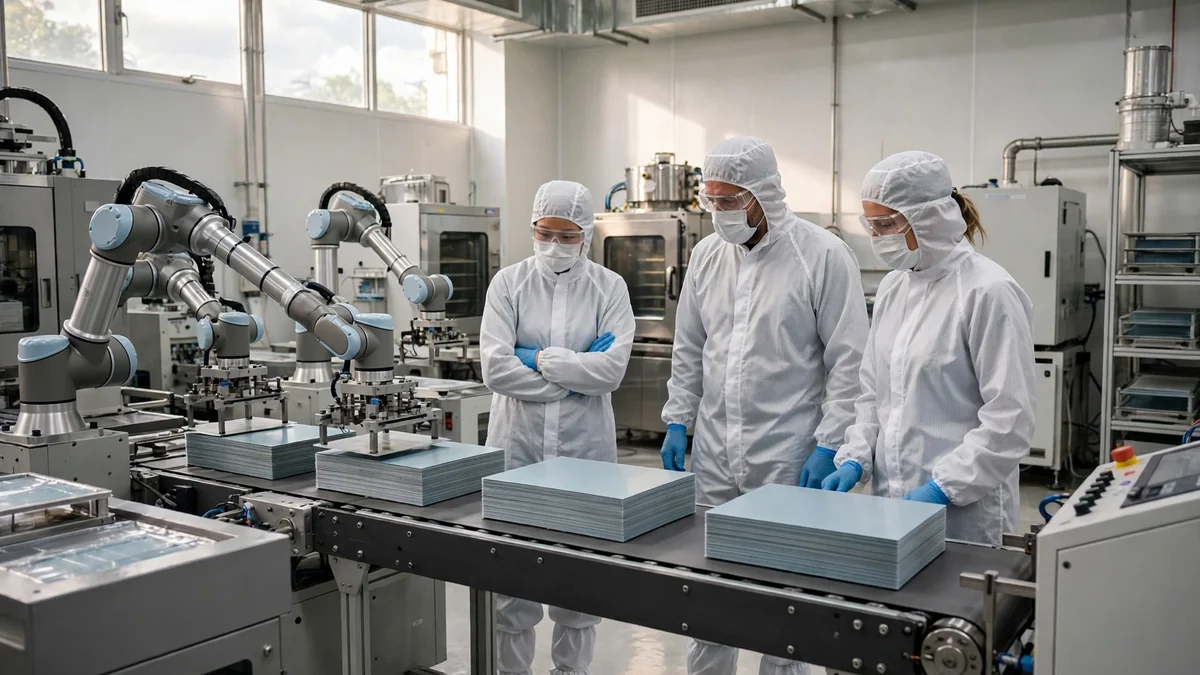
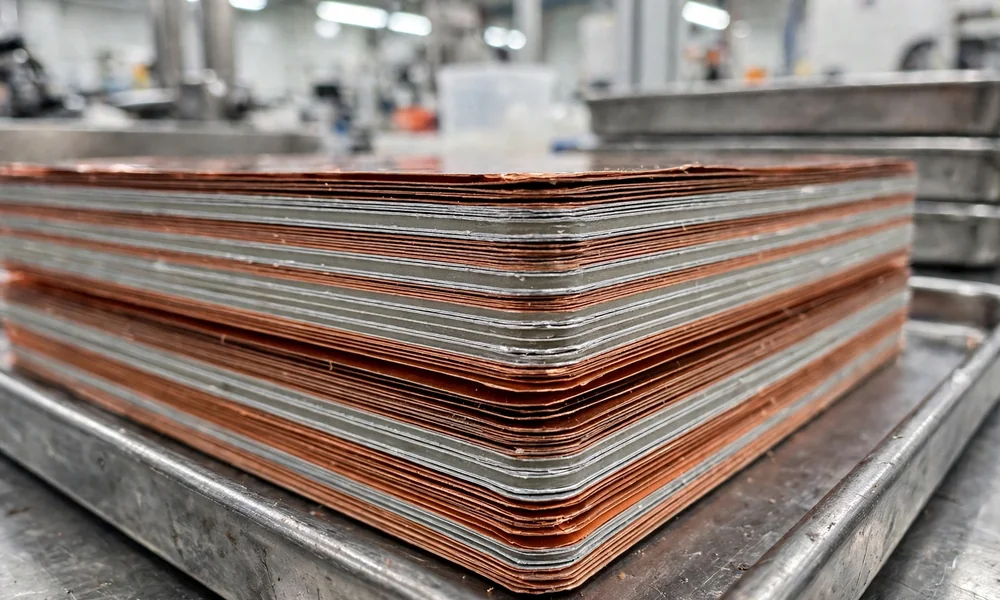
The two electrodes are made separately. The cathode, usually a nickel-rich oxide, is mixed into a slurry, coated onto a thin sheet of aluminium foil, and dried in long ovens. The anode is where solid-state batteries differ most from ordinary ones: many designs use pure lithium metal, which stores far more energy than the graphite used today, but is soft, reactive, and hard to handle. The lithium is rolled into a thin foil and laminated onto copper, all inside a dry room where the humidity is kept near zero. Workers wear full protective clothing, because lithium metal reacts violently with water — even the moisture in a breath is enough to damage it.
Step 3: Stacking the layers
The cell is built like a sandwich, layer by layer: cathode, solid electrolyte, anode, and then the same again, repeated dozens of times. Robots do the stacking, because the layers are thin, fragile, and must line up to within a fraction of a millimetre. Any gap between the electrolyte and an electrode is dead space where no current can flow, and any overlap at the edges is a short circuit. Some factories press the whole stack under enormous pressure to force the layers into intimate contact, a step called isostatic pressing. The details of the design decide how the cell performs, and how a solid-state battery is made in full shows how much of the work is really about making two surfaces touch perfectly.
Step 4: Sealing the cell
Once stacked, the cell is sealed inside a pouch or a metal can, and the terminals are welded on. The seal matters more here than in any other battery, because the solid electrolyte and the lithium anode must never meet damp air, not during shipping, not during the life of the car, not ever. The sealing is done inside the dry room, and the finished cell is leak-tested before it leaves. Some designs add a small amount of pressure inside the casing, because the layers need to stay pressed together as the cell expands and contracts with every charge.
Step 5: Formation — the first charge
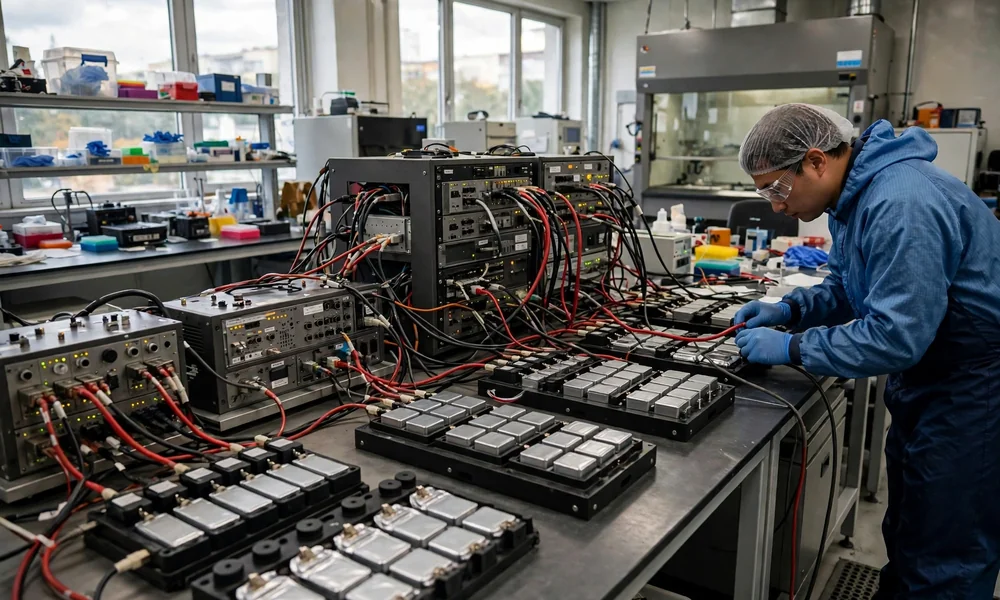
A new cell is not ready to use. It must go through formation, a slow first charge and discharge that builds the thin chemical layers where the electrodes meet the electrolyte. The cell is connected to a test channel and charged at a low current for hours, sometimes days, while machines watch its voltage for any sign of trouble. This is where many cells fail: if a tiny spike of lithium metal, called a dendrite, grows through the electrolyte, the cell short-circuits and is scrapped. Formation is slow and expensive, and it is one of the reasons solid-state batteries are still hard to make in large numbers.
Step 6: Testing, grading, and ageing
Every cell is then tested for capacity, internal resistance, and self-discharge. Cells that pass are graded and grouped with others that match them closely, because a car battery pack is only as good as its weakest cell. Sample cells are put through ageing tests — hundreds of charge cycles at hot and cold temperatures — to prove they will last for years in a real car. The best cells go to car makers for prototype packs, and the rest of the data goes back to the engineers, who use it to tune the recipe. The numbers behind all of this are the subject of solid-state battery specs explained, and they are improving with every generation.
Specs
| Specification | Typical figure |
|---|---|
| Electrolyte type | Sulphide glass or oxide ceramic |
| Electrolyte thickness | Roughly 20–100 microns |
| Energy density (prototype) | Around 400–500 watt-hours per kilogram |
| Anode | Lithium metal in most designs |
| Operating temperature | About −30°C to 60°C |
| Charge time (claimed) | 10–80% in about 10–15 minutes |
| Cycle life (target) | Over 1,000 full charges |
| Dry room humidity | Below 1% relative humidity |
Price
There is no showroom price for a solid-state battery yet, because no mass-market car uses one. Pilot production cells are estimated to cost several times as much as an ordinary lithium-ion cell of the same size, and the gap is widest in the electrolyte and the dry-room manufacturing. These are estimates, and the real cost depends on the chemistry, the yield, and the scale of the factory. Car makers and battery companies are spending billions to close that gap, and most expect the first solid-state cars to appear in small numbers before the end of the decade, priced as premium models. The reason for all that spending is the subject of why the solid-state battery is so expensive, and the answer is mostly the factory, not the materials.
A Rare Fact
The solid electrolyte at the heart of these batteries is a sheet of ceramic or glass thinner than a sheet of paper, yet it has to survive thousands of charges without cracking, while being pressed against a metal that grows and shrinks every time the battery is used. Engineers compare it to building a window that must stay watertight while the house around it expands and contracts with the seasons. The first team to solve that problem reliably will have built one of the most important inventions of the electric age.
The solid-state battery is still a promise, but it is a promise being built one layer at a time in dry rooms around the world. When the first cars with these batteries arrive, they will charge faster and drive further than anything before them — and they will do it with no liquid inside at all. The factory that makes that possible is one of the most demanding rooms in modern manufacturing.