Stand at the foot of a racing yacht in a boatyard and look up, and the mast seems impossibly thin for its height: a dark, smooth column rising thirty metres into the sky, barely wider than your shoulders at the base, holding up a sail the size of a tennis court. It looks too delicate to do the job, and that is exactly the point. A carbon fibre mast is built to be as light as possible while staying stiff enough to hold its shape in a gale, and every number on its spec sheet is a record of that balancing act.
Carbon fibre changed mast building because it is far stiffer and lighter than aluminium, the material it replaced, and it let designers build masts that are taller, thinner, and more precisely shaped than ever before. But carbon fibre is also unforgiving: it does not bend and warn you the way metal does, it fails suddenly if it is overloaded, and it costs a fortune to make and to repair. Reading the spec sheet means understanding what the numbers promise and what they quietly leave out.

Length, Weight and the First Trade
The first two numbers on any mast spec sheet are its length and its weight, and together they tell most of the story. A carbon fibre mast on a 15-metre racing yacht is typically 20 to 22 metres tall and weighs roughly 120 to 180 kilograms, while an aluminium mast of the same height would weigh nearly twice as much. On a 30-metre superyacht, the mast can rise 45 metres or more and still weigh under a tonne, a figure that would have been unthinkable in the aluminium era. That saved weight sits at the very top of the boat, where it matters most, because weight aloft makes a yacht heel over in the wind and roll more at anchor.
Length is not just about height. The mast’s length decides the size of the mainsail it can carry, and sail area is the engine of a sailing yacht, so a taller mast usually means a faster boat. The spec sheet’s length figure is therefore a promise and a demand at the same time, and the boat it sits on was designed around it.
The Spec Table, in Plain Numbers
| Specification | Typical 20-metre racing mast | What it means |
|---|---|---|
| Mast length | 21 metres | Sail area and boat speed |
| Mast weight | 150 kilograms | Stability and righting moment |
| Section depth | 380 millimetres | Fore-and-aft stiffness |
| Section width | 220 millimetres | Side-to-side stiffness |
| Wall thickness | 6 to 12 millimetres | Strength where loads are highest |
| Bend, fore-and-aft | Controlled, 300 mm | Sail shape control |
| Fibre type | High-modulus carbon | Stiffness per kilogram |
| Rigging type | Carbon or rod standing rigging | What holds the mast up |
| Righting moment saved | About 15 percent | Less heel, more speed |
| Design wind speed | 40 knots sustained | Survival limit under sail |
Stiffness, Bend and the Shape of the Sail
Stiffness is the number that separates a good mast from a great one, and it is measured in two directions. Fore-and-aft stiffness, the resistance to bending toward the bow or the stern, is set by the depth of the mast section, the front-to-back measurement, and a deeper section is stiffer in that direction. Side-to-side stiffness is set by the width of the section. A racing mast is deliberately not equally stiff in both directions: it is built to bend in a controlled way fore and aft, because that bend is how the crew controls the shape of the mainsail, flattening it in strong wind and powering it up in light air.
The bend figure on the sheet, often given as a distance in millimetres under a standard load, is the sailmaker’s working tool. Too stiff a mast and the sail cannot be depowered when the wind rises, so the boat heels over and slows down; too bendy and the sail loses its shape in light wind, so the boat never gets going. The right number depends on the sail, the boat, and the crew, which is why a mast is rarely bought off the shelf: it is designed as a pair with the sails it will carry. The sheet’s stiffness figures are the language the mast builder and the sailmaker use to talk to each other.
Wall Thickness and Where the Strength Lives
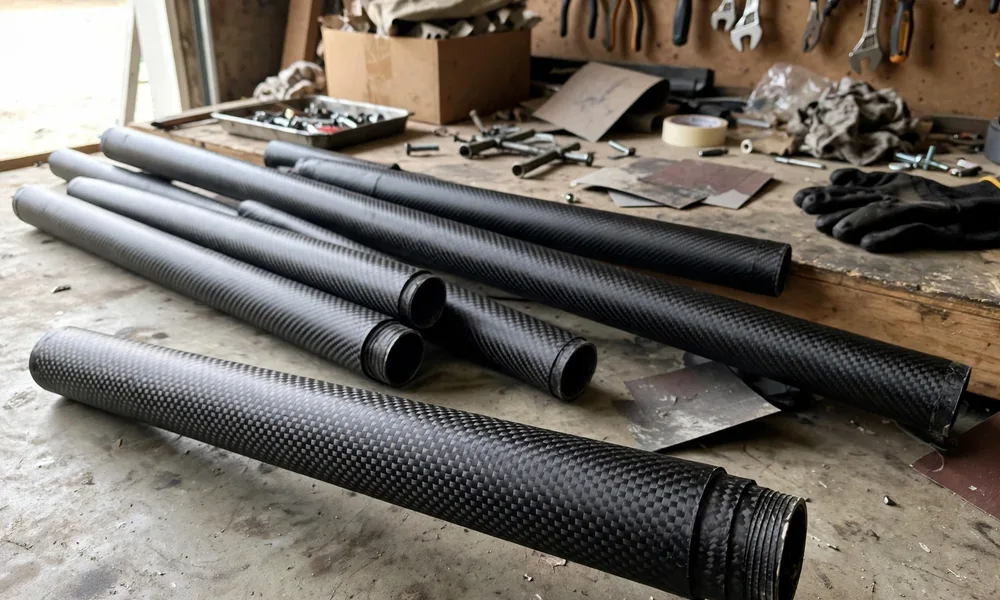
A carbon fibre mast is not a solid tube but a hollow shell, and its wall thickness varies along its length. At the base, where the bending loads are greatest, the wall may be 12 millimetres thick or more, built up from many layers of carbon cloth laid in different directions. Halfway up, where the loads are lower, it may thin to 6 millimetres, and near the top, where the mast carries only the head of the sail, it can be thinner still. This tapering is one of carbon fibre’s great advantages over aluminium, which is much harder to vary along its length, and it is how a mast can be both strong and light.
What a Carbon Fibre Mast Costs
Price is rarely printed on a mast spec sheet, so here are estimates, labelled as such. A carbon fibre mast for a 15-metre racing yacht costs roughly $80,000 to $150,000, including the standing rigging and the fittings, while a mast for a 30-metre superyacht can cost $500,000 to more than $1 million. The standing rigging alone, the wires or rods that hold the mast up, can add tens of thousands of dollars, and carbon rigging costs several times more than stainless steel. By comparison, an aluminium mast for the same boat would cost roughly a third as much, which is why carbon masts are still mostly found on racing yachts and superyachts.

One Rare Fact Worth Knowing
Here is the rare fact that even many sailors do not know: a carbon fibre mast can be tuned like a musical instrument, and racing teams do exactly that. By adjusting the tension of the rigging, the crew changes how much the mast bends and in which direction, and the sail changes shape with it, so the same mast and sail can be set up for light wind in the morning and heavy wind in the afternoon. Some masts even carry strain gauges, small sensors glued to the carbon that report the bending load in real time, letting the crew see numbers on a screen that their grandparents could only guess at by feel. The mast is not just a pole; it is an adjustable wing, and the spec sheet is its tuning chart. How a carbon fibre mast works explains the forces behind those numbers, and the build itself is a story of cloth, resin, and patience.
Read the sheet in this order and it will serve you well: length and weight first, then the section dimensions, then the bend and fibre figures, and finally the rigging it was designed to work with. Compare two masts of the same length and the numbers will show you which one is built for speed and which one for a long, quiet life at sea. The carbon mast looks simple from the dock, a dark line against the sky, but its spec sheet holds a whole engineering argument, and how a carbon fibre mast is made shows why that argument costs what it does. Choose the mast that matches the sailing you actually do, and the numbers will look after the rest. A hydrofoil catamaran’s spec sheet plays the same game in a different key, trading height for speed above the water.