Stand on the deck of a racing yacht in a stiff breeze and look up. The mast above you is taller than a ten-storey building, thinner than you would believe, and it is carrying a sail the size of a tennis court. The wind is trying to tear that sail off, the boat is heeling hard, and the mast is bending, visibly curving like a fishing rod, yet it does not break. It is supposed to bend. In a modern luxury yacht that mast is made from carbon fibre, and the bend is not a flaw but the whole point.
A carbon-fibre mast weighs about half as much as an aluminium one of the same strength, and that weight saved high above the deck makes the boat steadier, faster and kinder to its crew. But lightness alone does not explain it. The mast has to be stiff enough to hold the sail’s shape in a gust and flexible enough to spill wind when the gust turns dangerous. Getting that balance right is one of the cleverest pieces of engineering on any yacht.

How It Works
Step 1: The sail’s pull is carried down the mast
Everything starts with the sail. Wind fills it and pulls, and that pull is carried through the sail’s edges into the mast: up the front edge, down the back, and sideways through the battens. The mast feels that force as a bend, pushed sideways by the wind and pulled down by the tension in the rigging. A carbon mast handles it because its fibres run mostly up and down, exactly along the direction of the load, like the grain in a wooden beam. Where the loads are greatest, near the deck and at the spreaders, the builders lay in extra layers of fibre, so the mast is thickest and strongest exactly where it needs to be.
Step 2: The fibres are laid to tune the bend
Not all the fibres run the same way. Most run lengthwise for stiffness, but some are wrapped around the mast in a spiral to stop it twisting, and others run at an angle to carry the sideways loads from the sails. By changing the mix, the builders tune how the mast behaves: stiffer sideways so the sail keeps its shape, a little softer fore and aft so the top can bend away from a gust. That tuned bend is what keeps the boat safe. When a gust hits, the top of the mast bends to leeward and the sail twists open at the top, spilling wind automatically, like a valve letting off pressure. The way a whole yacht uses its rig, as how a luxury superyacht works explains, depends on this quiet automatic response.
Step 3: Spreaders and rigging share the load
A tall mast cannot stand alone, so it is held by standing rigging, the wire or carbon cables that run from the masthead down to the deck and to the sides. Spreaders, the horizontal arms partway up the mast, push those cables out at a wide angle, so they can hold the mast upright with less tension, like the guy ropes of a tent. The rigging is tuned with great care, tightened a little at a time while the mast is checked for straightness, because uneven tension will bend the mast the wrong way and ruin the sail’s shape. On the best yachts the rigging itself is carbon fibre too, lighter and stretch-free, so the whole system stays in tune longer.
Step 4: Halyards and sails are hoisted inside the spar
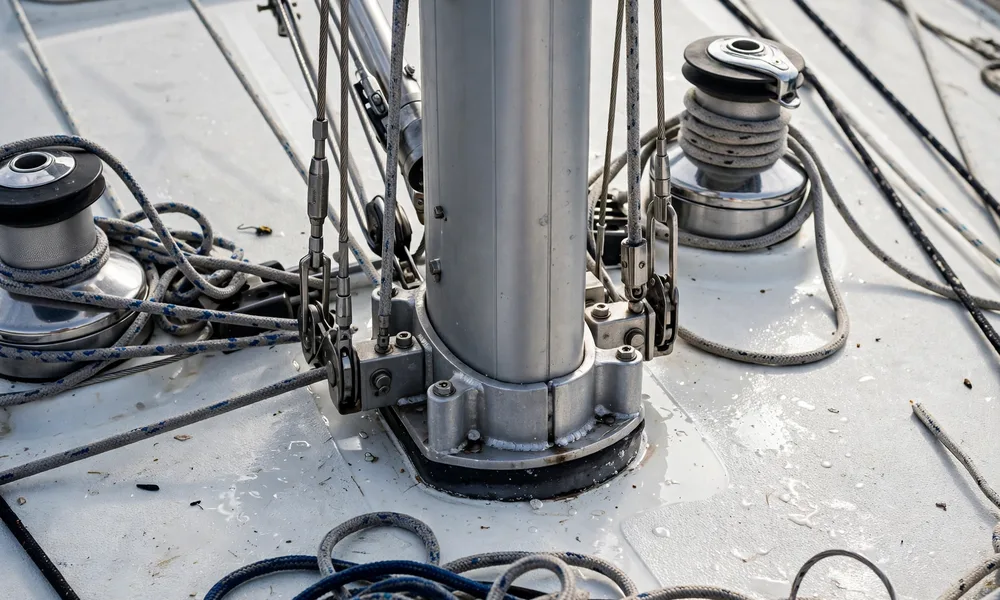
Inside the hollow mast run the halyards, the ropes that hoist the sails, and on many luxury yachts the sails themselves disappear into the mast when they are lowered. A furling mainsail rolls up inside the spar like a blind, protected from sun and spray, and unrolls at the push of a button. That hollow centre is also where the mast’s strength lives, since a tube is far stiffer for its weight than a solid rod, and the wall thickness is varied along the length, thicker at the bottom where the bending force is greatest, thinner at the top where weight matters most. Wiring for lights, wind sensors and antennas runs inside too, safe from the weather.
Step 5: The mast flexes to spill a gust
When a gust strikes, the mast does its cleverest work. The top bends away from the wind, the sail twists, and the force on the boat drops before the crew even needs to react. Sailors call this automatic depowering, and it is why a carbon mast is safer than a stiffer one in a squall: it gives a little instead of passing the whole shock to the hull and the crew. The same flexibility helps in waves, as the mast absorbs the jerks of the boat pitching and rolling rather than fighting them. A powered yacht relies on its engines in the same way, as how a luxury motor yacht works shows, but a sailing yacht’s engine is the wind, and the mast is the gearbox that lets the crew use it gently.
Step 6: The deck, keel and hull answer the mast
Nothing on a yacht works alone. The enormous downward pull of the mast is carried through the deck into the hull and down to the keel, the heavy fin below the boat that stops it being blown sideways and keeps it upright. The mast step, the socket the mast stands in, spreads that load across strong frames in the hull, and the keel answers with its own weight, often several tonnes of lead, hanging below. When the mast bends and spills wind, the keel’s job gets easier, the boat heels less, and the crew stays drier. The whole balance, mast above and keel below, is what lets a yacht carry a sail many times its own size and still feel calm and in control.

Carbon-Fibre Mast Specifications
The figures below describe a typical large carbon-fibre mast on a current luxury sailing yacht. Sizes vary greatly by vessel, but the working principles are the same.
| Specification | Typical value |
|---|---|
| Mast height | 25 to 45 metres |
| Mast weight | About 400 to 900 kilograms |
| Weight saving over aluminium | Roughly 40 to 50 percent |
| Wall thickness | About 10 to 25 millimetres |
| Sail area carried | 200 to 500 square metres |
| Inspection interval | Ultrasound check every few years |
What It Costs
A carbon-fibre mast for a luxury sailing yacht costs an estimated $150,000 to $600,000, depending on height and complexity, and the rigging and furling systems add considerably to that figure. Those are estimates, not quotes, and they reflect the hand lay-up of the fibres, the autoclave curing, and the careful tuning of the bend. The saving comes in performance and in the life of the boat: a lighter mast means a steadier boat, less wear on the rig, and a yacht that needs a smaller crew to sail well. On a large yacht the mast is only one part of a very expensive whole, and the figures that describe such a vessel, in the superyacht specs, show how the rig, the hull and the keel are all sized together, each one depending on the others to work.
A Rare Fact
Here is a detail most sailors never guess. The top of a tall carbon mast can bend sideways by several metres in a strong gust, and it is designed to do exactly that, springing back straight the moment the wind eases, thousands of times over its life.