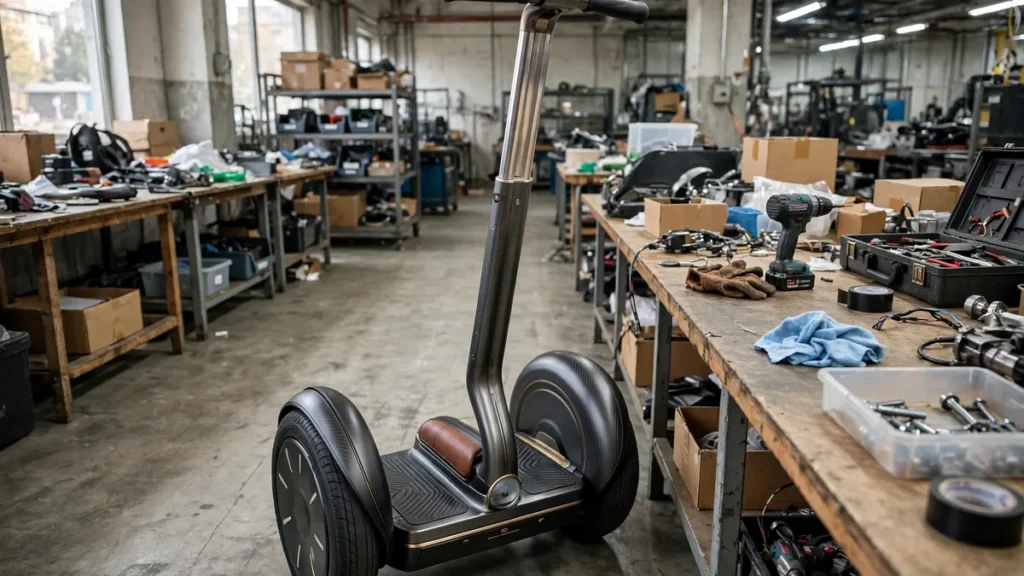
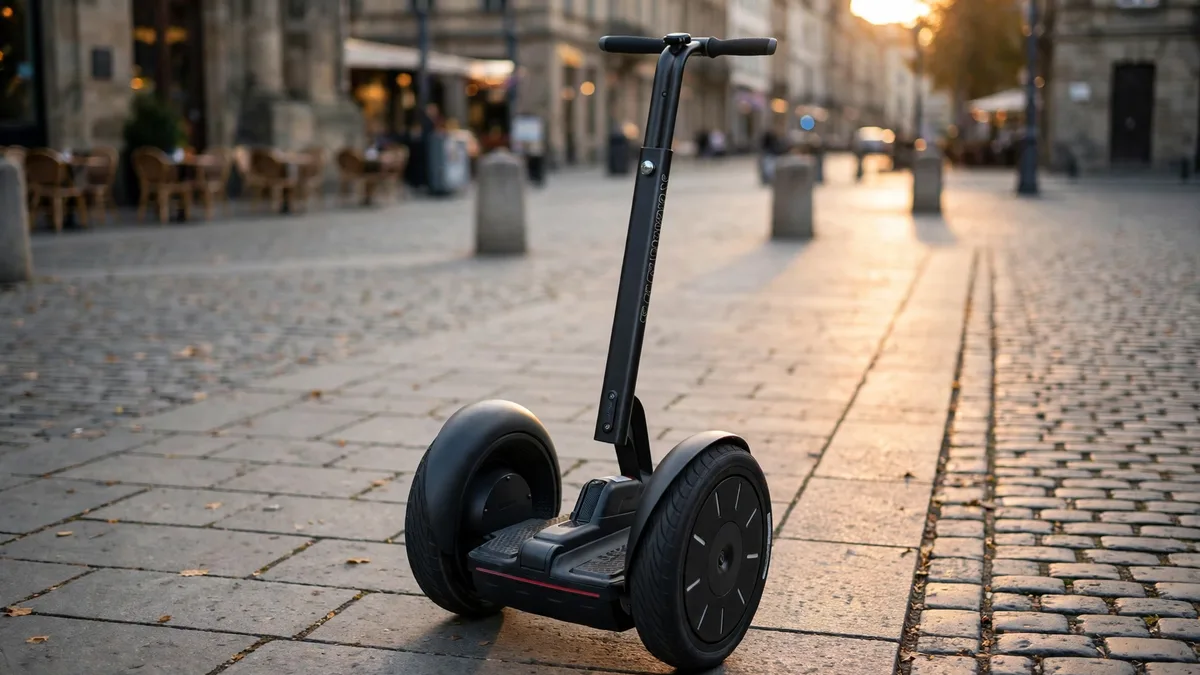
The square was empty at sunrise except for a man standing on two wheels, holding a tall handlebar and gliding across the cobbles without pedalling, pushing or seeming to do anything at all. A woman watching from a café doorway laughed and said it looked like magic. It was not magic. It was a set of numbers working together: two motors, a battery, a gyroscope and a computer that makes a thousand tiny corrections every second to keep the rider upright. The machine was a luxury Segway, and its spec sheet reads like a small electric vehicle, because that is what it is.
The spec sheet is a better guide, because the ride on a smooth showroom floor hides the things that matter on a real street: how far it goes, how steep a hill it climbs, how much weight it carries and how it behaves when the battery runs low. This guide explains the numbers in plain words, so you can judge a luxury Segway by what it can actually do rather than by how clever it looks standing still.
The spec sheet at a glance
| Specification | Typical luxury figure | What it tells you |
|---|---|---|
| Motor power | 2 × 800–1,200 W | How strongly it pulls and climbs |
| Battery capacity | 800–1,600 Wh | How much energy it carries |
| Range | 40–80 km | How far it goes on one charge |
| Top speed | 20–25 km/h | How fast it is allowed to travel |
| Max load | 100–130 kg | How much rider and luggage it carries |
| Climbing angle | 15–30 degrees | How steep a slope it can climb |
| Tyre size | 19–21 inches | How it rides over rough ground |
| Weight | 45–60 kg | How heavy it is to lift or load |
| Water resistance | IPX5–IPX6 | How much rain and spray it tolerates |
| Display | LCD with speed and battery | What the rider sees while riding |
Motors: two wheels, two engines
A luxury Segway has one motor in each wheel, and the power figure is usually written as two numbers, for example two times eight hundred watts. That means each wheel has its own eight-hundred-watt motor, giving a combined output of sixteen hundred watts, and the two motors are controlled independently. Independent control is what lets the machine turn: to turn left, the right wheel spins slightly faster than the left, and the difference in speed steers the machine without any mechanical steering at all. Power shows up instead as acceleration and climbing ability. A machine with two twelve-hundred-watt motors will pull away smoothly with a heavy rider and climb a steep ramp without slowing, while a weaker machine will hesitate and beep a warning. The same idea of a hub motor doing all the work appears in other small electric machines, and the way a rider is carried by a single wheel instead of two is set out in how a luxury electric unicycle works, where balance depends on the same kind of gyroscope and motor control.
Battery and range: the numbers that shrink first
Battery capacity is measured in watt-hours, and a luxury Segway typically carries between eight hundred and sixteen hundred watt-hours. A bigger battery means a longer range, but the range figure on the sheet is the one to read with the most care. It is measured with a light rider, on flat ground, at a steady speed, in warm weather, which is not how anybody actually rides. A heavy rider, a cold morning, a hilly route and frequent stops can cut the claimed range by a third or more, so a machine that claims eighty kilometres may deliver fifty in real use.

Top speed, load and climbing
Top speed on a luxury Segway is usually twenty to twenty-five kilometres per hour, and that ceiling is deliberate. The machine could go faster, but the faster it goes, the less time the balancing system has to react, and the harder a fall would be. Maximum load is the number that many buyers ignore and then regret. A limit of one hundred kilograms sounds generous until you add the rider, a backpack, a coat and a shopping bag, and the machine starts to complain. Climbing angle, usually fifteen to thirty degrees, tells you how steep a slope the machine can climb from a standing start. A thirty-degree climb is a serious hill, and the figure is worth more than the top speed if your route includes ramps, bridges or hilly streets. A machine with a high climbing angle and strong motors will take a hill in its stride, while a weaker one will slow, warn and eventually stop.
Tyres, weight and weather
Tyre size is written in inches, and luxury machines typically use nineteen to twenty-one inch tyres. A larger tyre rolls over bumps, kerbs and cobbles more easily than a small one, because it does not drop as far into every dip in the surface. That is why the same machine can feel smooth on a promenade and harsh on a rough lane: the tyre is the suspension, since most Segways have no springs at all. Weight is the number that surprises people most, because a luxury Segway weighs forty-five to sixty kilograms, which is far too heavy to carry up a flight of stairs. Water resistance is rated on the IP scale, and IPX5 means the machine can handle rain and splashes, while IPX6 means it can handle stronger jets of water. The display on the handlebar shows speed, battery level and mode, and on the better machines it also shows trip distance and warnings. The range of machines that share this electric DNA is wide, and the makers who build the best scooters are ranked in the best electric scooter brands ranked, where the same battery and motor questions decide the order.

What a luxury Segway costs, and a rare fact
A luxury Segway typically costs an estimated $6,000 to $12,000, depending on the battery size, the motor power and the build quality. The money is visible in the spec sheet if you know where to look: a sixteen-hundred-watt-hour battery, two twelve-hundred-watt motors, a thirty-degree climbing angle and a sixty-kilogram build all push the price up, and each one is a number you can check before you buy. The rare fact is that the original Segway was so secret before its launch that it was known inside the company only by the codename Ginger, and its inventor predicted it would change cities the way the car did. It did not, but the balancing technology it pioneered quietly spread into hoverboards, electric unicycles and cargo bikes, including the working machines described in how a luxury cargo bike works, where the same idea of electric assistance carries a far heavier load. Read the sheet, knock a quarter off the range, and choose the machine whose climbing angle and load limit match your streets, because those are the numbers that decide whether you ride it every day or leave it in the garage.