Stand on the dock beside a large luxury ship and look at her bow, and you will see nothing but smooth painted steel curving down to the water. The anchor is there all the same, tucked into a hollow in the side of the bow, sitting so flush with the hull that you could walk past it without noticing. That hollow is the anchor pocket, and the sheet of numbers that describes it is one of the most exact documents on the whole ship.
This guide reads a luxury ship anchor pocket specification sheet line by line, in plain language. It is about the numbers themselves: how deep the pocket is, how thick its steel, how much load it carries, how tightly the anchor must fit, and how the pocket is protected against the sea. The sheet is where the promise is written down, and this is what each number on it means.

The Spec Sheet, Line by Line
1. Pocket depth and the size of the opening
The first numbers describe the hollow itself: its depth, height, and width at the mouth. Depth is measured from the outside surface of the hull to the back wall of the pocket, and on a large luxury ship it is usually between 800 millimetres and 1.4 metres. The pocket must be deep enough to swallow the anchor whole, flukes and all, so that nothing sticks out past the line of the hull. A pocket that is too shallow leaves the anchor proud of the bow, where it catches the water, adds drag, and bangs against the steel in a seaway. The sheet also gives the pocket volume, which tells the yard how much water the drain at the bottom must clear each time the anchor comes home wet.
2. Plate thickness and the grade of steel
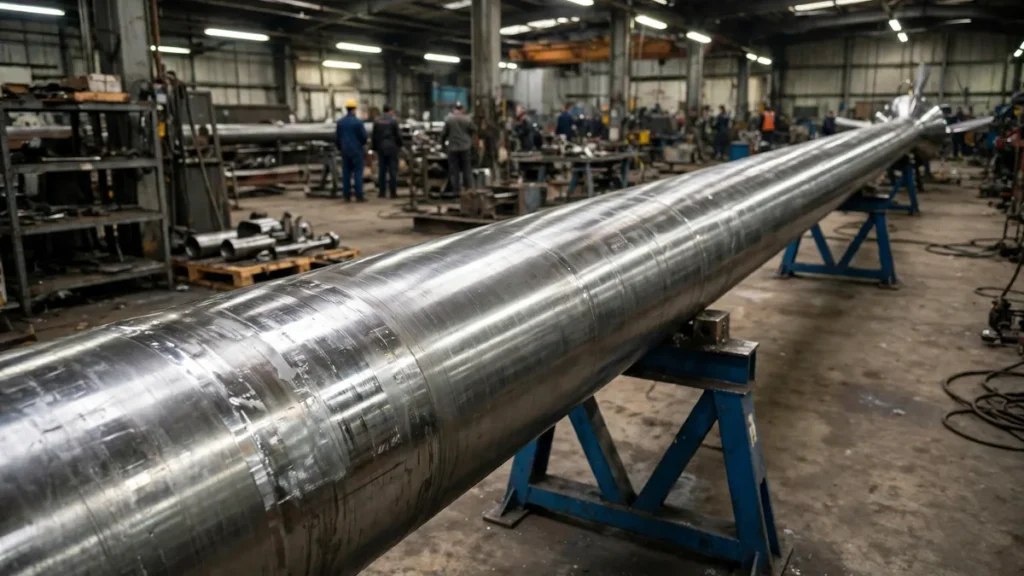
The next lines give the thickness of the steel that forms the pocket walls, and the grade of that steel. Pocket plating on a large luxury ship is typically 16 to 25 millimetres thick, heavier than the ordinary shell plating around it, because the pocket walls take a beating no other part of the bow takes. The anchor slides against them every time it is raised or lowered, scraping off paint and pressing hard against the steel, and the pocket must survive that for decades. The sheet names the grade exactly, and the way a luxury ship anchor pocket is made shows how that steel is shaped and welded before the bow is finished.
3. Design load, and the anchor it must hold
The sheet then gives the load the pocket is designed to carry, and this number surprises people who think of the pocket as an empty space. It is not empty when it matters. It holds the anchor, and the anchor on a large luxury ship weighs between 3 and 12 tonnes. The pocket, its framing and the lashings that secure the anchor are designed for that weight, plus a margin for the shock of the anchor swinging as the ship rolls. The sheet states the anchor weight to the kilogram, because the pocket and the anchor are a matched pair. How a luxury ship anchor pocket works shows what those loads feel like in service, every time the anchor comes home.
4. Clearances and the tolerance of the fit
The tightest numbers on the sheet are the clearances, the gaps between the anchor and the pocket walls when the anchor is seated. They are given in millimetres, and they are small: typically 25 to 50 millimetres on each side, enough for the anchor to slide in without touching, and tight enough that it cannot rattle once it is home. The tolerance is the allowed error on those clearances, usually plus or minus 5 millimetres, which is a demanding figure on a structure the size of a small room.

5. Drainage, coating and the anode
A pocket that holds water will rot from the inside, so the sheet gives the drainage numbers: the size of the drain hole at the lowest point, usually 50 to 75 millimetres across, and the fall of the pocket floor towards it, usually a slope of about one in twenty. The drain must clear the water that comes up with the anchor, and the mud and shell that come with it, without blocking. A typical specification calls for primer plus two coats of marine epoxy, 300 to 400 microns thick in total, far thicker than the paint on the open hull.
6. The hawsepipe angle and the chain fit
The last numbers belong to the hawsepipe, the steel tube above the pocket that the anchor chain runs through. The sheet gives the pipe diameter, usually 1.5 to 2 times the diameter of the chain links, and the angle of the pipe, measured from the vertical, usually between 25 and 40 degrees. The angle matters because the chain must run down the pipe in a straight line. If the pipe is too steep, the chain falls too fast and piles up in the locker. If it is too shallow, the chain drags on one side and wears a groove in it within a season. Why a luxury ship anchor pocket is so expensive explains how much of the bill belongs to getting these few numbers exactly right.
Anchor Pocket Specs at a Glance
The figures below are typical ranges for a large luxury ship, and they show how the numbers grow with the ship. The rules are the same at every size: the pocket is shaped to one anchor, and the fit is measured in millimetres.
| Specification | 50 metre ship | 80 metre ship | 120 metre ship |
|---|---|---|---|
| Pocket depth | 800 to 1,000 mm | 1,000 to 1,200 mm | 1,200 to 1,400 mm |
| Plate thickness | 16 to 20 mm | 20 to 22 mm | 22 to 25 mm |
| Anchor weight held | 3 to 5 tonnes | 5 to 8 tonnes | 8 to 12 tonnes |
| Side clearance | 25 to 40 mm | 30 to 45 mm | 40 to 50 mm |
| Drain diameter | 50 mm | 65 mm | 75 mm |
| Coating thickness | 300 microns | 350 microns | 400 microns |

What the Specs Mean for You
If you are buying, chartering or inspecting a luxury ship, the anchor pocket sheet tells you a great deal about how the ship was built. A sheet that names the anchor by maker and model, gives clearances to the millimetre, and states a coating thickness with an inspection minimum is the sheet of a yard that took the pocket seriously. A sheet with round numbers and no anchor named is the sheet of a pocket that was guessed at, and a guessed pocket will show it: a rattle under way, paint worn through in a season, or an anchor that needs two attempts to seat.
Here is a detail worth knowing. The anchor pocket is one of the few parts of a ship where the specification is written around a single other object, the anchor itself, rather than around a standard. Most fittings are built to a size and then matched to whatever fits them. A pocket is built backwards, from the anchor to the hull, and if the anchor is ever changed, the pocket has to be checked all over again. A pocket that fits its anchor perfectly is a quiet thing, noticed by nobody, doing its job on every voyage.