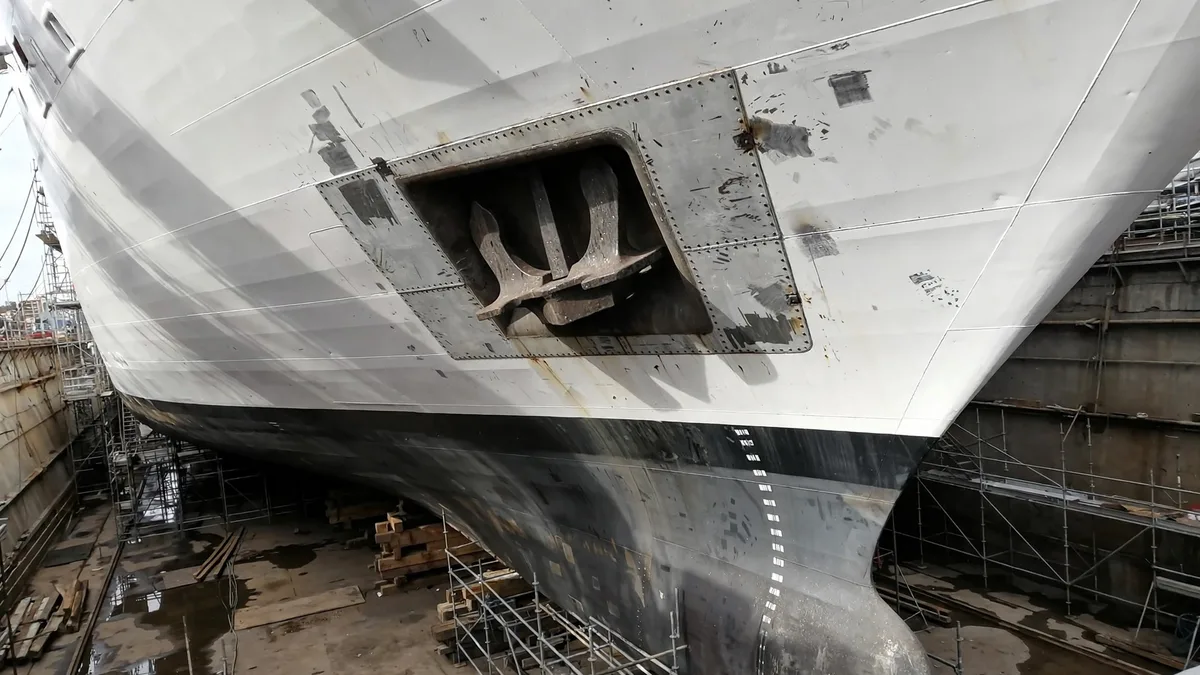
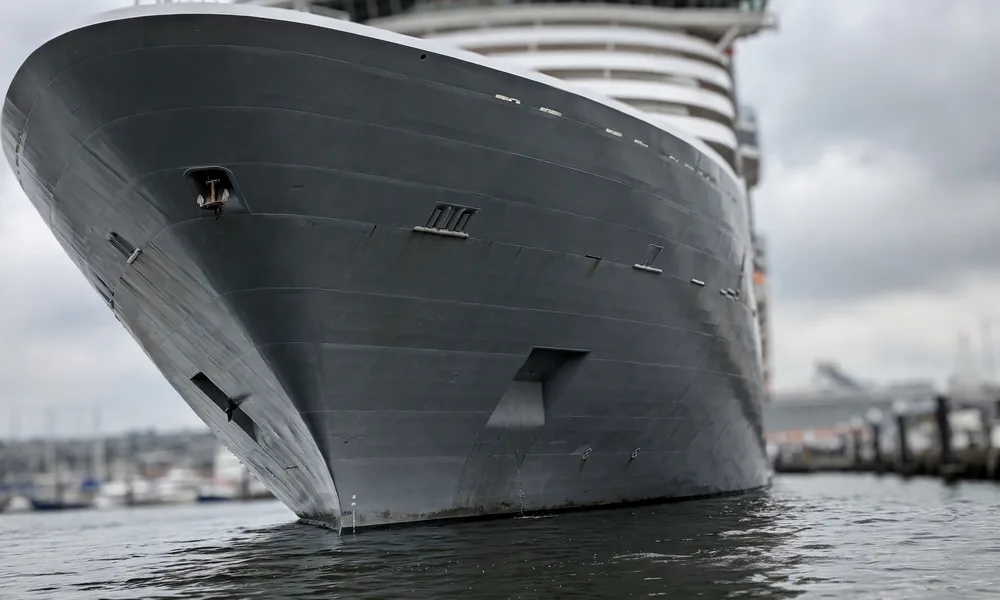
Look at the bow of a large ship under way and you will see smooth, clean steel, with no anchor in sight. The anchor is there, though, tucked away in a hollow carved into the side of the bow, sitting flush with the hull. That hollow is the anchor pocket, and it is one of the most expensive holes on the whole vessel. It holds nothing and moves nothing, yet building one can cost as much as a good house.
Owners regularly ask why. A pocket is, after all, an absence: a space where steel is not. The answer is that the absence has to be exactly the right shape, in a part of the hull curved in two directions that takes the full force of the sea. Get the shape wrong by a few centimetres and the anchor jams on the way in, or rattles against the steel every time the ship rolls.
This article explains where the money goes. It is strictly about cost: the design, the steelwork, the coatings, the dry dock time and the testing, and why each one costs far more than the size of the hollow suggests. It is not about how the pocket is built or how the anchor settles into it.
Designed Around One Anchor
The first cost is the design, and it starts with the anchor, not the hull. Before any steel is cut, the designers take the exact shape of the anchor, its flukes, its shank and its crown, and draw a hollow that matches it like a mould matches a casting. The pocket must be deep enough to hold the anchor, wide enough to let it swing in, and shaped so the anchor cannot rattle once it is home. The shape is tested in models and then in full-size mock-ups on the shop floor.
The design work is billed by the hour. The pocket changes the shape of the bow, which changes how the water flows around the bow, and the team models the bow with the pocket in place, checking that the hollow does not add drag or throw spray onto the deck, and that the anchor still swings in cleanly when the ship is rolling. A pocket that is too tight traps the anchor and jams the windlass; a pocket that is too loose lets the anchor swing and bang against the steel in a seaway. The fit has to be exact for the life of the ship.
The Steelwork: Plates, Frames and Welding
The second cost is the steelwork, and it is the largest share of the bill. The bow of a ship is built from curved steel plates, and the pocket is formed by shaping those plates rather than cutting a hole in them afterwards. Each plate is cut to a pattern, then rolled and pressed into the double curve of the bow, with the recess of the pocket pressed into the plates that will form its walls. The plates are thick, the curves are tight, and each one has to match its neighbours exactly.
Behind the pocket, inside the hull, the yard fits extra frames and brackets to spread the load, because the pocket is a hollow in a part of the ship that takes the full force of the sea. The anchor weighs tonnes, and every time it is raised or lowered it pulls and pushes on the pocket walls. The reinforcement is invisible from outside, but it is hours of skilled steelwork, and the welds are inspected with ultrasound. How a luxury ship anchor pocket is made shows that steelwork in detail.

Dry Dock: The Clock That Never Stops
The third cost is the dry dock, and it is the one that surprises owners most. A pocket cannot be built or repaired while the ship is in the water. The work needs the bow out of the sea, on blocks, and dry dock days are billed whether work is happening or not. A pocket job can hold a ship in dock for days, and every day in dock is a day the ship is not earning.
The dock time is also unforgiving. The pocket plates must be formed, fitted, welded and inspected in sequence, and each step waits on the one before it. If a plate is formed wrong it goes back to the press, and the dock clock keeps running. If a weld fails inspection it is cut out and re-welded, and the clock keeps running. The pocket is often on the critical path, the chain of jobs that decides when the ship can sail again.
Coatings: The Pocket Rots First
The fourth cost is the coating, and it is a cost that never ends. The inside of the pocket is the hardest place on the ship to protect. The anchor slides against it every time it is raised and lowered, scraping the paint off, and then salt water sits in the bottom of the hollow, eating the bare steel. The pocket is given the best coating on the ship, layer after layer of primer and antifouling paint, applied by hand, and it still wears through faster than any other coating on board.
The coating is renewed in dry dock, and the pocket is one of the first places the surveyors look, because a neglected pocket tells them everything about how the ship has been kept. The old coating is blasted off, the steel is checked for thinning, and the surface is primed and painted again, all by hand. A large ship has two pockets, one on each side of the bow, and both need the same treatment.
Where the Money Goes
The shares surprise people who expect steel to dominate. Steel is only a part of the price. Design, docking and handwork take the rest.
| Cost driver | Share of the price |
|---|---|
| Steelwork and welding | About 35 percent |
| Design and mock-ups | About 20 percent |
| Dry dock time | About 20 percent |
| Coatings and protection | About 15 percent |
| Inspection and testing | About 10 percent |
The pattern is familiar across the bow. The windlass that hauls the anchor home is priced the same way, and why a luxury anchor windlass is so expensive shows the same split between heavy steel, hand fitting and dock time. The pocket costs more in steelwork alone, because the windlass is built in a workshop, while the pocket can only be built into the ship itself.
Why Owners Keep Paying
Against the price, the pocket buys something no other fitting can: a clean bow. A ship with its anchor hanging outside the hull drags more water and bangs its anchor against the steel in every seaway. A ship with a proper pocket stays quiet, smooth and undamaged for life, and the anchor disappears into the hull the moment it is hauled home. How a luxury ship anchor pocket works shows why a good pocket is the difference between a bow that stays smooth and a bow that is battered.
The pocket is also cheap insurance against the alternative. An anchor that jams on the way in, or that rattles loose in a storm, can damage the bow, the windlass and the chain, and the repair means another dry docking. The cost of the pocket is small beside rebuilding a bow that has to be cut open. The bill is large because the hollow is exact, the steel is heavy, and the work is done by hand in dry dock.