Stand on the dock beside a luxury ship at dawn and the first thing you meet is the bow. It rises out of the water like the blade of a knife, painted white, curving back from a point that looks sharp enough to cut the sea.
The bow is where a ship meets the water first, and everything about it is a compromise. A sharper bow cuts through waves more cleanly, but it gives up space inside for cabins and stores. A fuller bow carries more weight forward, but it pushes more water aside and burns more fuel.
This guide walks through the main figures on a luxury ship bow specification sheet, one by one, and explains what each of them means in plain language.
Luxury Ship Bow Specs at a Glance
| Specification | Typical range | What it decides |
|---|---|---|
| Stem rake angle | 15 to 35 degrees from vertical | How cleanly the bow parts the water |
| Bulbous bow diameter | 3 to 6 metres | Wave resistance at cruising speed |
| Bow flare angle | 20 to 45 degrees | How much spray stays off the deck |
| Plating thickness at the stem | 18 to 30 millimetres | Resistance to ice, impact and wear |
| Anchor and chain weight | 8 to 15 tonnes per anchor | Holding power in wind and current |
| Freeboard at the bow | 10 to 16 metres | Dryness of the foredeck in heavy seas |
Stem Rake: The Angle of the Cut
The stem is the leading edge of the bow, the line that runs from the keel up to the deck, and its rake is the angle at which it leans. A stem that stands nearly upright, with a rake of only fifteen degrees, meets the water like a wall. A stem raked back at thirty degrees or more slices into a wave gradually, lifting the bow as the wave passes underneath rather than slamming into it, and passengers feel the difference as a softer ride.
Luxury ships usually sit in the middle of that range, around twenty to thirty degrees, because comfort matters more than cargo space at the sharp end. The rake is not even a single straight line. On many luxury ships the stem curves, steeper near the waterline and more raked near the deck, so the bow behaves like a sharp knife where resistance matters most and like a flared shield higher up, where spray matters most.
The Bulbous Bow: A Bump That Saves Fuel
Look at a luxury ship in dry dock and you will see something odd below the waterline at the very front: a rounded bulb, like a torpedo, sticking out ahead of the stem. It looks like a mistake, but it is one of the most carefully calculated parts of the whole vessel. The bulb creates its own small wave as the ship moves, and that wave is timed to cancel out the larger wave the bow itself would make.
The diameter of the bulb is given on the spec sheet, usually between three and six metres on a large luxury ship, and it is tuned to one speed above all others: the ship’s normal cruising speed. A bulb designed for twenty knots does its best work at twenty knots, and much less at twelve. On a ship that spends its life crossing oceans at a steady pace, the saving is real, often several percent of fuel over a long voyage, which on a ship burning many tonnes a day is a serious amount of money. It is also the first thing to hit anything the ship runs into, which is why the plating around it is thicker than the plating on the flat sides of the hull.
Flare, Freeboard and the Dry Deck
Bow flare is the way the sides of the ship lean outward as they rise from the waterline to the deck, and it is the number that decides whether the foredeck stays dry. On a ship with generous flare, the outward lean throws the water back down and away, and the deck stays usable even in weather that keeps most passengers indoors. The flare angle on a luxury ship is typically between twenty and forty-five degrees, and it works together with freeboard, the height of the deck above the water, usually ten to sixteen metres at the bow.
There is a trade-off, and the spec sheet shows it. More flare means a wider deck at the front, which means more wind catches the bow when the ship is manoeuvring in port, and plates bent into more complex curves, which cost more to build and repair. The sheer size of the ships these bows belong to is part of the story too, and the full specification of a luxury ocean liner shows how the bow figures fit into a vessel that can be three hundred metres long.
Plating, Anchors and the Working End
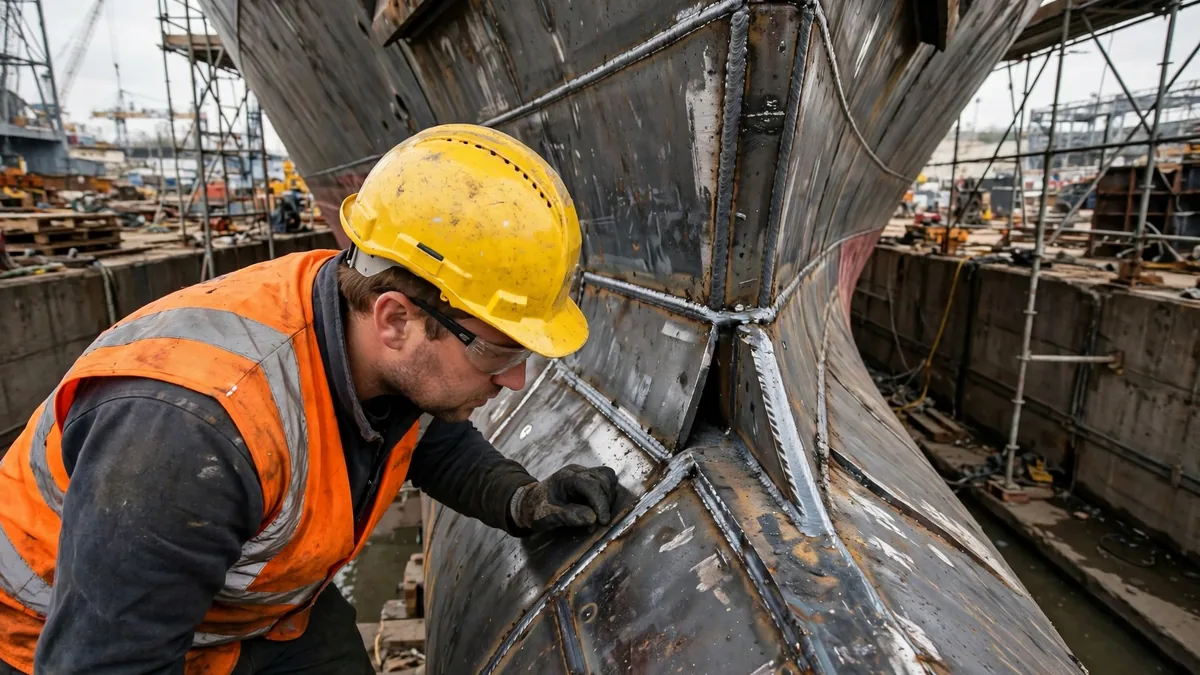
Plating at the stem runs from eighteen to thirty millimetres, roughly double the thickness of the plating amidships, because the bow takes the hardest punishment: waves slamming, anchors swinging, ice in northern waters, and the occasional bump against a quay. The steel is a high-strength grade, and the welds are inspected with ultrasound, because a crack at the stem can run, and a running crack at sea is the kind of problem that ends voyages.
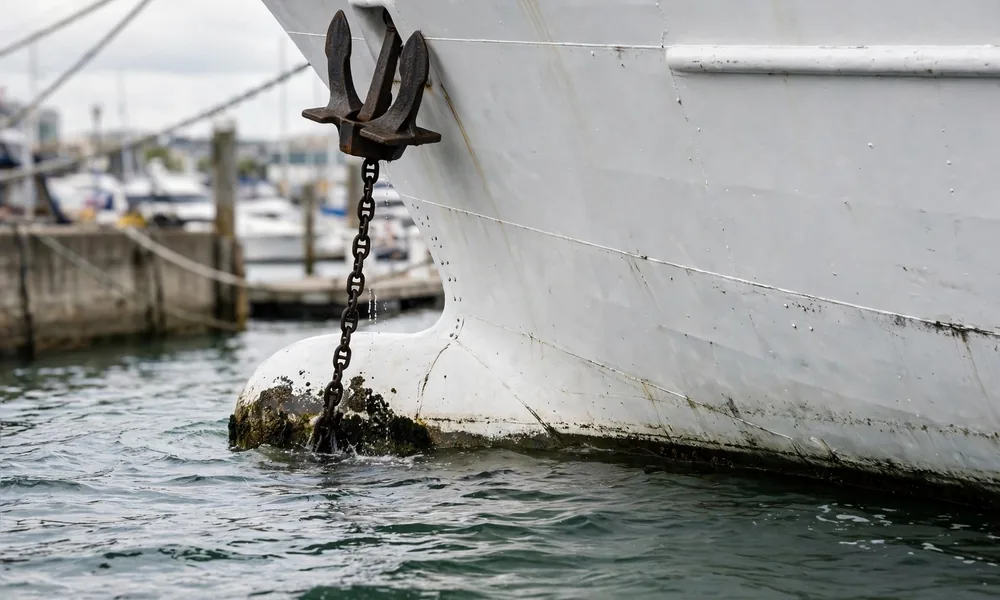
The anchors are part of the bow specification too. A single anchor on a large luxury ship can weigh between eight and fifteen tonnes, and it hangs from a chain where every link is the size of a dinner plate. The same obsession with weight, strength and careful fitting runs through the rest of the hull, and why an aluminium hull costs so much explains what happens when builders try to get the same strength from a much lighter metal. The choices around the bow’s structure are inseparable from the material of the hull itself, and how a carbon fibre yacht hull is specified shows the same trade between weight and strength taken to its extreme.

A Rare Fact About the Bow
Here is a detail that surprises even people who work at sea. On some of the largest luxury ships, the bulbous bow is so precisely tuned that the shipyard builds it as a separate piece, tests it, and then welds it on last, and the bulb alone can be longer than a city bus. It is a small, hidden piece of engineering, invisible whenever the ship is in the water, and it quietly decides how much fuel the ship burns on every single voyage.
What the Specs Mean for You
If you are choosing a cruise, or simply standing on deck watching the sea, the bow specification tells you how the ship will feel when the weather turns. A raked stem with generous flare and a well tuned bulb means a softer ride, a drier foredeck, and a ship that does not fight every wave it meets.
The next time you board a luxury ship, walk forward before the crowds arrive and look down at the water breaking against the stem. You will see the rake, the flare, and the faint swirl where the bulb is working below the surface.


