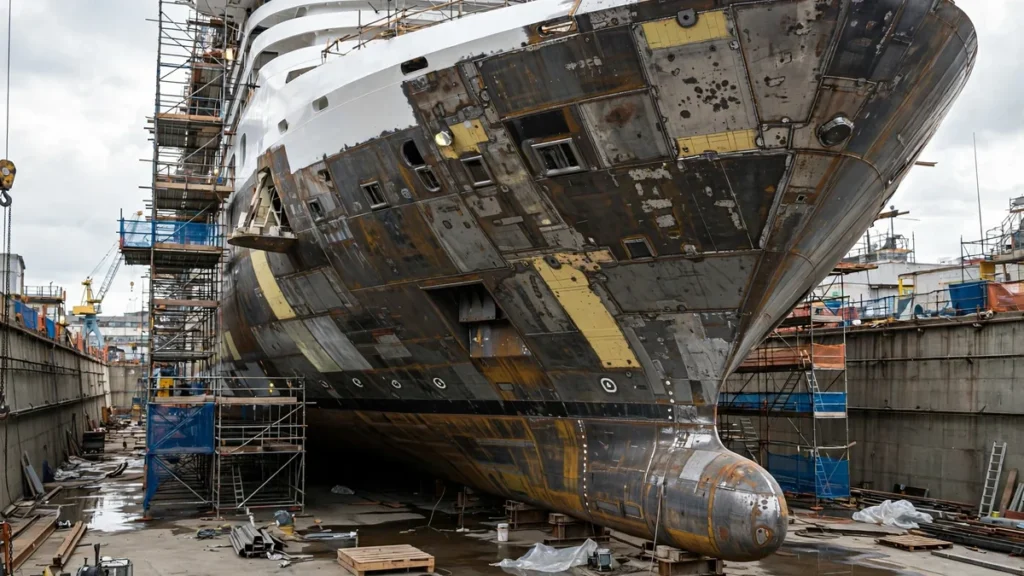
Stand on the quay beside a large ship in dry dock and the propeller is the first thing that stops you. It hangs under the stern like a bronze flower, several metres across, each blade curved and polished, and it looks far too beautiful to be a piece of machinery.
A luxury ship propeller is not bought off a shelf. It is designed for one hull, one engine, and one cruising speed, then cast, machined, and balanced as a single piece of metal. The specification sheet that comes with it reads like a foreign language to most people, full of diameters, pitches, and blade areas, but each number answers a simple question about how the ship will move through the water.
This guide reads that specification sheet line by line. It explains what each number means, how the propeller is made, and why two ships of the same size can end up with propellers that look nothing alike.
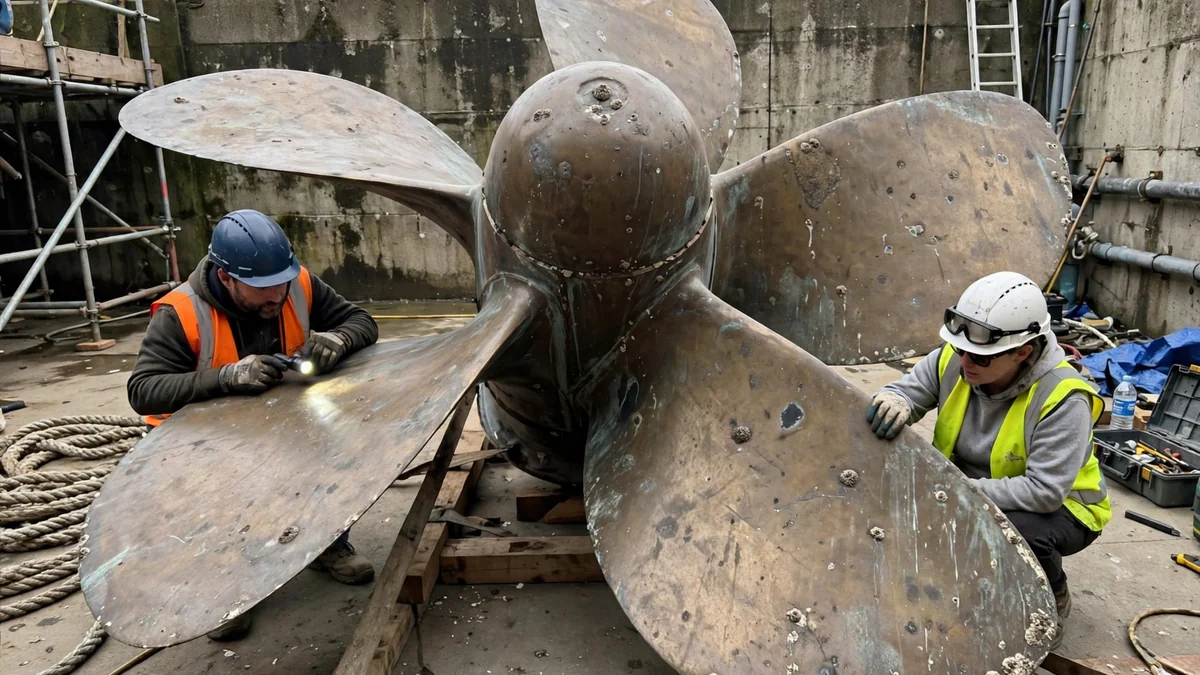
1. Diameter: the size of the circle the blades sweep
The diameter is the simplest number on the sheet and the most important. It is the width of the circle swept by the blade tips as the propeller turns, and on a large luxury ship it is commonly between three and seven metres. A bigger diameter moves more water with each turn, which usually means better efficiency at cruising speed, but the hull sets a hard limit, because the blade tips must clear the hull above and the seabed below.
Designers trade diameter against tip speed. Spin a huge propeller too fast and the blade tips start to cavitate, forming bubbles that collapse violently and eat away at the metal. That is why large ships turn their propellers slowly, often below 150 revolutions per minute, while smaller fast craft spin small propellers much faster. The rudder sits directly behind the propeller and shapes the flow it produces, as explained in the guide to how a luxury ship rudder works, where the two parts are tuned together as a pair.
2. Pitch: how far the propeller screws through the water
Pitch is the distance the propeller would travel forward in one full turn if it were screwing through a solid, like a wood screw through timber. A propeller with a pitch of five metres would, in theory, advance five metres per revolution.
Pitch is matched to the engine and the ship’s speed. Too much pitch and the engine cannot reach its rated speed, so it labours and burns extra fuel. Too little pitch and the engine over-revs while the ship crawls. Many luxury ships use controllable-pitch propellers, where the blades rotate in their hub so the pitch can be changed from the bridge, giving full thrust ahead or astern without reversing the engine.
3. Blade count and blade area: grip on the water
Most large ship propellers have four, five, or six blades. More blades spread the load and run more quietly, which matters on a luxury ship where vibration in the cabins is unacceptable, but each extra blade adds drag and cost. Four blades are common on cargo ships, while five or six blades are chosen when quiet running matters more than the last fraction of efficiency.
Blade area ratio measures how much of the swept circle is actually covered by metal. A high ratio, up to 1.0 or more, is needed when the propeller is heavily loaded and cavitation is a risk. The designer picks the smallest area that keeps cavitation under control, because extra blade area is extra drag on every voyage.

4. Materials: bronze, and why it stays the standard
Almost every large ship propeller is cast from nickel aluminium bronze, an alloy of copper, aluminium, nickel, and iron. It resists corrosion in seawater, it is strong enough to carry enormous bending loads, and it can be repaired by welding when a blade is damaged.
The casting is a major event in itself. Molten bronze at over 1,000 degrees Celsius is poured into a sand mould the size of a small room, then left to cool slowly for days so the metal does not crack. The rough casting is then machined on a huge lathe and milling machine, polished by hand, and balanced so precisely that a multi-tonne propeller spins without shaking the ship. The shaft that carries it is a costly component in its own right, as shown by why a luxury ship propeller shaft is so expensive, where forging, bearings, and seals all add to the price.
5. Testing: balancing, cavitation, and the sea trial
Before a propeller is fitted, it is balanced on a machine that detects even a tiny unevenness in weight. A heavy blade would send a vibration through the whole ship at cruising speed, so metal is ground away or added until the balance is within a few hundred grams on a propeller weighing many tonnes.
The real test comes at sea. During trials, the ship runs at set speeds while engineers measure fuel use, vibration, and noise. If cavitation is heard or the speed falls short, the propeller may be taken off and repitched, a costly but normal part of tuning a new ship. The hull it pushes through the water is built to match, as described in how a luxury ship hull is made, where the shape of the stern decides how cleanly water reaches the blades.
Luxury Ship Propeller Specs
| Specification | Typical range |
|---|---|
| Diameter | About 3 to 7 metres on a large luxury ship |
| Pitch | About 3 to 6 metres, matched to engine and speed |
| Blade count | Usually 4, 5, or 6 blades |
| Blade area ratio | About 0.5 to 1.0 |
| Material | Nickel aluminium bronze |
| Rotation speed | About 80 to 150 revolutions per minute |
| Weight | About 10 to 40 tonnes |
| Service life | About 20 to 25 years with repairs |
What Does a Luxury Ship Propeller Cost?
A propeller for a large luxury ship is estimated to cost roughly $500,000 to $2,500,000, depending on its size, blade count, and whether the pitch is fixed or controllable. A fixed-pitch bronze propeller of about four metres is estimated at roughly $500,000 to $900,000, while a large controllable-pitch propeller of six metres or more is estimated at roughly $1,500,000 to $2,500,000. Machining, balancing, and fitting add further cost, and a spare propeller, which many owners keep, doubles the bill.
A Rare Fact
Some of the largest ship propellers ever cast weigh more than 100 tonnes, heavier than a fully loaded passenger jet, yet they are balanced so finely that they spin for decades without shaking the ship. The largest single-piece bronze castings in the world are propellers, and only a handful of foundries on Earth can pour them.
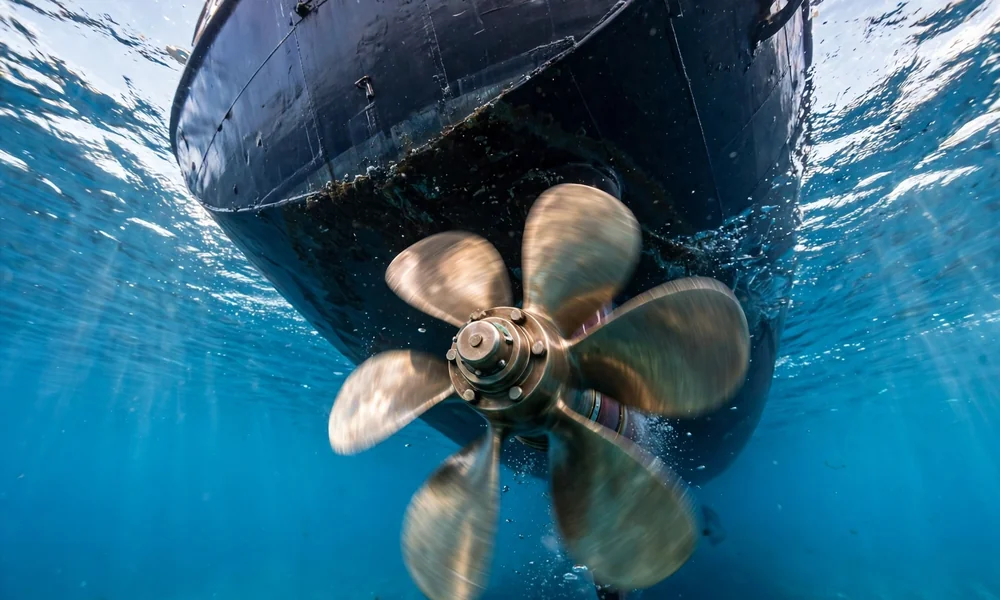
A propeller looks simple from the quay, a few curved blades on a hub, but its specification sheet carries the whole character of the ship: how fast she will go, how quietly she will run, and how much fuel she will burn. Read the diameter, the pitch, and the blade count, and you can picture the vessel before you ever step aboard.