Picture a ship the length of three football fields moving through the water at twenty knots, and imagine turning it. There is no steering wheel that connects to the sea, no handle to grab hold of, only a flat blade of steel hanging behind the propeller, smaller than you would expect for the job it does.
A rudder works by using the water itself as a lever. The propeller pushes a fast stream of water backwards, the rudder sits in that stream, and when it angles to one side it deflects the flow, creating a sideways force at the stern that swings the ship’s heading.
On a luxury ship, where the bridge is quiet and the steering feels effortless, the rudder is doing heavy work out of sight, underwater and unnoticed. Here is how a luxury ship rudder works, from the wheel on the bridge to the steel blade in the water.

1. The helm order reaches the steering gear
Everything starts on the bridge, where the officer of the watch turns the helm or enters a course into the autopilot. That command travels as an electrical signal down to the steering gear compartment at the stern, a steel room deep in the ship where the rudder machinery lives. Modern ships use a follow-up system, which means the rudder moves to exactly the angle ordered and stops there, rather than drifting past the command, and the helmsman can see the actual rudder angle on a display at all times.
The signal is checked against the rudder’s position by sensors on the rudder stock, the shaft that carries the blade, so the system knows where the rudder is and how fast it is moving. The bridge itself is a study in control, and how a luxury ship helm works explains how the wheel, the autopilot, and the steering gear talk to each other.
2. Hydraulic rams push the rudder stock
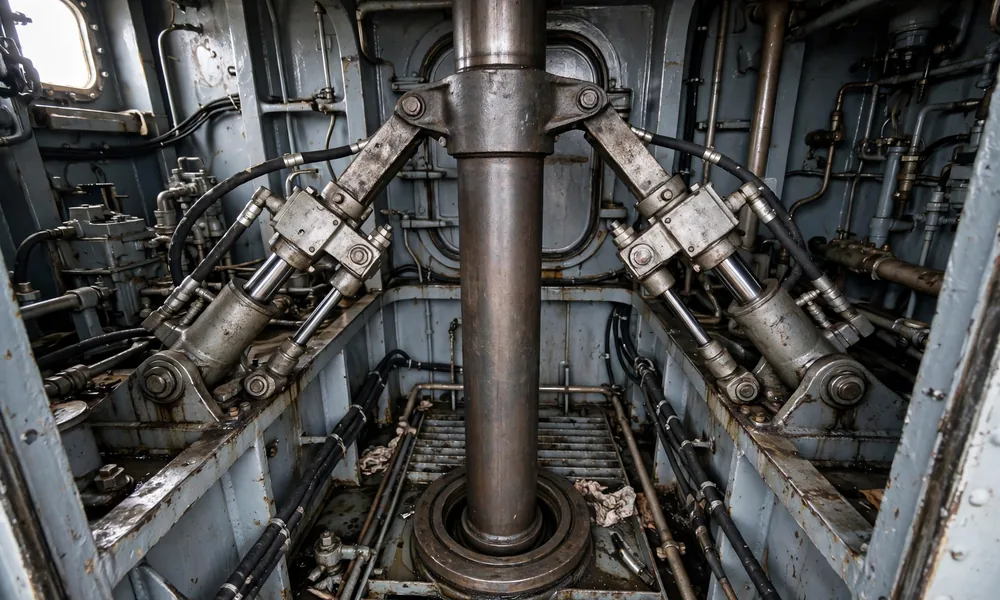
The force that moves the rudder comes from hydraulic rams, large cylinders that push and pull on a tiller arm attached to the top of the rudder stock. On a big ship there are usually two independent hydraulic systems, each with its own pumps and rams, so that if one fails the other can still steer the ship.
The rams are controlled by valves that open in proportion to the steering command, so a small helm movement gives a gentle rudder movement and a hard-over order drives the rudder to its limit quickly. The system is designed so the rudder can move from hard over on one side to hard over on the other in about 28 seconds, a requirement set by maritime rules, because a ship that cannot turn quickly enough is a ship that cannot avoid a collision.
3. The rudder blade deflects the propeller stream
The rudder blade itself is a streamlined steel structure, shaped like a wing standing on its end, with a rounded leading edge and a tapered trailing edge. It hangs in the propeller’s slipstream, and when it turns, the water flowing past it is deflected to one side. That deflection creates lift, a sideways force, just as an aircraft wing creates lift in the air, and because the rudder sits at the stern, that force pushes the back of the ship sideways and swings the bow around.
The blade is hollow and stiffened inside with ribs and webs, and it is filled with corrosion protection and sealed against the sea. The making of the blade is described in how a luxury ship rudder is made, from the steel plates to the finished, balanced blade.
4. The ship turns, heels, and steadies
When the rudder force swings the stern, the ship begins to turn, and the hull itself starts to generate its own turning force as water flows along its side at an angle. The ship heels slightly outward at first, then inward as the turn develops, and the officer on the bridge watches the rate of turn and eases the rudder back toward amidships before the ship overshoots the new course. A large ship does not turn like a car; it advances forward for several ship lengths while it swings, and the turning circle can be more than a kilometre across.
At higher speeds the rudder is more effective, because the water flows faster past it, but the forces are also greater, so the helm is used gently at speed and more boldly at slow speed. The thruster that does that job is covered in how a luxury ship bow thruster works, a neat partner to the rudder in tight manoeuvres.
5. Feedback, autopilot, and emergency steering
Once the ship is on its new course, the autopilot takes over, making tiny rudder movements to hold the heading against wind and current, often using less rudder than a human helmsman would. The system constantly compares the ship’s heading with the ordered course and adjusts, and on a long ocean passage it can steer for days with barely a degree of error, saving fuel by keeping the rudder near amidships where drag is lowest.
If the main steering fails, emergency steering takes over, and this is where the redundancy matters. The crew drills for steering failure regularly, because a ship without steering is at the mercy of the sea, and the ability to keep steering is one of the most important safety systems on board.
How Luxury Ship Rudder Works: Specs
| Specification | Typical range |
|---|---|
| Rudder area | About 2 to 4 percent of the hull’s lateral area |
| Rudder weight | About 20 to 80 tonnes on a large ship |
| Maximum rudder angle | About 35 degrees each side of amidships |
| Hard-over to hard-over time | About 28 seconds or less |
| Hydraulic pressure | About 150 to 200 bar |
| Steering systems | Two independent hydraulic systems |
| Rudder stock diameter | About 400 to 800 millimetres |
| Turning circle | Several ship lengths in diameter |
What Does a Luxury Ship Rudder Cost?
A rudder and steering gear for a large luxury ship is estimated to cost roughly $500,000 to $2,000,000, depending on the size of the blade, the torque of the steering gear, and the level of redundancy fitted. The rudder blade alone is estimated at roughly $200,000 to $800,000, while the hydraulic steering gear, pumps, and controls are estimated at roughly $300,000 to $1,200,000. Overhauling the steering gear in dry dock is estimated at roughly $100,000 to $300,000, which is why it is inspected and maintained on a strict schedule.
A Rare Fact
Some of the largest ships ever built have rudders so heavy that they cannot be lifted by a single crane, and they are fitted in dry dock using two cranes working together, or floated into place on pontoons. The rudder of a very large container ship can weigh more than 300 tonnes, heavier than a fully loaded jumbo jet, and it still turns on a single shaft, guided by bearings that must never fail.

The rudder is the quietest hero of a ship. It has no glamour, no speed, and no noise, yet without it the most powerful engines in the world could only push a ship in a straight line.


