At first light in a quiet Mediterranean marina, a white yacht slipped away from the quay without a sound. There was no rumble of diesel, no puff of exhaust, no vibration through the deck. The only movement was the slow turn of the crew on deck and the glint of dark glass panels across the roof, already drinking in the morning sun.
The honest answer is written in its specifications, and those numbers tell a more interesting story than the silence does. A luxury solar yacht is not a normal yacht with a few panels bolted on. This guide explains the key specifications of a luxury solar yacht: the solar array, the battery bank, the range, the speed, and how the whole system fits together.
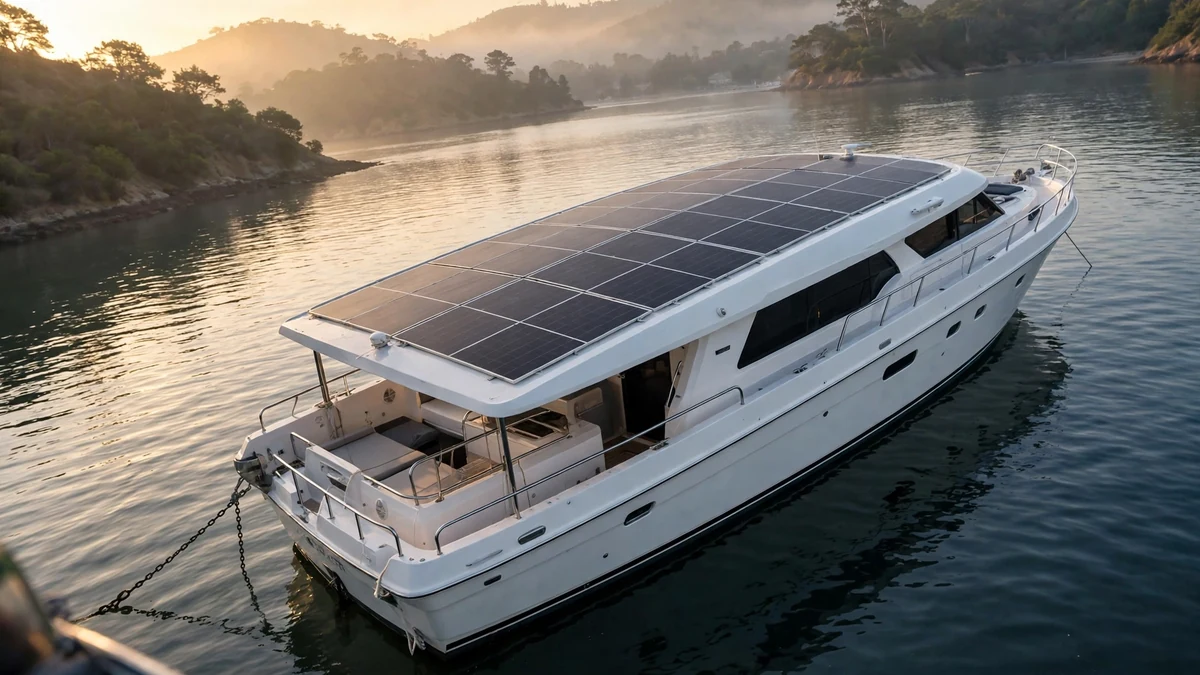
Step 1: The solar array catches the light
Everything starts on the roof. A luxury solar yacht carries a large array of photovoltaic panels, usually spread across the hardtop, the coachroof, and sometimes the deckhouse sides. A typical installation on a yacht of around 18 to 24 metres produces between 10 and 20 kilowatts at peak output in strong sunshine.
The panels feed direct current into charge controllers, which squeeze the maximum power from the array as the sun moves and clouds pass. On a good summer day in the Mediterranean, an array of this size can generate 50 to 80 kilowatt-hours of electricity, which is the fuel for everything that follows.
Step 2: The battery bank stores the sunshine
Sunlight is only useful if it can be kept until it is needed, and that is the job of the battery bank. Luxury solar yachts use lithium iron phosphate batteries, chosen for safety, long life, and the ability to charge and discharge deeply without damage. A typical bank stores between 100 and 250 kilowatt-hours, which is roughly the energy in two to five large electric car batteries, packed low in the hulls where the weight steadies the boat.
The battery bank is the heart of the specification sheet. Its size decides how far the yacht can motor after sunset, how long the air conditioning can run at anchor, and how much reserve the captain keeps for a cloudy week. The luxury electric yacht specifications, explained show how the same battery thinking applies across electric yachts, and the solar yacht simply adds its own charging source on top.
Step 3: Electric motors turn power into motion
The motors on a luxury solar yacht are electric, quiet, and usually mounted in pods beneath the hulls. A common setup is two motors of 50 to 100 kilowatts each, giving a combined output of 100 to 200 kilowatts, which is roughly 130 to 270 horsepower. That sounds modest beside a diesel yacht of the same size, and it is, but electric motors deliver their full torque from a standstill, so the yacht accelerates smoothly and holds speed without drama.
The trade-off is that the motors draw heavily on the battery bank, which is why the speed and range figures must always be read together, never on their own.
Step 4: Range depends on speed more than anything else
Range is the specification buyers ask about first, and it is also the easiest to misunderstand. At a gentle cruising speed of 5 to 6 knots, a luxury solar yacht can motor for many hours on its batteries, and on a sunny day the panels replace much of what the motors use, stretching the range to 100 nautical miles or more.
Push the throttle to 10 or 12 knots and the picture changes completely. The power needed rises steeply with speed, because pushing a hull through water takes far more energy with every extra knot, and the battery bank can drain in one or two hours. The solar array cannot keep up at that pace.
Step 5: Speed, and what the top number means
Most luxury solar yachts cruise at 6 to 8 knots and reach a top speed of 10 to 14 knots, depending on size, weight, and motor power. A solar yacht is built for silent, unhurried passages and long stays at anchor, not for racing between marinas.
The hull shape helps. Many solar yachts are catamarans, with two slim hulls that slip through the water with little resistance, and the wide deck between them gives room for more panels. How a luxury electric yacht is made describes the same lightweight construction, and the solar version takes it one step further.
Step 6: Charging, house loads, and life at anchor
The last part of the system is the one owners feel every day: the house loads. Air conditioning, refrigeration, cooking, water making, and lighting all draw from the same battery bank as the motors.
At anchor on a sunny day, the yacht can be self-sufficient, with the panels covering the house loads and recharging the batteries for the evening. The charge controllers, the inverter, and the battery management system work together silently, and the crew watches it all on a single screen at the helm.

Key specifications at a glance
| Specification | Typical figure |
|---|---|
| Length | 18 to 24 metres |
| Solar array | 10 to 20 kilowatts peak |
| Daily solar yield | 50 to 80 kilowatt-hours in summer sun |
| Battery bank | 100 to 250 kilowatt-hours, lithium iron phosphate |
| Motors | Two electric motors, 50 to 100 kilowatts each |
| Cruising speed | 6 to 8 knots |
| Top speed | 10 to 14 knots |
| Range at cruising speed | 100 nautical miles or more on a sunny day |
| Guests | 8 to 12, with 3 to 4 crew |
What a luxury solar yacht costs
As an estimate, a new luxury solar yacht of this size typically costs between 4 million and 10 million dollars, depending on length, build quality, and the size of the solar and battery systems. The solar array and the battery bank add a large share of that figure, and the custom interior, with its hand-finished wood, stone, and fabrics, adds much of the rest.
A rare fact
Here is a rare fact worth knowing: on some solar yachts, the panels generate so much power on a bright day at anchor that the crew must find ways to use it, running the watermaker, the air conditioning, and the laundry at full tilt simply to soak up the surplus. The yacht becomes a small power station that happens to float, and the limiting factor is no longer generating electricity but finding something useful to do with it. What a hybrid electric yacht is shows the alternative approach, where a diesel generator fills the gaps the sun leaves behind.
The specifications of a luxury solar yacht only make sense as a system. The array feeds the bank, the bank feeds the motors and the house, and the speed decides how far the whole arrangement will carry you. Read the numbers together, ask what speed the range was measured at, and check the usable battery capacity rather than the headline total. Do that, and the quiet yacht slipping out of the marina at dawn stops being a mystery and becomes a machine you can understand, right down to the last kilowatt.


