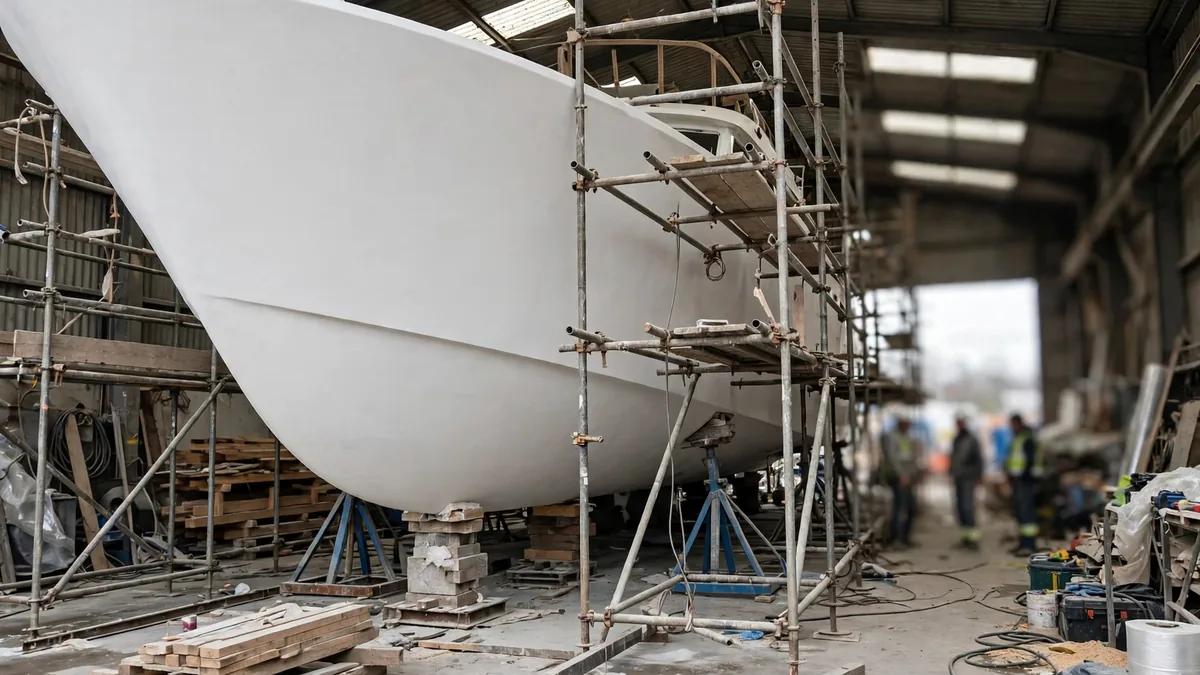
On a still morning in a northern Italian shipyard, a hull the colour of brushed pewter slides out of its shed on cradles, and the first thing you notice is what is missing. There is no funnel, no exhaust stack, no diesel rumble shaking the water. A luxury electric yacht is built around silence, and that silence starts long before launch day, in design offices where naval architects argue over kilograms the way other yards argue over horsepower. Every battery cell, every metre of cabling and every piece of furniture has to earn its place, because weight is range, and range is the whole promise of the boat.
The yard building her is not a car plant. A handful of hulls a year is a busy schedule, and much of the work is still done by hand: laminators laying carbon fibre by eye, joiners fitting teak by millimetres, electricians threading cable through spaces no bigger than a shoebox. What follows is the journey from bare mould to first silent cruise, and the engineering choices that make an electric yacht feel less like a boat with batteries and more like a floating house that happens to move.
How a luxury electric yacht is made
Step 1: Designing the hull around the battery
Everything begins with the battery, not the bow. Designers decide how far the owner wants to cruise on electric power alone, then work backwards to the size and weight of the pack, which can weigh as much as a small car. The hull is drawn around that mass, with the pack set low and central to keep the centre of gravity down and the ride steady. Naval architects run tank tests and computer simulations to shape a hull that slips through the water with as little resistance as possible, because every knot of drag is energy the batteries cannot spare. The result is usually a long, slender hull with a fine entry, quite different from the bluff bows of older diesel yachts.
Step 2: Laying up the composite hull
Most luxury electric yachts are built from carbon fibre or glass fibre composites rather than steel, because saving weight matters more than anything else. In the mould, laminators lay sheets of fibre cloth by hand, brushing in resin layer by layer, then the whole hull is sealed under vacuum and cured in an oven so the resin hardens evenly. Bulkheads and structural frames are bonded in while the hull is still in the mould, and the deck is laminated separately before the two halves are joined. A single hull can take weeks of laminating, and the quality of this work decides whether the yacht is quiet and stiff or creaks and flexes for the rest of its life.
Step 3: Installing the battery bank and electric motors
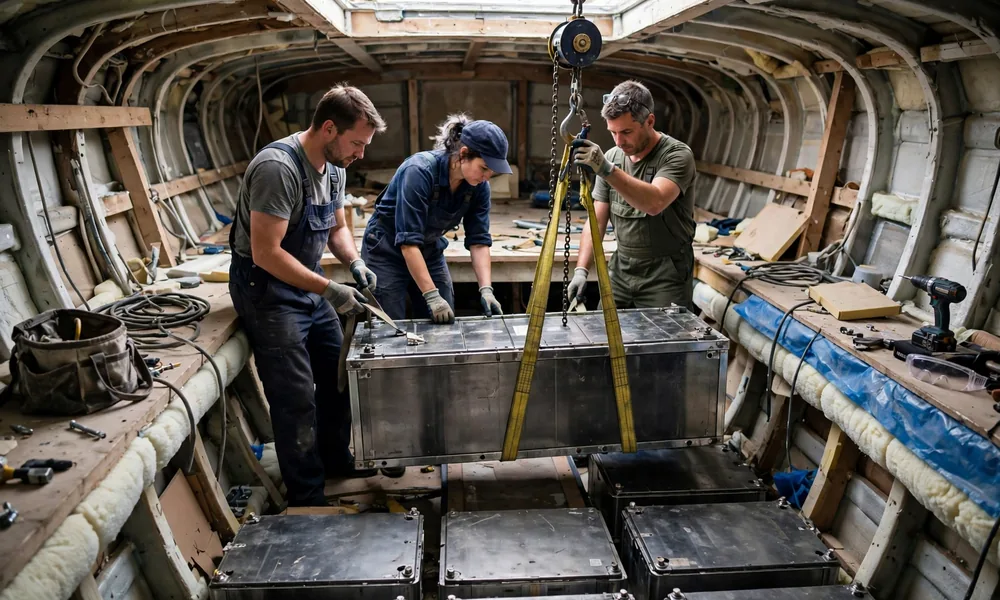
With the hull cured, the battery modules arrive in sealed, fire-resistant compartments, each one wired with its own cooling loop and monitoring system. Technicians lower the packs into place with cranes and bolt them to reinforced bearers, then connect them to the power management system that decides when to draw, when to charge and when to protect the cells. Electric motors, far smaller and lighter than diesel engines of the same power, are mounted on flexible beds to stop vibration reaching the cabins.
Step 4: Fitting the charging and energy systems
An electric yacht is also a power station. Shore-power chargers, solar panels on the hardtop, and often a small range-extender generator are all wired into the same energy system, so the crew can top up at a marina, harvest sun at anchor, or cruise further when the batteries run low. The galley, air conditioning and stabilisers all draw from the same bank, so energy management software juggles demand around the clock, quietly shutting down non-essential loads when the owner asks for full speed. Cabling runs through dedicated fireproof trunking, and the switchboards look more like those of a small ship than a pleasure boat.
Step 5: Joinery, cabins and the quiet interior
Only when the engineering is complete does the interior go in. Joiners fit cabins, saloons and galleys in book-matched veneers and hand-stitched leather, working around the battery compartments and cable runs that were planned in from the start. Because there is no engine noise or exhaust smell, the finish can be lighter and more open: large windows, pale timbers and thin insulation that would never survive beside a diesel. Soundproofing still matters, but now the enemy is the hum of pumps and the slap of water, so floating floors and soft-mounted panels keep the cabins almost silent at cruising speed.
Step 6: Sea trials and the silent sign-off
The finished yacht goes to sea for trials that last days, not hours. Engineers measure range at different speeds, test the battery management under full load, and check that the motors deliver their rated power without overheating. They also listen. A luxury electric yacht is signed off only when the cabins stay quiet at cruising speed, the helm answers without delay, and the boat can hold station on electric power alone. The owner takes delivery when the trials data matches the design promises, and the first cruise is usually taken at a gentle pace, the crew learning how far the batteries really go in real water.
Luxury electric yacht specifications
| Specification | Typical figure |
|---|---|
| Length overall | 24 to 40 metres |
| Battery capacity | 800 kWh to 2,500 kWh |
| Electric cruising range | 40 to 100 nautical miles |
| Top speed | 18 to 25 knots |
| Propulsion | Twin electric pod drives |
| Guests | 8 to 12, plus crew |
What a luxury electric yacht costs
Prices vary enormously with size and finish, but a new luxury electric yacht of around 30 metres typically costs an estimated $15 million to $30 million, with larger or fully custom builds passing $50 million. The battery system alone can account for several million dollars of that figure, and the cost of the electric drivetrain is partly offset by simpler maintenance: fewer moving parts, no diesel servicing, and no exhaust system to replace. Running costs are lower than a comparable diesel yacht, but marina charging infrastructure and battery replacement after many years remain real expenses owners plan for from the start. For a closer look at how the systems behave once the yacht is running, read how a luxury electric yacht works, and for the numbers behind the brochure, see the luxury electric yacht specs explained.
A rare fact about luxury electric yachts
Some of the quietest electric yachts are so silent at low speed that their builders fit underwater speakers, not for music, but to warn swimmers and marine life that the boat is moving. It is a strange reversal of a century of yacht design, where the problem was always making engines quieter, and now the problem is making silence safe.

Building a luxury electric yacht is an exercise in subtraction: less noise, less vibration, less machinery, and more thought about where every kilogram goes. The yards that do it well treat the battery as the heart of the boat rather than an accessory, and the result is a yacht that changes how people spend time on the water. If you are wondering why that silence comes at such a price, the real cost of a luxury electric yacht explains where the money goes, from carbon fibre to charging systems.