The first time you lift the lid of a really good turntable, you expect drama. A flash of chrome, maybe, or a platter that glows. What you actually get is quiet. That is the whole point of a luxury turntable. It does not shout about its quality. It hides it in tolerances you cannot see, in weights you can barely feel, and in numbers that only make sense once you know what to look for.
Most of us grew up with turntables that were, frankly, toys. A plastic box, a belt that slipped, a needle that skipped if you walked too hard across the room. A luxury turntable is the opposite. Every part has been engineered to do one job: spin a record at exactly the right speed, hold the stylus perfectly still in the groove, and get out of the way of the music. The specifications printed on the box are the shorthand for all of that engineering.
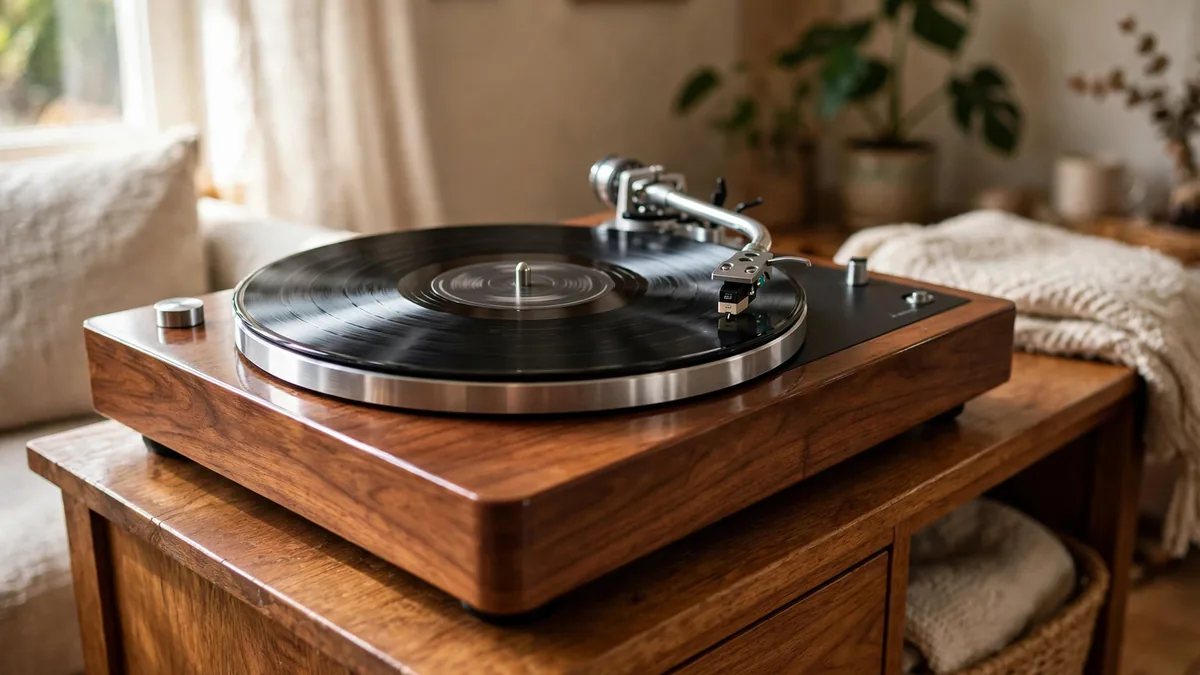
Speed: The Number That Decides Everything
A record is a spiral of sound, and its pitch depends entirely on how fast it turns. A standard album spins at 33⅓ revolutions per minute, a single at 45. If the speed drifts by even a fraction of a percent, every note drifts with it. That is why speed accuracy is the first specification worth reading.
On a luxury turntable, speed accuracy is usually quoted as a percentage, and the numbers are tiny. A good machine holds 33⅓ rpm to within plus or minus 0.1 percent, and the best manage 0.05 percent or better. The heavy platter matters more than it looks. A platter weighing five kilograms or more carries so much momentum that a tiny wobble in the motor cannot push it off speed.
Wow and Flutter: Hearing the Wobble
Wow and flutter is the measurement of speed variation, and it tells you whether a turntable will sound steady or seasick. Wow is the slow drift, the gentle rise and fall of pitch over seconds. Flutter is the fast jitter, a trembling that roughens the sound. They are quoted together as a percentage, and lower is always better. A decent turntable might manage 0.15 percent. A luxury machine aims for 0.1 percent or less, and the finest reach 0.05 percent or even 0.03 percent.
What makes the number hard to achieve is everything that can disturb a spinning disc. A motor that pulses, a belt that stretches unevenly, a platter bearing with the slightest roughness, a record that is not perfectly flat. Luxury makers attack each of these separately. They machine the platter bearing from hardened steel running in a brass sleeve with a film of oil between them. Each fix shaves a little more off the wow and flutter figure, and the number on the sheet is the sum of all that quiet work.

The Tonearm and the Cartridge
If the platter is the heart of the turntable, the tonearm is its hand. It holds the cartridge, and the cartridge holds the stylus, the tiny diamond tip that rides in the groove and reads the music. The tonearm has to let the stylus follow those movements freely while keeping it from bouncing or resonating like a tuning fork.
Two specifications govern this balance. Effective mass is the weight the stylus feels when it tries to move the arm, usually quoted in grams. A low-mass arm, around 8 to 10 grams, suits a light, compliant cartridge. A heavier arm, 12 grams or more, suits a stiffer cartridge. Get the pairing wrong and the arm and cartridge resonate together at a frequency that colours the sound, usually a woolly thump in the bass. The second specification is the bearing.
The cartridge brings its own numbers. Output voltage tells you how loud the signal is: a moving-magnet cartridge typically gives around 4 to 5 millivolts, while a moving-coil cartridge gives a whisper-quiet 0.2 to 0.5 millivolts and needs a special phono stage to amplify it. Tracking force, the weight pressing the stylus into the groove, is usually between 1.5 and 2 grams, about the weight of a small paperclip. Set it too light and the stylus skips. Set it too heavy and it grinds the groove away.
Signal, Noise, and the Plinth
A turntable’s signal is tiny. The stylus generates a voltage measured in thousandths of a volt, and anything that shakes the machine can be louder than the music itself. Signal-to-noise ratio is quoted in decibels, and for a turntable the figure usually falls between 65 and 80 decibels. Higher is better, and every extra decibel means the silence between the notes is a little blacker.
Makers reach those numbers by isolating the platter and tonearm from vibration. Some use a plinth made of layered wood and resin that turns vibration into heat. Others float the whole mechanism on springs or rubber feet tuned to absorb exactly the frequencies that footsteps produce.

The Specification Sheet, Decoded
| Specification | What to look for | What it means for the sound |
|---|---|---|
| Speed accuracy | ±0.1% or better at 33⅓ and 45 rpm | Notes stay in tune and the pitch never drifts |
| Wow and flutter | 0.1% or lower, 0.05% on the best machines | A steady, still sound with no seasick wobble |
| Signal-to-noise ratio | 70 dB or higher | Quieter silences between notes and less hiss |
| Tonearm effective mass | 8–10 g for light cartridges, 12 g or more for stiff ones | Matched arm and cartridge give clean, controlled bass |
| Channel separation | 25 dB or more, 30 dB is excellent | A wider stereo image with instruments placed clearly |
| Tracking force | Usually 1.5–2.0 g, inside the maker’s range | Enough grip to track the groove without wearing it out |
What a Luxury Turntable Costs
A luxury turntable is not a single price but a ladder. A well-made machine with a good tonearm and a moving-magnet cartridge typically starts at an estimated $2,000 to $5,000. Move into the mid-luxury range, with a heavier platter, a better bearing, and a moving-coil cartridge, and the estimate rises to $8,000 to $20,000.
What you are paying for is not really the parts. It is the labour of making them to tolerances measured in microns, the time spent listening and adjusting, and the fact that many of these machines are built in small batches by people who have spent decades on a single detail, like the shape of a bearing or the damping of a plinth. The specification sheet is your map for those upgrades, because it tells you exactly which number each new part will improve.
If you want to see how one of these machines comes together before you start reading its numbers, our guide to how a luxury turntable is made follows the build from raw materials to finished machine. For the mechanics behind the spin, how a luxury turntable works explains the motor, bearing, and tonearm in motion. And if the price tag still makes you blink, why a luxury turntable is so expensive breaks down where the money actually goes.
A Rare Fact Worth Knowing
Here is a detail that rarely makes it onto a specification sheet. The diamond stylus tip that reads your records is so small that its contact patch with the groove is narrower than a human hair, yet it carries the entire weight of the tonearm on that tiny point. Under a microscope, the tip of a worn stylus looks like a chisel dragged across stone, and a fresh one looks like a polished jewel. The music is what tells you the rest.