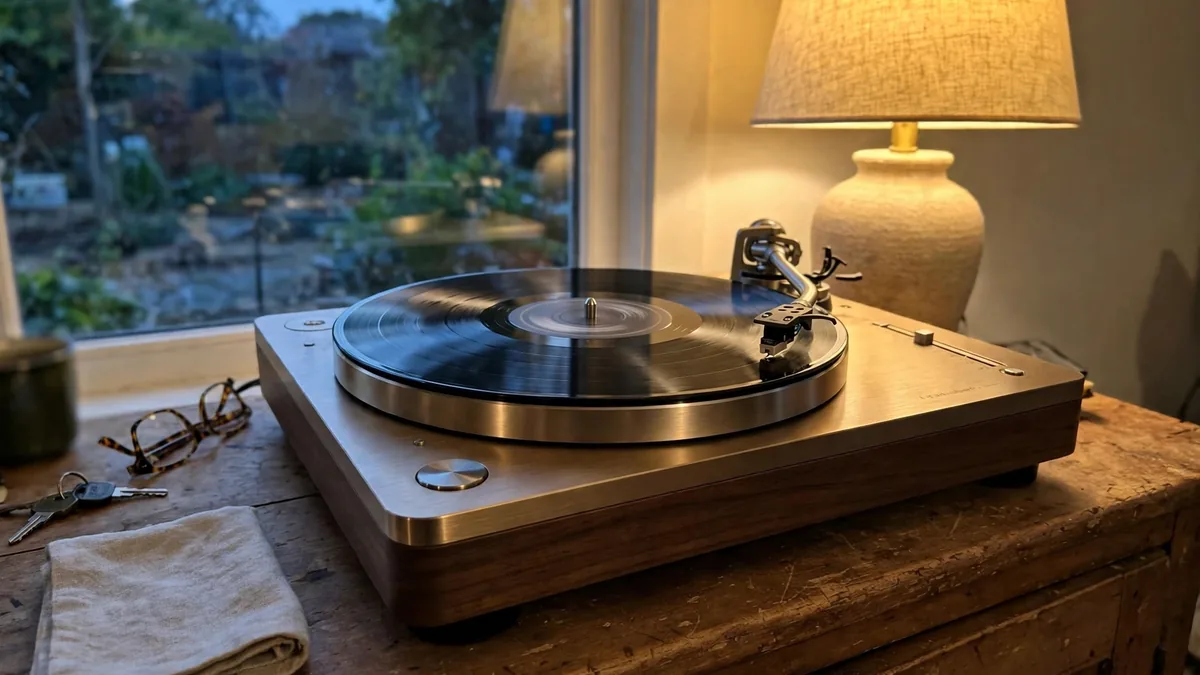
In a living room at dusk, a man lowers a needle onto a black disc, and the room fills with a sound that no digital device quite makes: warm, wide, a little imperfect, with a faint crackle before the first note that tells everyone in the room that the music is real, and that it is being played, right now, by a machine. The machine is a luxury turntable, and it works by a trick so simple it feels like magic: a diamond tip rides in a groove cut into vinyl, and the tiny wobbles of that groove are turned into music, one vibration at a time.
This guide explains how a luxury turntable works, in plain English: the platter that spins the record, the motor that keeps it steady, the tonearm that carries the needle, the cartridge that turns wobble into electricity, the phono stage that makes the signal loud enough to hear, and the plinth that keeps the whole machine still, all working together to play a record.
The platter: a heavy disc that spins true
The heart of a turntable is the platter, the heavy disc the record sits on, and a luxury platter is made from metal or acrylic, machined flat and balanced so precisely that it spins without wobbling. The platter is heavy on purpose, because weight is what keeps it spinning steadily: once it is turning, its mass resists any small push or pull, and the record rides smoothly, without speeding up or slowing down. The record is held flat by the platter, sometimes with a small weight on top called a record clamp, and a thin mat between the record and the platter stops it slipping. The guide to how a luxury turntable is made follows this platter from the factory to the finished machine, where the metal is machined, the bearing is fitted, and the whole platter is balanced on a machine that can feel a wobble no hand could find.
The motor: slow, quiet and exact
The platter is turned by a motor, and a luxury turntable motor is slow, quiet and exact, because the record must spin at exactly thirty-three and a third revolutions a minute, and a motor that hurries or drags will make the music play sharp or flat. The motor is kept quiet by design, because a motor that can be heard is a motor that has failed at its one job.
The tonearm: a lever that must not wobble
The tonearm is the long arm that carries the needle across the record, and it is one of the most delicate parts of the machine. The arm is made from metal or carbon fibre, stiff so it does not bend, and light so it can follow the groove as the record spins.
The cartridge: where wobble becomes music
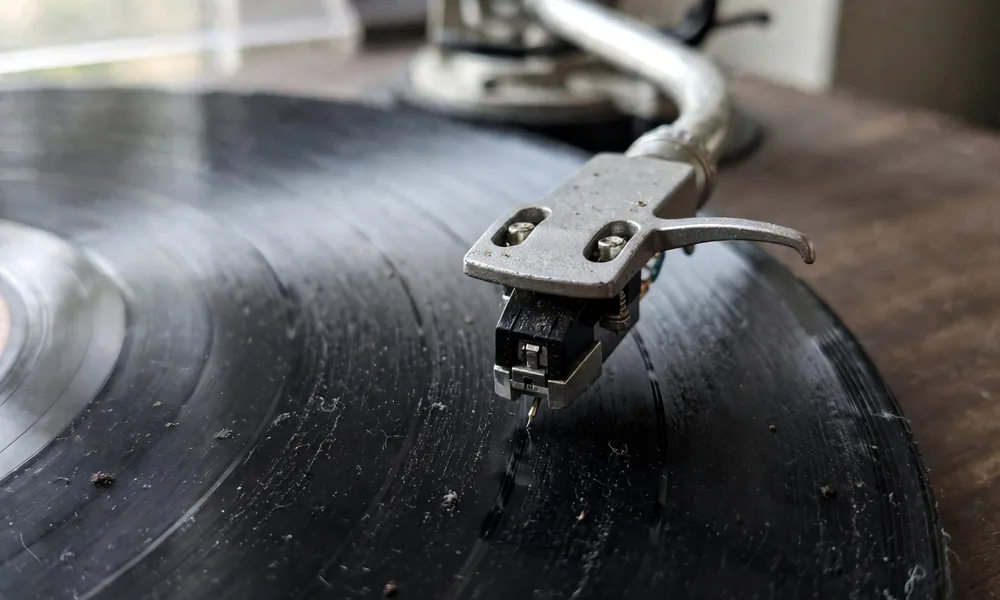
At the end of the tonearm is the cartridge, and inside it is a diamond stylus, the needle, which rides in the groove of the record. The groove is not smooth: it wobbles from side to side, and those wobbles are the music, cut into the vinyl as a physical shape. As the stylus rides the groove, it vibrates, and those vibrations are turned into electricity by a tiny generator inside the cartridge, either a magnet moving past a coil, or a coil moving past a magnet. The signal is tiny, far too quiet to hear, and it is different for the left and right channels, because the groove carries two signals at once, one on each wall. The guide to luxury headphones specs, explained sets out the numbers for a different kind of listening, where the signal is already loud and digital, and the headphones only have to turn it into sound, while a turntable must first rescue its signal from a groove thinner than a hair.
The phono stage: making a whisper loud
The signal from the cartridge is so quiet that it must be amplified hundreds of times before it can be heard, and the part that does this is called the phono stage. A luxury phono stage is built with care, because any noise it adds will be amplified along with the music, and its owner will hear it as a hiss behind every quiet passage. Some turntables have the phono stage built in, and some leave it separate, in its own box, so that the owner can choose one that matches their taste.
The plinth: stillness, by design
The last system is the plinth, the base the whole machine sits on, and it matters more than it seems, because a turntable is a machine that listens to vibrations, and it cannot tell the difference between the groove and a footstep. A luxury plinth is heavy and layered, sometimes made from wood, metal and rubber together, so that vibrations from the floor are absorbed before they reach the record. The guide to how a luxury smartphone works follows a device that works in the opposite way, where the parts are packed tight and the machine is carried everywhere, while a turntable is a machine that stays in one place, and stays still, on purpose.
The turntable at a glance
| Part | Typical luxury figure | What it tells you |
|---|---|---|
| Platter | Heavy metal or acrylic, machined flat | How steadily the record spins |
| Motor | Belt or direct drive, 33 and a third rpm | How the speed stays exact |
| Tonearm | Metal or carbon fibre, counterweighted | How the needle tracks the groove |
| Cartridge | Diamond stylus, magnet or coil generator | How the wobble becomes electricity |
| Phono stage | Amplifies the whisper, corrects the tone | How the signal becomes loud enough to hear |
| Plinth | Heavy, layered, levelled on springs | How the machine stays still while it plays |
| Speeds | 33 and a third, sometimes 45 rpm | Which records the turntable can play |

What it costs
A luxury turntable typically costs an estimated $1,000 to $5,000, depending on its platter, its tonearm and its cartridge, and the estimate covers the turntable alone, not the phono stage, the amplifier or the speakers, which are a real part of playing a record, and which can cost as much as the turntable itself. The estimate also leaves out the records, which are bought one at a time, and which are a real part of owning a turntable, though a single record can be played a hundred times and still sound new.
A rare fact
One detail few owners ever learn is that a record groove is so fine that the stylus reads details smaller than the width of a human hair, and the whole side of a record, twenty minutes of music, is cut into a groove that would stretch for about half a mile if it were unwound in a straight line. It is the slowest journey in the house, and it is the one that makes the most sound.
Put the six systems together, platter first, then motor, tonearm, cartridge, phono stage and plinth, and a luxury turntable stops looking like an old-fashioned machine with a needle and starts looking like what it is: a precision instrument that turns a wobble in plastic into music, by keeping everything still except the one tiny diamond that is allowed to move.