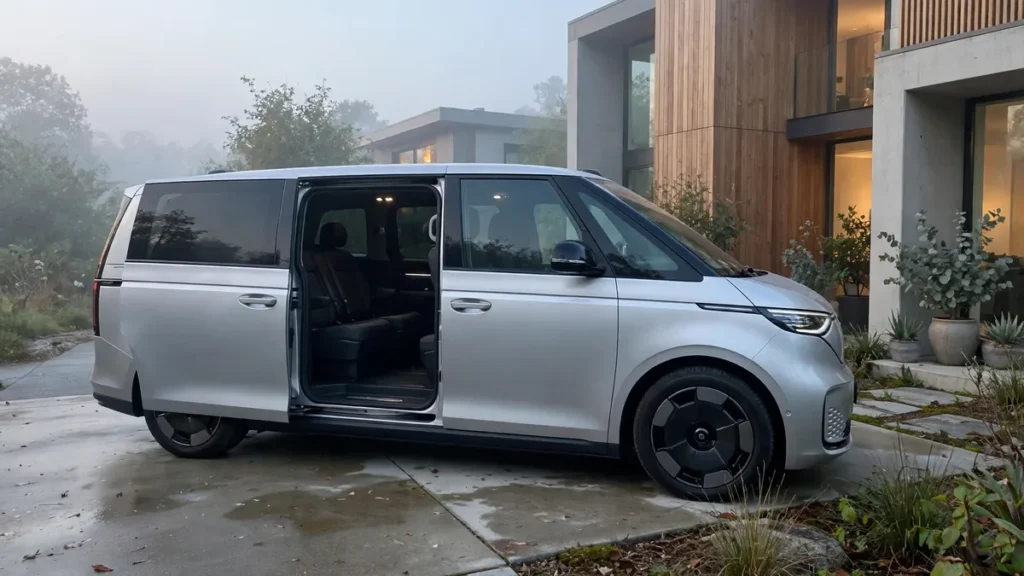
The sliding door opens with a soft electric whirr, and the inside does not look like a van at all. There is standing headroom, a flat floor, four leather chairs that face each other across a small table, and a ceiling that glows with a thin strip of warm light. Outside, the vehicle is a plain black box on wheels, the sort of thing that disappears in a hotel car park. Inside, it is a meeting room that happens to move at motorway speed. That contrast is the whole idea of a luxury van: a full-size van, bigger and taller than any minivan, rebuilt from the bare metal up as a private lounge for eight or ten people.

The spec sheet at a glance
| Figure | Typical range | What it tells you |
|---|---|---|
| Length overall | Roughly 5.9 to 7.4 metres | How long the van is, and whether it fits a standard parking space |
| Interior height | Roughly 1.9 to 2.0 metres | Whether passengers can stand and walk inside |
| Seating | Usually 8 to 12 seats | How many people travel in comfort, not just in theory |
| Engine | Diesel or electric, roughly 190 to 280 hp | How it pulls a heavy, fully loaded body |
| Payload after conversion | Roughly 800 to 1,200 kilograms | How much the luxury fit-out leaves for people and luggage |
| Wheelbase | Roughly 3.7 to 4.3 metres | How stable the ride is, and how wide it turns |
| Price | Roughly $120,000 to $350,000 | What a converted luxury van costs, as an estimate |
Size first: a van, not a big car
A luxury van starts life as a full-size commercial van, the tall, long kind used for deliveries and airport shuttles, and that starting point matters. It is roughly six to seven and a half metres long, with an interior tall enough for most adults to stand upright, and that height changes everything about the conversion. Where a luxury minivan, which you can read about in how a luxury minivan works, squeezes seven seats into a car-shaped body, a luxury van has room for a flat floor, a proper aisle, and chairs that swivel, recline and slide on rails. The wheelbase, the distance between the front and rear wheels, runs roughly 3.7 to 4.3 metres, and a longer wheelbase is what gives the van its calm, level ride.
The engine: moving a small building
A converted luxury van is heavy. The base vehicle weighs around three tonnes before the conversion, and the interior adds leather, wood, screens, batteries and sound insulation, so the engine has real work to do. Most conversions keep the standard diesel, a turbocharged four-cylinder making roughly 190 horsepower, with a nine-speed automatic gearbox that keeps the revs low and the cabin quiet. Either way, the figure that matters most is torque, the twisting force that gets a heavy van moving from a standstill, and diesel vans make most of theirs at low revs, which is why they pull away smoothly even with ten people and their luggage aboard.
The cabin: chairs, tables and light
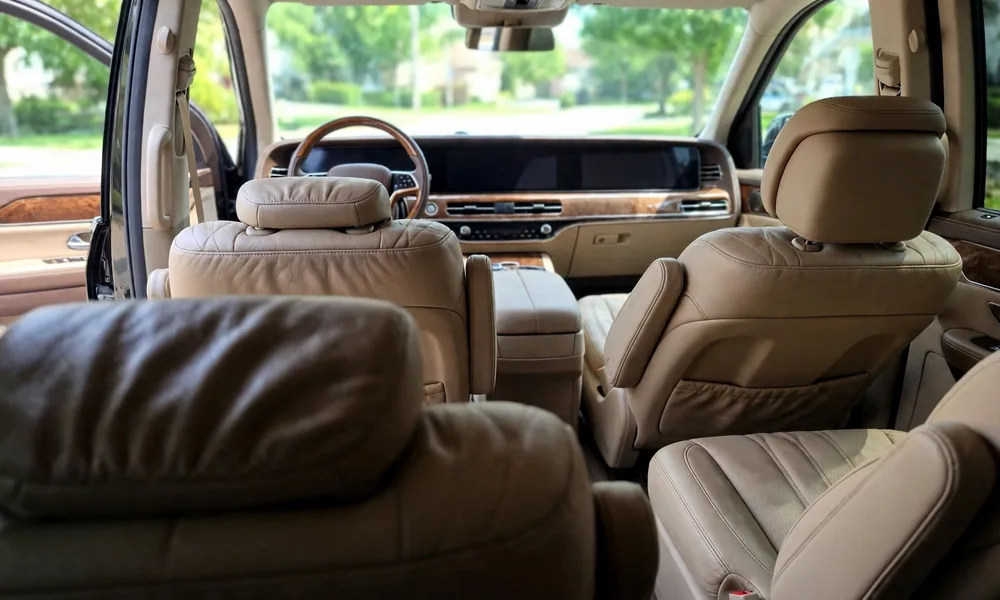
The cabin is where the conversion budget goes. The usual layout is four captain chairs in the rear, two facing forward and two facing back across a table, plus a three-seat bench or two more chairs behind, for eight to twelve seats in total. Each captain chair reclines, has a footrest, a heater, and sometimes a massage function, and each one slides on a floor rail so the layout can change from a meeting room to a cinema row in a few minutes. The floor is flat and covered in wood-effect vinyl or carpet, the walls are lined in Alcantara or leather, and the ceiling carries a strip of LED light that can be dimmed from bright white for working to warm amber for evening.

Sound and ride: the invisible engineering
A bare commercial van is a noisy place. The engine sits close to the cabin, the big flat panels drum at motorway speed, and the tyres roar on coarse roads. A luxury conversion attacks all three. The floor, walls and roof get extra layers of dense insulation and damping mats, roughly 25 to 40 kilograms of material that does nothing but absorb sound, and the windows get thicker, laminated glass. The result is a cabin quiet enough for a phone call at 120 kilometres per hour, which is the real test: if you can hold a normal conversation without raising your voice, the insulation has done its job. It is a similar kind of quiet to the one a luxury camper van’s spec sheet promises, but here the quiet serves work and rest, not sleeping under the stars.
Power, air and the details that run out
Ten people, each charging a laptop and a phone, with screens, lights and a fridge running, need more electricity than a standard van alternator provides. Luxury conversions add a second battery, sometimes a lithium pack under the floor, charged by the engine and by the mains when parked, and an inverter that turns it into ordinary socket power. The air conditioning is upgraded to a rear unit with its own controls, because a cabin full of people in suits generates far more heat than a delivery driver’s cab.
Payload: the number that limits everything
Every conversion has to respect the payload, the weight the van is legally allowed to carry after its own weight is counted. A luxury fit-out is heavy, and after the chairs, the wood, the batteries and the insulation, the remaining payload is usually roughly 800 to 1,200 kilograms. That sounds generous until you count ten adults, their luggage, and a full tank of fuel, which can easily reach 900 kilograms. Good converters weigh the finished van on a scale and print the real figure, because guessing risks an overloaded vehicle, worn brakes and an insurance problem.
What it costs
A converted luxury van usually costs roughly $120,000 to $350,000 as an estimate, starting with the base vehicle and adding the conversion on top. A straightforward executive layout with eight seats, leather and screens sits near the bottom of that range; a top-end build with a full lounge, a bar, a high-end sound system and a bespoke finish can reach the top. The money goes mostly to labour: a good conversion takes several hundred hours, much of it by hand, because every panel is cut to fit one specific van. A full-size luxury RV’s spec sheet shows the same idea taken further, with beds and a kitchen added to the lounge.
A rare fact
Here is a detail few passengers ever notice: the sliding door on a luxury van is usually the most expensive single part of the conversion after the seats. The original door is replaced or rebuilt with a powered mechanism, soft-close latches and extra seals, because a door that slams or rattles ruins the quiet the whole conversion was built to create.