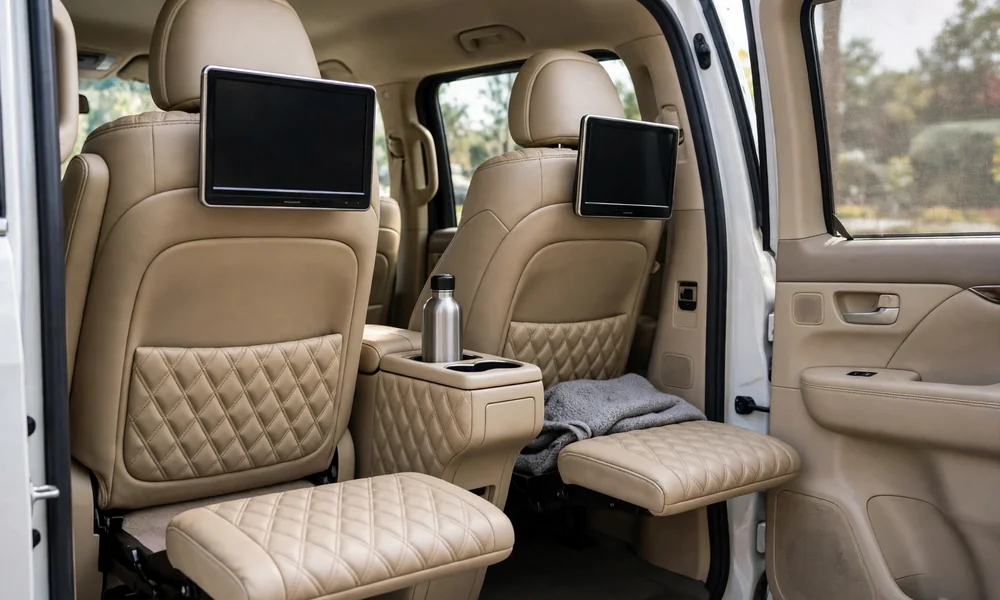
The sliding door glides open on its own, and the second row is already waiting like a lounge: two leather chairs, a footrest folded out, a screen on the seatback and a cup holder within easy reach. Nobody outside gives the van a second look. Everybody inside wonders why every car is not built like this.
A luxury minivan is a quiet piece of engineering, a vehicle that carries seven people in comfort while looking like it is only going to the shops. This is how a luxury minivan works, from the hybrid system under the floor to the door that opens with a wave of a foot.

Step 1: The hybrid system decides petrol or electric
Under the bonnet, a petrol engine works alongside an electric motor, and a computer decides moment by moment which one should do the work. Pulling away from a junction, the electric motor does it alone, silently, because an electric motor makes its full twisting force from a standstill. At motorway speed, the petrol engine takes over, running at its most efficient revs, and the electric motor helps only when the driver asks for more.
The battery that powers the motor is small by electric car standards and sits low under the floor between the axles, which keeps the centre of gravity down and the cabin floor flat.
Step 2: The transmission keeps everything smooth
Between the hybrid system and the wheels sits an electronically controlled transmission, and its job is to be invisible. There are no gear changes to feel, because the transmission varies its ratio continuously, holding the engine at the revs where it is quietest and most efficient while the van gathers speed. The result is a smooth, unbroken pull away from a standstill, with none of the lurching that older automatics used to give.
The driver can still take control when they want it, with paddles behind the wheel or a sport mode that holds the revs higher, but most owners never touch them. The transmission also manages the switch between petrol and electric power, blending the two so smoothly that the only sign of a change is a small light on the dashboard. The way the hybrid system and the transmission are tuned together is described in the guide to how a luxury hybrid car works, where the same partnership of engine, motor and gearbox decides how a car feels.
Step 3: The sliding doors open themselves
The sliding doors are the minivan’s signature, and they work harder than they look. Each door runs on a track hidden in the bodywork, guided by rollers top and bottom, and driven by a small electric motor that has to open the door smoothly whether the van is parked on flat ground or on a slope. Sensors watch the doorway, and if a hand or a bag is in the way, the door stops and reverses.
Opening them is deliberately easy. A button on the key, a handle on the door, a sensor under the rear bumper that responds to a foot waved beneath it when the driver’s hands are full of shopping, or a button on the dashboard for the driver to open the rear doors for passengers.
Step 4: The cabin becomes a lounge
Once everyone is aboard, the cabin does its real work. The second-row captain chairs slide on rails, recline, and fold out ottoman leg rests, while the third row folds flat into the floor when cargo takes priority over passengers.
The quiet is engineered too. Acoustic glass in the windows, extra insulation in the floor and doors, and active noise cancelling through the speakers all work together to keep road noise out, so conversation at motorway speed is easy and the rear screens can be heard without turning the volume up. The seats themselves are the heart of it, thickly padded and covered in quilted leather, and the way they are built is laid out in the guide to how a luxury minivan is made, where the cabin is trimmed like a lounge rather than a car interior.

Step 5: Screens, cameras and driver aids watch everything
A modern luxury minivan carries cameras that watch the road ahead, the blind spots and the cabin itself, while radar sensors track the traffic around the vehicle. The 360-degree camera stitches the views together into a picture of the van from above, which makes parking a five-metre vehicle in a tight space feel like a small one, and the rear camera switches on the moment reverse is selected.
The driver aids work quietly in the background. Adaptive cruise control follows the car ahead and stops and starts in traffic, lane keeping gently steers the van back to the middle of its lane, and blind-spot warnings light up in the mirrors when a car is hiding beside the sliding door. The rear screens keep the second row entertained on long journeys, and a cabin camera lets the driver check on the children in the back without turning around.
Step 6: Safety systems stand ready in the background
Behind all of it, the safety systems wait. The body is built with crumple zones that absorb the force of a crash before it reaches the cabin, and the flat floor that makes the interior so roomy is reinforced with high-strength steel under the seats. Airbags cover the front, the sides and the full length of the cabin in curtains, because a minivan carries its passengers in three rows and every row deserves the same protection.
The brakes are part of the safety system too, blending regenerative braking from the electric motor with the friction brakes so the van stops smoothly and evenly even with a full load. The full equipment list, from the hybrid drivetrain to the rear entertainment system, is laid out in the luxury minivan spec sheet, and it reads like the equipment list of a car twice the price. That is the minivan’s trick: it spends its money where the passengers sit, not where the neighbours look.
The spec sheet at a glance
| Specification | Typical luxury figure |
|---|---|
| Length | 5.1 to 5.3 metres |
| Seats | Seven, in three rows |
| Engine | 2.5 litre hybrid petrol, four-cylinder |
| Power | 240 to 300 horsepower combined |
| Gearbox | Electronically controlled continuously variable |
| Drive | Front-wheel drive, some all-wheel drive |
| Fuel economy | 6 to 7 litres per 100 kilometres combined |
| 0 to 100 km/h | 7.5 to 8.5 seconds |
| Sliding doors | Power operated, both sides, foot sensor |
| Screens | Front touchscreen plus rear seatback screens |
| Seats | Quilted leather, heated and ventilated, ottoman second row |
| Safety | Cameras, radar, blind-spot and cabin monitoring |
What it costs, and a rare fact
A luxury minivan costs an estimated $60,000 to $110,000, depending on the trim, the hybrid system and the rear-seat equipment, with chauffeur-spec examples costing more.
Here is the rare fact the brochure never mentions. The sliding doors on a luxury minivan are tested by opening and closing them more than one hundred thousand times on a rig before the design is approved, which is roughly thirty years of school runs, and the test rig counts every single cycle. The door that survives that test is the one that still glides silently on the day the youngest child finally learns to open it alone.


