Hold a smartphone and press the small metal tray that holds the SIM card. It is smaller than a postage stamp, thinner than a coin, and shaped with a precision no ordinary casting could manage: a tiny spring clip, a slot, a bevelled edge, all in one piece of steel. It was not machined. It was not cast. It was injected, like a plastic toy, and then baked in a furnace until it became solid metal. That is metal injection moulding, and it is how the world makes small, complicated metal parts by the million.
The process is a hybrid, and that is its genius. Fine metal powder is mixed with a plastic binder to make a feedstock that flows like warm plastic, and that feedstock is injected into a mould, exactly as a plastic part would be.
The specification sheet for metal injection moulding is where the process shows both its powers and its limits: how small a part can be, how tight its tolerances are, how dense and smooth it comes out, and how many you must order before it makes sense. This guide explains each number in plain English.

The Specs That Matter
1. Part size and weight
Metal injection moulding is a small-part process. A typical part weighs about 0.1 to 100 grams and fits comfortably in the palm of a hand — a gear, a bracket, a hinge, a surgical tool, a watch case. Parts up to about 250 grams are possible, but the bigger the part, the longer the binder takes to wash out and the greater the risk of distortion in the furnace, so the economics fade fast. The full journey from powder to finished part is told in how metal injection moulding is made.
2. Wall thickness
Wall thickness is the thinnest section of the part, and it decides whether the feedstock can fill the mould at all. The practical minimum is about 0.5 millimetres, with most parts designed at 1 to 3 millimetres. Good design keeps the walls even, because a part that is thick in one place and thin in another will shrink unevenly in the furnace and come out warped.
3. Dimensional tolerance
Tolerance is how far the finished part may wander from the drawing, and it is the specification that surprises newcomers most. A typical moulded part holds about plus or minus 0.3 percent of its dimension, which on a 10-millimetre feature is plus or minus 0.03 millimetres — about a third of a human hair. The catch is the shrinkage: the part loses roughly 15 to 20 percent of its linear size in the furnace, so the mould is made oversize and the sintering must be identical every time. How the heat and timing are controlled is explained in how metal injection moulding works.

4. Sintered density
Density is the measure of how solid the finished metal really is. A sintered part typically reaches about 95 to 99 percent of the theoretical density of the solid metal, with the remainder made up of tiny pores scattered through the material. At 98 percent and above, the part behaves much like wrought metal for most purposes, with only a small penalty in fatigue strength. Density is controlled by the powder, the sintering temperature, and the time in the furnace, and it is the number a supplier should be able to quote for every alloy they offer.
5. Surface finish
Straight from the furnace, a moulded part has a smooth, faintly grainy surface, typically measuring about 1 to 3 microns Ra — smoother than a casting and rougher than a machined face. That is good enough for most uses, and it is one of the process’s quiet advantages: the mould’s polished surface transfers directly to the part, so a well-made tool produces parts that need no finishing at all. The number on the sheet should be the finish as sintered, not after polishing.
6. Mechanical strength
Strength is where moulded metal earns its keep against plastic. A moulded stainless steel part typically reaches a tensile strength of about 500 to 700 megapascals, close to the wrought steel it replaces, and a moulded titanium part reaches about 800 to 950. The numbers are slightly lower than wrought metal, because of the residual pores, but the gap is small and shrinking as powders and furnaces improve.
7. Production volume
Volume is the specification that decides whether the process makes sense at all. The mould tooling is expensive — a single-cavity steel mould is estimated to cost roughly $10,000 to $50,000 — and that cost must be spread across the run. Below about 10,000 parts a year, machining is usually cheaper; between 10,000 and a million, moulding wins, and the per-part price falls steeply as volume rises. The machines that make this scale possible sit in the same world as the large-format metal printers in inside metal 3D printing production.
Metal Injection Moulding Specs
| Specification | Typical range |
|---|---|
| Part weight | About 0.1 to 100 grams typical; up to about 250 grams maximum |
| Wall thickness | About 0.5 millimetres minimum; 1 to 3 millimetres typical |
| Dimensional tolerance | About plus or minus 0.3 percent typical; plus or minus 0.1 percent achievable |
| Sintered density | About 95 to 99 percent of theoretical density |
| Surface finish | About 1 to 3 microns Ra as sintered |
| Tensile strength | About 500 to 700 MPa for stainless steel; 800 to 950 MPa for titanium |
| Linear shrinkage | About 15 to 20 percent during sintering |
| Production volume | About 10,000 to over 1,000,000 parts per year |
What Does Metal Injection Moulding Cost?
The cost of a moulded part is a story in two halves: the tooling, paid once, and the parts, paid forever after. Tooling is estimated to cost roughly $10,000 to $50,000 for a single-cavity mould, and more for multi-cavity tools that make several parts per shot. Once the tool is paid for, a small steel part in volume is estimated to cost roughly $0.50 to $5.00 each, depending on size, alloy, and finishing, against roughly $5 to $50 to machine the same shape one at a time. All prices are estimates only and vary widely by alloy, complexity, and order size.
A Rare Fact
Metal injection moulding began as a solution to a problem nobody else wanted. In the 1970s, the American engineer Raymond Wiech was trying to make tiny, intricate parts for the aerospace industry, and he realised that the plastics industry had already solved the shaping problem — it injected molten material into moulds millions of times a day. Wiech simply replaced the plastic with metal powder mixed into a binder, and the process he pioneered, through the company Parmatech, quietly took over the small-parts world.
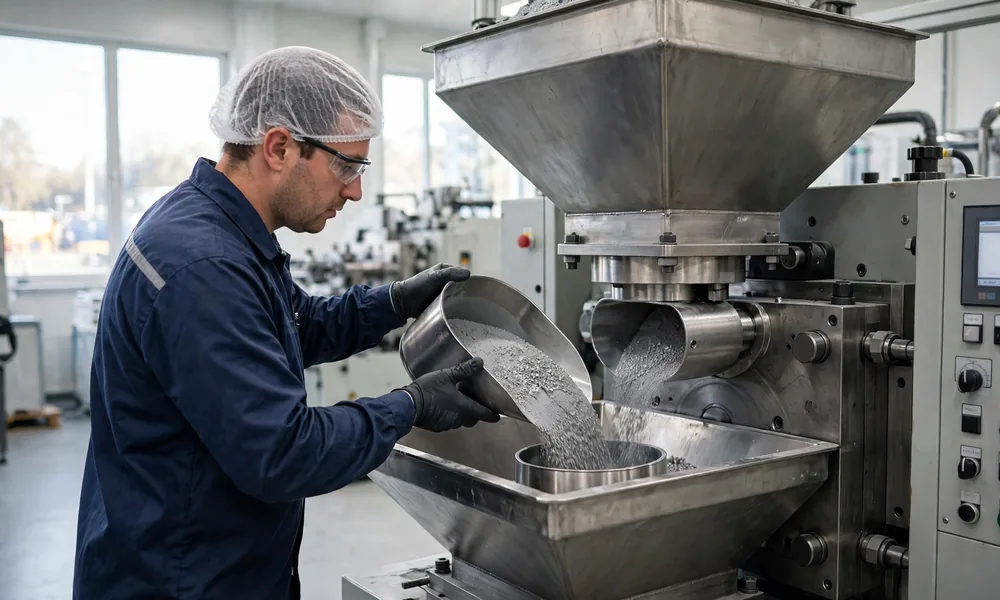
Metal injection moulding is manufacturing’s quiet middle ground: cheaper than machining at volume, more precise than casting, and able to make shapes neither process can touch. Read the specification — part size, tolerance, density, and volume together — and you can tell at a glance whether a tiny, complicated part belongs in a mould, or whether it should stay on the milling machine.


