The strongest material humans have ever made is invisible. A carbon nanotube is a rolled-up sheet of carbon atoms, fifty thousand times thinner than a human hair, yet pound for pound it is stronger than steel and lighter than plastic. The problem is turning a powder of microscopic threads into something you can bolt onto an aeroplane, and doing it the same way a thousand times in a row.
Carbon nanotube composites are already flying in experimental aircraft parts, stiffening sports equipment, and shielding sensitive electronics. They promise structures that are lighter than carbon fibre and tougher than anything in service today. The catch is that every step of production fights the physics of the material: nanotubes clump together like wet hair, they resist being spread evenly, and a single poorly mixed batch can hide weak spots no eye can see. The line that tames them is slow, fussy, and expensive, and it is getting better every year.

Inside the Production
Step 1: Growing the nanotubes
Production begins in a reactor, not on a bench. Most factories buy their nanotubes from specialist suppliers, but the material starts the same way everywhere: a carbon-bearing gas, usually methane or ethylene, is fed into a hot furnace over a metal catalyst, and the carbon atoms assemble themselves into hollow tubes a few nanometres wide and many microns long. This is chemical vapour deposition, and it runs at temperatures above 700 degrees Celsius. The harvest is a black, fluffy powder that looks like soot and floats at the slightest draught. Workers handle it in sealed glove boxes and fume hoods, because breathing in loose nanotubes is a health risk the industry takes seriously. Quality is checked by electron microscope: the tubes must be long, straight, and free of soot and metal residue.
Step 2: Dispersing the nanotubes into resin
A nanotube is only useful if it is separated from its neighbours and spread evenly through the material around it, and that is the hardest step in the whole line. Dry nanotubes clump into tangled bundles held together by strong attraction forces, so the powder is mixed into an epoxy resin using high-shear mixers, ultrasonic baths, and sometimes three-roll mills that squeeze the mixture between steel rollers again and again. The goal is a smooth, uniform dispersion with no clumps larger than a few microns. Technicians check the mixture under a microscope and by measuring its viscosity before it is allowed anywhere near a mould.
Step 3: Making prepreg and laying up the part
Once the resin is ready, it is spread into thin sheets of carbon fibre cloth to make prepreg, a fabric already loaded with nanotube-enhanced resin and kept cold so it stays workable. In the layup room, technicians cut the prepreg into plies and stack them onto a mould, one layer at a time, alternating the direction of the fibres so the finished part is strong in every direction that matters. Each ply is pressed down by hand and rolled to chase out trapped air, because a bubble left between layers becomes a weak spot after curing. A large panel can take dozens of plies and hours of careful handwork, and the room is kept clean and temperature-controlled, since dust and warmth both ruin the layup. The craft here is close kin to the work described in how carbon nanotube composite is made.
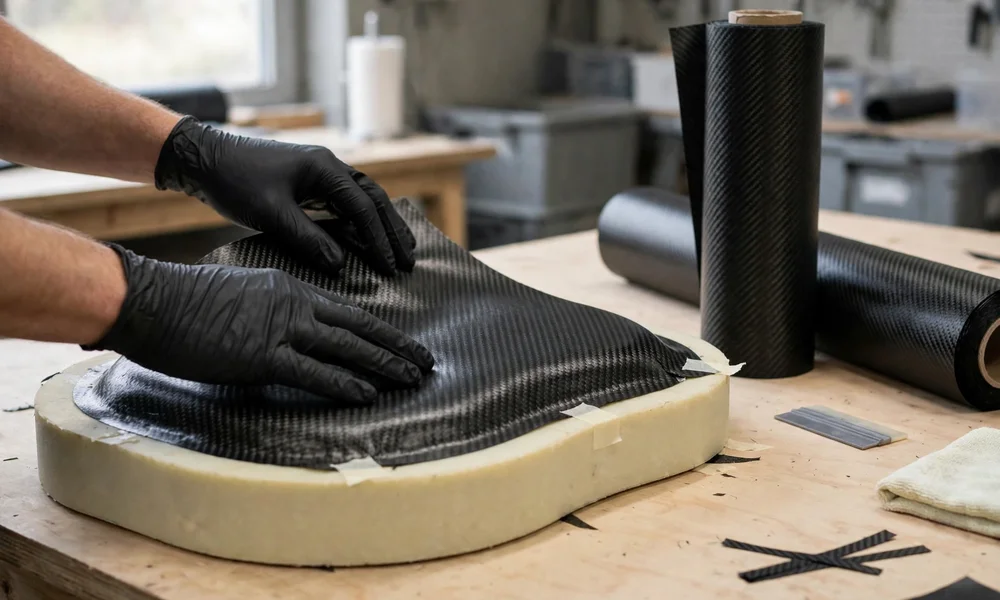
Step 4: Curing in the autoclave
With the layup complete, the mould is sealed inside a vacuum bag, and the whole assembly goes into an autoclave: a giant heated pressure vessel that is the beating heart of the factory. The autoclave heats the part to around 120 to 180 degrees Celsius while pressing it with several atmospheres of pressure, and holds it there for hours while the resin hardens around the nanotubes and fibres. The vacuum bag sucks out air and excess resin as the part cures. The temperature ramp is programmed to the minute, because heating too fast traps gas and heating too slow wastes a day. When the door finally opens and the bag is peeled away, the soft cloth stack has become a rigid, glossy black solid.
Step 5: Trimming and machining
The cured part comes out of the mould oversized and rough at the edges, so it goes to the machine shop. Diamond-coated tools and waterjet cutters trim the edges, drill the bolt holes, and cut any openings the design needs. Carbon composites eat ordinary cutting tools alive and throw off fine dust that is hazardous to breathe, so the machines run inside extraction hoods and the operators wear respirators. Tolerances are tight, often within a tenth of a millimetre, and every hole is checked, because a composite part cannot be bent or hammered into fit the way metal can. A part that measures wrong here is usually scrap, however many hours went into laying it up.
Step 6: Testing and proving the part
No nanotube composite leaves the factory on trust. Inspectors scan each part with ultrasound to hunt for delamination and hidden voids, tap-test the surface for dull spots that signal internal damage, and cut sample coupons from the same batch for destructive strength tests. The numbers are compared with the design targets and with the properties published in the carbon nanotube composite specs, and a batch that falls short is quarantined until engineers find out why. Some customers demand full traceability, with every ply, every resin batch, and every autoclave run recorded. It is slow and costly, and it is exactly why aerospace buyers are starting to trust the material. The same insistence on a clean, void-free cure connects this line to the wider craft of composite layup production.
Carbon Nanotube Composite at a Glance
| Specification | Typical Value |
|---|---|
| Nanotube diameter | 1–50 nanometres, depending on type |
| Nanotube strength | Up to about 100 GPa tensile strength, single tube |
| Growth method | Chemical vapour deposition above 700°C |
| Matrix | Epoxy resin, nanotube-enhanced |
| Cure cycle | 120–180°C in an autoclave, several hours |
| Density | About 1.5 g/cm³ for the finished composite |
| Key advantage | Extreme stiffness and strength at very low weight |
What Does It Cost?
Carbon nanotube composites are among the most expensive structural materials in production today. Research-grade nanotubes can cost hundreds of dollars per gram (estimates), though industrial multi-walled grades have fallen to roughly $50–$200 per kilogram in bulk (estimates). A finished composite panel can cost several times more than an equivalent carbon fibre part (estimates), and the autoclave time, hand layup, and testing add far more than the raw material. The economics only work where weight savings pay for themselves: aircraft, spacecraft, racing cars, and high-end sporting goods. As nanotube production scales up and dispersion gets easier, prices are falling, but this is still a material for parts where grams matter more than dollars.

A Rare Fact
A single carbon nanotube is roughly one hundred times stronger than steel at one sixth of the weight, yet a rope made of nanotubes has never been built at any useful scale, because the tubes slip past each other instead of gripping. The factory’s real achievement is not making the tubes but forcing them to work together, locked in resin and fibre so that a load on the part is shared across millions of them at once. Until that problem was solved, the strongest material on Earth was also one of the least useful.


