She was walking through the old town with her hands free and her eyes up, and a thin line of light floated in front of her, turning left at the corner where the bakery was. The directions were not on a phone in her hand. They were in her glasses, drawn onto the street itself, and when she looked at the cathedral the name of the architect appeared quietly beside the tower, then faded away.
Smart glasses are the oldest dream in wearable technology: a computer you wear on your face, light enough to forget, that puts information into the world instead of onto a screen. For years they were heavy, hot, and embarrassing to wear. The new luxury models are none of those things, and the reason is written in their specifications, in numbers for the display, the weight, the battery, and the optics.
What follows is a reading of those numbers, and what they mean for a device that has to disappear on your face while doing the work of a phone.
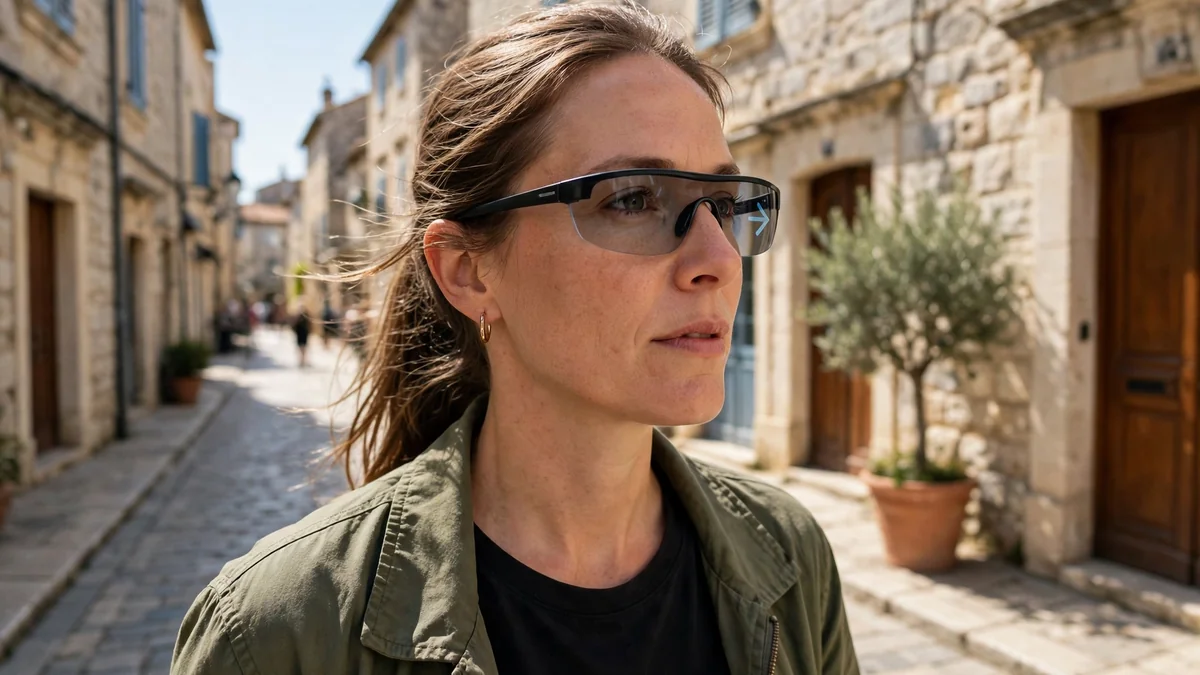
Smart Glasses Specs Explained
1. Display and optics
The display is the heart of smart glasses, and it is not a screen in the ordinary sense. Most luxury models use a tiny micro-OLED or micro-LED panel, sometimes no bigger than a fingernail, whose image is projected into the wearer’s eye through a waveguide, a thin piece of glass that bends light along its length and releases it in front of the pupil. The image appears to float a few metres ahead, as if it were painted on the air. Resolution is typically equivalent to a 1080p display, and the brightness reaches 1,000 nits or more, so the image stays visible in sunlight. The waveguide itself is the hardest part of the whole device to make, and its cost is explained in why an AR glasses waveguide is so expensive, where a sliver of glass is ground to tolerances measured in nanometres.
2. Field of view
Field of view is the size of the virtual image, measured in degrees, and it decides whether the glasses feel like looking through a letterbox or a window. Early smart glasses managed only 20 to 30 degrees, which made the image feel like a small television floating in front of you. Luxury models now reach 40 to 55 degrees, which is enough for navigation arrows, messages, and captions to feel like part of the room.
3. Battery life
Battery life is the hardest compromise in smart glasses, because the battery has to fit in an arm no thicker than a pencil. Most luxury models run for 4 to 6 hours of mixed use, with the display on for directions and notifications, and some stretch to a full day when the display is mostly off and the glasses act as headphones and a camera. The battery is split between the two arms to balance the weight, and the glasses charge in a case, like wireless earbuds, which tops them up several times over.
4. Cameras and sensors
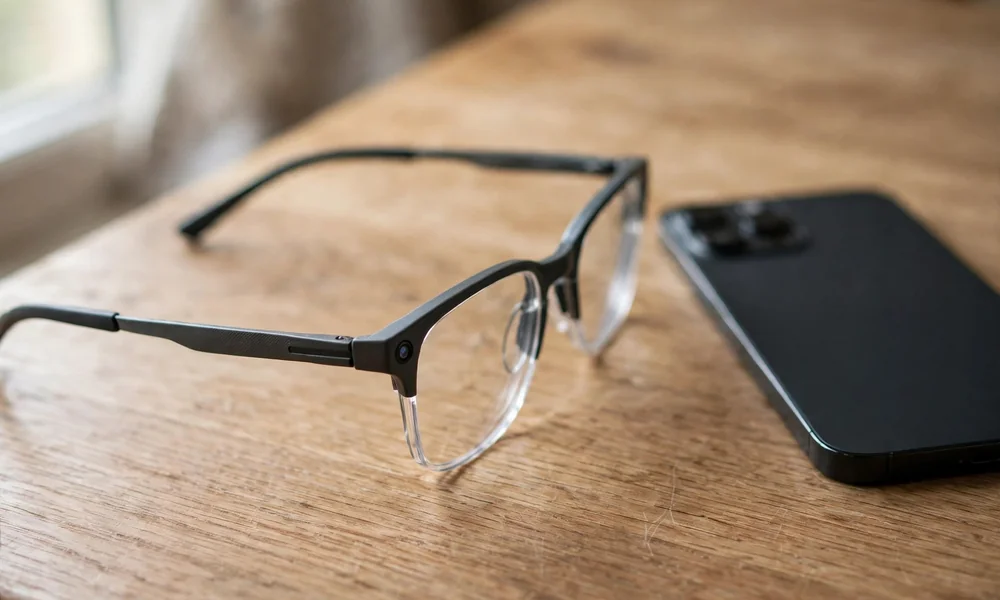
Smart glasses see the world through a small camera, usually 12 megapixels, mounted in the frame, and a set of sensors that track the wearer’s head, eyes, and hands. The camera records what you see, takes photos with a tap or a voice command, and lets the glasses recognise objects, translate signs, and remember where you left your keys. Privacy is the trade-off: a tiny LED lights up whenever the camera is recording, so the people around you know.
5. Audio
Smart glasses have no earbuds. Sound comes from small speakers built into the arms, aimed at the wearer’s ears, so music, calls, and directions play in the open air while the wearer can still hear the street. The sound is private enough that the person next to you hears only a faint whisper, and it is tuned so voices stay clear at walking pace. The same open-ear approach appears in other wearables, and the display technology inside the lenses shares its roots with how foldable smartphone displays work, where thin, flexible panels are bent to fit where no rigid screen could go.
6. Weight and fit
Weight is the number that decides whether smart glasses get worn or left in a drawer. Luxury models weigh between 35 and 50 grams, about the same as an ordinary pair of sunglasses, and that lightness is the whole achievement. Every gram is fought for: titanium frames, miniature batteries, and lenses that are thinner than a credit card. The fit matters as much as the weight, because the waveguide only works when it sits at exactly the right distance from the eye, so luxury glasses come with adjustable nose pads and prescription lens options. A pair that weighs 80 grams feels like a helmet after an hour, and a pair that weighs 40 grams disappears.
7. Connectivity and processing
Smart glasses are not a phone, and they do not try to be. They connect to a phone over Bluetooth and Wi-Fi, and the phone does the heavy work: the maps, the messages, the apps. The glasses themselves carry a small processor that handles the display, the sensors, and the voice commands, and some models add a dedicated AI chip that runs on-device tasks like translation and object recognition. The link to the phone has to be instant, because a navigation arrow that arrives a second late is worse than no arrow at all, and the same demand for a connection anywhere on Earth is what drives how smartphone satellite connectivity works, where a phone talks directly to a satellite when no tower is in reach.
Smart Glasses Specs
| Specification | Typical range |
|---|---|
| Display type | Micro-OLED or micro-LED via waveguide |
| Resolution | Equivalent to 1080p |
| Brightness | About 1,000 nits or more |
| Field of view | About 40 to 55 degrees |
| Battery life | About 4 to 6 hours of mixed use |
| Camera | About 12 megapixels |
| Audio | Open-ear speakers in the arms |
| Weight | About 35 to 50 grams |
| Connectivity | Bluetooth and Wi-Fi to a phone |
| Frame material | Titanium or lightweight alloy |
What Do Smart Glasses Cost?
Luxury smart glasses are estimated to cost roughly $300 to $2,000, depending on the display, the optics, and the brand. A well-made pair with a simple display and open-ear audio is estimated at the lower end, while a flagship pair with a wide field of view, a precision waveguide, and prescription lenses is estimated at the top end or beyond. The price is mostly the optics: the waveguide and the projector cost more to make than everything else in the glasses combined, and the yield, the share of waveguides that come out of the factory good enough to sell, is still low.
A Rare Fact
The waveguide inside smart glasses is made using some of the same machines that make computer chips, and a single speck of dust during manufacturing can ruin a lens worth hundreds of dollars. The factories that make them are cleaner than hospital operating theatres, and the workers wear full suits, hoods, and gloves, just to make a piece of glass you look through.

The best smart glasses are the ones you forget you are wearing, until the street tells you where to turn. The specifications are the reason they disappear: a display the size of a fingernail, a battery the size of a pencil, and a piece of glass ground finer than anything in a camera.