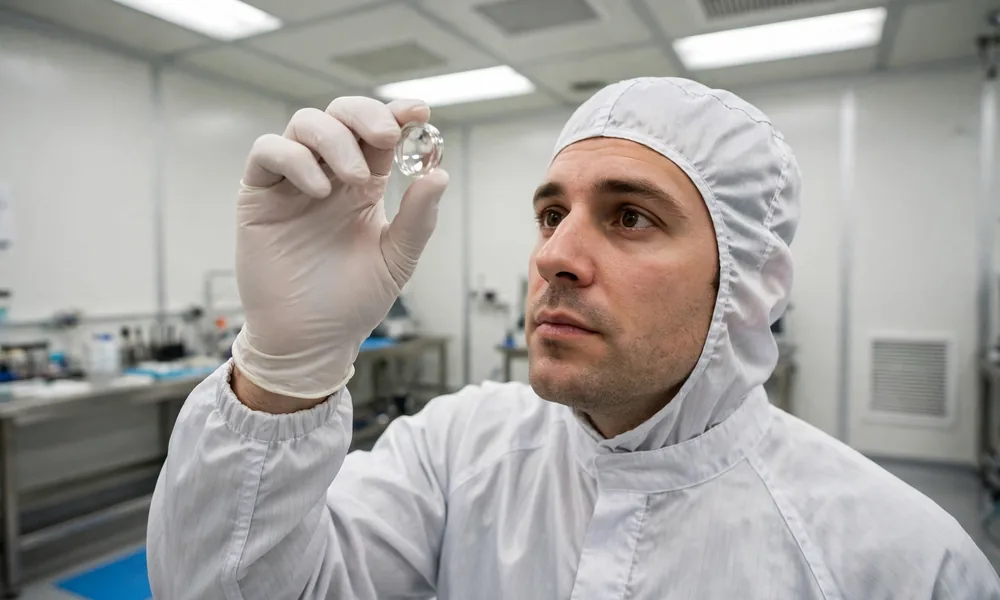
In a cleanroom in California, an engineer holds a piece of glass the size of a postage stamp up to the light. It looks like nothing at all: clear, flat, unremarkable. Then she tilts it, and a tiny image appears in the glass, a green arrow floating in mid-air. That little piece of glass is doing something extraordinary. It bends light from a tiny projector around the curve of a pair of glasses and into the wearer’s eye, so digital images appear to float in the real world.
That piece of glass is called a waveguide, the heart of every serious pair of augmented-reality glasses, and one of the most expensive small objects in consumer technology. A waveguide must be optically perfect, thinner than a credit card, and made in a factory cleaner than an operating theatre. Most waveguides ever made have failed in testing, and the few that pass are worth more than the phone in your pocket. This is why it costs so much.
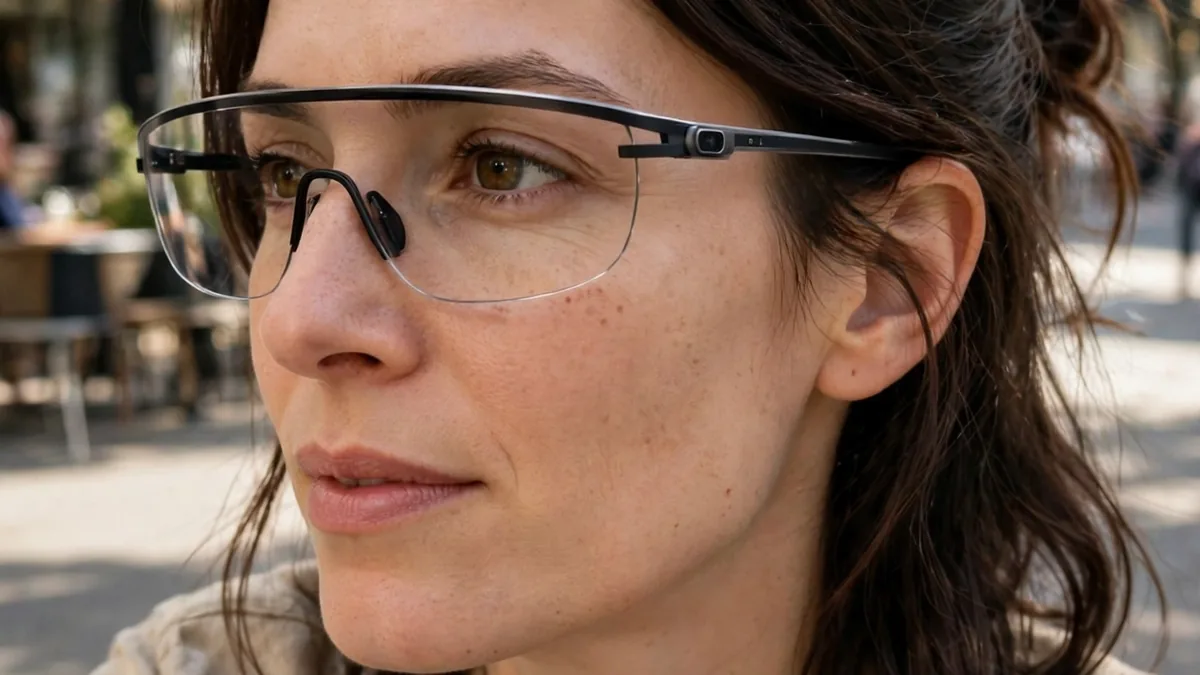
Why It Costs So Much
Reason 1: The glass itself must be optically perfect
A waveguide is made from glass with a very high refractive index, a property that lets it trap light and bounce it along inside the lens. That glass is not window glass. It is a specialised material made in small batches by a handful of suppliers, and it must be free of bubbles, striae and impurities that would scatter the light. A flaw invisible to the naked eye can ruin the image, so each blank is inspected with lasers before it is even cut. The material alone can cost hundreds of dollars per lens.
Reason 2: The gratings are carved at the nanoscale
To get light into and out of the waveguide, engineers carve microscopic gratings into its surface, patterns of lines and grooves smaller than the wavelength of light. These are made with electron-beam lithography or nanoimprint machines that cost millions of dollars and run in cleanrooms where a single speck of dust can destroy a batch. The gratings must be aligned to within nanometres, and the machines that make them are among the most precise ever built. The way light travels through those gratings is told in how an AR glasses waveguide works, where the physics of total internal reflection does the heavy lifting.
Reason 3: The yield is brutally low
Waveguide manufacturing is famous for its low yield. In the early years, fewer than one in ten passed inspection, and even today the best factories lose a large share of every batch to defects. Each failed lens still consumed the expensive glass, the cleanroom time and the lithography, so the cost of failure is loaded onto the few that survive. This is the same economics that makes advanced chips expensive, and it is the single biggest reason a waveguide costs what it does. Until yields improve, prices will stay high.
Reason 4: The optics must be tuned for each wearer
No two pairs of eyes are alike, and a waveguide must deliver a sharp image across a wide field of view without distortion, ghosting or colour fringing. Engineers tune the gratings, the coatings and the projector for each design, using ray tracing, eye modelling and endless rounds of prototypes worn by test subjects. The coatings alone, layers of material a few atoms thick that control how light enters and leaves the glass, take months to perfect. The manufacturing behind those coatings is described in how an AR glasses waveguide is made, where the cleanroom steps run in a precise and unforgiving order.
Reason 5: The whole system must fit in a normal pair of glasses
Early augmented-reality headsets were bulky helmets, and nobody wanted to wear them in public. A modern waveguide must fit into frames that look like ordinary glasses, which means the projector, the battery, the sensors and the waveguide itself must all be miniaturised and packed into a few millimetres of space. The projector alone, a micro-display smaller than a fingernail, is a precision device with its own high cost. The full specification of what fits into that tiny package is laid out in AR glasses waveguide specs explained, and the numbers show just how tight the engineering margins are.
Reason 6: Only a handful of factories can do it at all
Waveguide production needs cleanrooms, lithography machines, coating chambers and optical test rigs that together cost hundreds of millions of dollars to build. Only a few companies in the world have made that investment, and their order books are dominated by the biggest technology firms. A small customer cannot simply order a batch; it must join a queue, accept a minimum order and pay for the privilege. With so few suppliers, there is little competition to push prices down, and every new design must be negotiated from scratch.
AR Glasses Waveguide at a Glance
| Feature | Detail |
|---|---|
| What it is | A thin glass lens that guides light from a projector to the eye |
| Thickness | Typically 1 to 2 millimetres |
| Glass type | High refractive index optical glass |
| Field of view | Typically 30 to 50 degrees in current designs |
| Light gratings | Nanoscale patterns carved by lithography |
| Manufacturing | Cleanroom fabrication, coating and optical testing |
| Typical yield | Often well under half of each batch passes |
| Key challenge | Optical perfection at consumer scale and cost |

What Does It Cost?
As rough estimates, a single waveguide lens typically costs around $300 to $1,000 at low volume, the micro-projector adds roughly $100 to $300, and a complete pair of AR glasses can run from about $1,000 to $3,500 or more depending on the design. Those figures are estimates, not quotes, and the real number depends on the volume, the supplier and the specification. The waveguide itself is usually the largest single share of the cost, followed by the projector and electronics, with assembly and testing making up the rest. As yields improve and volumes rise, prices should fall, but for now the waveguide remains the most expensive part of the glasses.
| Part of the system | Estimated share of the cost |
|---|---|
| Waveguide lens | About 40 to 50 percent |
| Micro-projector and display | About 20 to 25 percent |
| Electronics and sensors | About 15 to 20 percent |
| Assembly and testing | About 10 to 15 percent |
A Rare Fact
The idea behind the waveguide is older than the smartphone. Guiding light through glass, called total internal reflection, is the same trick that makes fibre-optic cables work, and it was first described in the nineteenth century. Early waveguide experiments in the 1990s were built for military pilots, whose helmet displays used bulky glass slabs to project flight data onto their visors. The military versions cost tens of thousands of dollars each. Today’s consumer waveguides use the same physics, shrunk from a pilot’s helmet to a piece of glass the size of a postage stamp, and the price, while still high, has fallen a hundredfold along the way.
An AR glasses waveguide looks like a piece of clear glass and is priced like a piece of jewellery, because it is really a nanoscale optical instrument, made in a cleanroom, tested with lasers, and produced by a handful of factories on earth. It costs so much because the glass is special, the gratings are carved at the nanoscale, the yield is low, and the whole thing must fit in a pair of glasses. Pay for all of that and digital images float in the real world; wait for the price to fall, and the view will only get clearer.