Hold a flagship phone up to the light and look at the camera bump. Behind that glass there is a stack of tiny lenses, each one smaller than a shirt button, arranged with a precision that would shame a watchmaker. Together they take in the light from a sunset, a face, a street at night, and bend it onto a sensor the size of a fingernail. The whole assembly is thinner than a coin.
Phone makers talk about megapixels and zoom, but the numbers that actually decide how a photo looks live on the lens spec sheet: aperture, focal length, the number of elements, the size of the sensor behind them, and how the whole stack is stabilised.
This guide explains the key numbers on a smartphone camera lens spec sheet in plain English: what aperture really does, why focal length is quoted in millimetres that never match the phone, how many lens elements is enough, and which figures are worth comparing between phones.
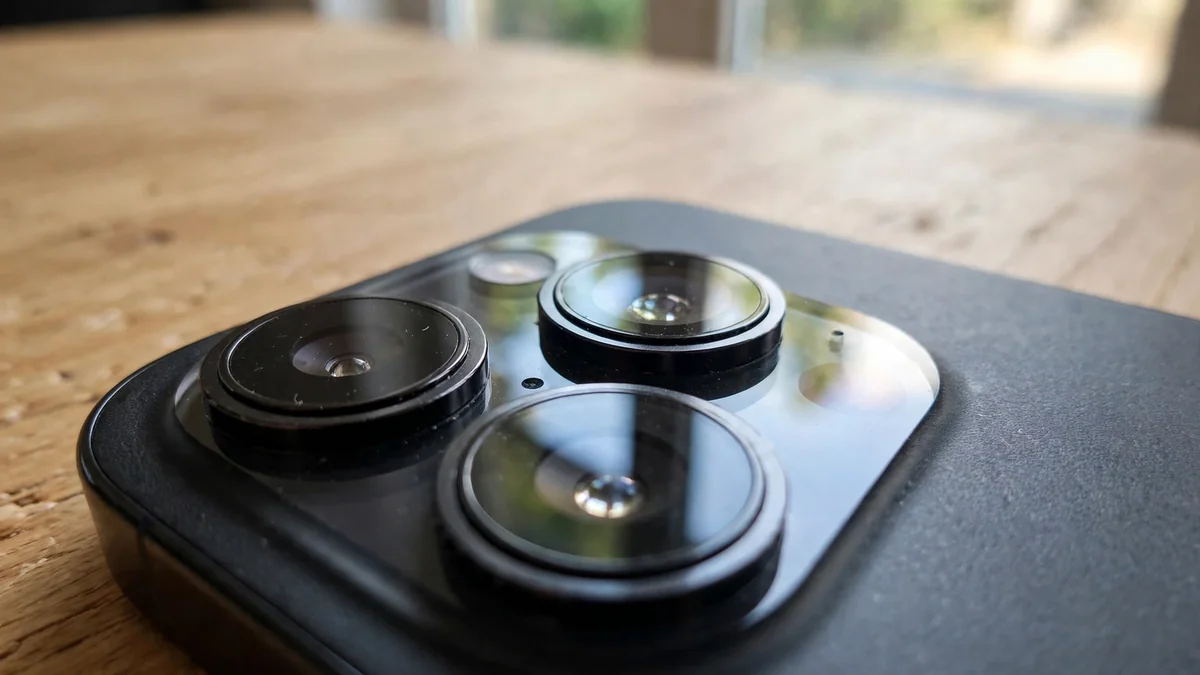
The Lens by the Numbers: What Each Figure Means for Your Photos
1. Aperture: how much light gets in
Aperture is written as an f-number, such as f/1.8 or f/2.4, and it is the single most important number on the sheet. A lower f-number means a wider opening and more light: an f/1.8 lens lets in roughly twice as much light as an f/2.4 lens, which is the difference between a sharp photo at dusk and a blurry one. Phone lenses are fixed at one aperture, unlike a camera lens that can stop down, so the number on the sheet is the only aperture the phone will ever have.
2. Focal length: how wide, how close
Focal length is measured in millimetres and quoted as a 35-millimetre equivalent, such as 24 mm for the main camera, 13 mm for the ultra-wide, and 70 to 120 mm for the telephoto. The equivalent exists because a phone sensor is tiny, so the real focal length is only a few millimetres — the equivalent tells you what the view would look like on a full-frame camera. The glass itself is a marvel of miniaturisation, and the reason a lens this small costs so much is covered in why the smartphone camera lens is so expensive.
3. Lens elements: the stack inside the bump
A phone camera lens is not one piece of glass. It is a stack of five to eight elements — individual lenses made of glass or moulded plastic — each one correcting a different flaw in the image. The spec sheet quotes the element count, such as 7P for seven plastic elements, and more elements usually mean a sharper image with less distortion and less flare. The sensor that sits behind the stack is just as important, and its own engineering is covered in the cinema camera sensor materials engineering guide.
4. Sensor size: the number behind the lens
The lens is only half the camera. Sensor size is quoted in inches, such as 1/1.3 inch or 1 inch, and it is the size of the chip that catches the light the lens delivers. A bigger sensor gathers more light, produces less noise in the dark, and gives a more natural depth of field — which is why the largest phone sensors, approaching one inch across, are the headline feature of the best camera phones.
5. Optical image stabilisation: holding the lens still
Your hands shake, always, by a fraction of a millimetre, and at night that shake is enough to blur a photo. Optical image stabilisation moves the lens or the sensor in the opposite direction, many times a second, to cancel it. The spec sheet quotes stabilisation in stops of improvement — typically two to four stops — meaning the phone can shoot at a shutter speed two to four times slower than an unstabilised camera and still stay sharp. How the lens is driven and focused is a separate piece of engineering, covered in how the smartphone camera lens works.
6. Zoom: optical, digital, and the difference that matters
Zoom is the most misunderstood number on the sheet. Optical zoom uses the telephoto lens and loses no quality; digital zoom crops the image and loses detail with every step. A phone that claims 10x zoom may offer 3x optical and the rest digital, and the spec sheet is where the honest figure hides — look for the optical zoom of the telephoto lens, not the headline number.
7. Minimum focus distance: how close you can get
Minimum focus distance is how close the lens can be to a subject and still focus, and it is the number that decides whether a phone can shoot a flower, a watch, or a page of text. A typical main camera focuses from about 10 centimetres; a dedicated macro mode can get to 2 or 3 centimetres. The ultra-wide camera often doubles as the macro lens, because its short focal length focuses closer, and the spec sheet quotes the figure for each camera separately — a detail that matters more to people who photograph small things than any megapixel count.

Smartphone Camera Lens Specs
| Specification | Typical range |
|---|---|
| Main aperture | f/1.6 to f/2.0 |
| Main focal length (equivalent) | 24 mm |
| Ultra-wide focal length (equivalent) | 13 to 16 mm |
| Telephoto focal length (equivalent) | 70 to 120 mm |
| Lens elements | 5 to 8 elements |
| Sensor size | 1/1.3 inch to 1 inch |
| Optical stabilisation | 2 to 4 stops |
| Minimum focus distance | 2 to 10 cm |
What Does a Smartphone Camera Lens Cost?
A flagship phone’s camera module is estimated at roughly $50 to $150 for the whole assembly, and the lens stack alone is estimated at $10 to $40, depending on the number of elements and the quality of the glass. A phone with three cameras carries three complete modules, and the periscope telephoto is the most expensive of them, estimated at $30 to $60 on its own. All prices are estimates only and vary widely by model, supplier, and volume. The lens is a small share of a phone’s price, but it is the part that most often decides which phone a buyer chooses.
A Rare Fact
The first camera phone, sold in Japan in 2000, had a camera of 0.11 megapixels — about a hundred times less than a modern phone — and its lens was a single piece of plastic. The engineers who built it thought of the camera as a novelty for sending pictures to friends. Within twenty years, the lens stack in a phone had more elements than the kit lens of a professional camera from the 1990s, and the phone had become the camera most people use for everything. The lens did not just get better; it swallowed the camera industry whole.

The spec sheet is the honest version of the marketing. Aperture tells you how much light gets in, sensor size tells you what happens to that light, stabilisation tells you whether a night photo stays sharp, and the zoom figure tells you whether the phone really zooms or only crops. Megapixels make the headline; the lens decides the photograph.


